تجربة مكافئ جول
Joule's Equivalent Experiment

تجربة مكافئ جولJoule’s Equivalent Experiment
مرّر تياراً في ملف مغمور في ماء داخل المسعر، وقس التيار والجهد والزمن وارتفاع الحرارة. تحسب الأداة مكافئ جول مع عدم اليقين، وتقارنه بالقيمة المقبولة، وتكشف أخطاء التجربة الشائعة.Pass a current through a coil immersed in water in a calorimeter, and measure the current, voltage, time and temperature rise. The tool computes Joule’s equivalent with its uncertainty, compares it with the accepted value, and reveals the common errors of the experiment.
الهدف والأجهزةObjective and apparatus
تعيين قيمة المكافئ الميكانيكي الحراري (مكافئ جول 4.186 J/cal) باستخدام الطريقة الكهربية، واعتماداً على مبدأ حفظ الطاقة.
To determine the mechanical equivalent of heat (Joule’s equivalent, 4.186 J/cal) by the electrical method, based on the principle of conservation of energy.
- مسعر، ومحرك، ومقاومة مناسبة (ملف تسخين)
- غلاف لعزل الحرارة
- مصدر للتيار المستمر
- مقاومة متغيرة (ريوستات)
- مقياس درجة حرارة (ثيرمومتر)
- ميزان حساس
- فولتميتر، وأميتر، وأسلاك توصيل
- ساعة إيقاف
- Calorimeter, stirrer and a suitable resistor (heating coil)
- Heat insulating jacket
- Direct current supply
- Variable resistor (rheostat)
- Thermometer
- Sensitive scale
- Voltmeter, ammeter and connecting wires
- Stopwatch
نظرية التجربةTheory
عند تطبيق فرق الجهد V على طرفي مقاومة R يمر فيها تيار كهربي I. فإذا كان ذلك لفترة زمنية t، فإن الشغل الكهربائي المبذول على السلك يعطى بالعلاقة:
When a potential difference V is applied across a resistance R, an electric current I flows in it. If this lasts for a time t, the electrical work done on the wire is given by:
وبسبب هذا الشغل ترتفع درجة حرارة السلك، فتنتقل الحرارة منه إلى الماء والمسعر المحيط به. وعند إيجاد النسبة بين الشغل الكهربائي وكمية الحرارة التي دخلت إلى الماء والمسعر وُجد أنها تساوي ثابتاً سمي بثابت جول:
Because of this work the temperature of the wire rises, so heat passes from it to the water and the calorimeter around it. The ratio of the electrical work to the quantity of heat that entered the water and calorimeter was found to be a constant, called Joule’s constant:
فإذا وضعنا المقاومة في مسعر فيه ماء ومررنا تياراً فيها، فبتطبيق قانون حفظ الطاقة تكون الحرارة التي تفقدها المقاومة مساوية للحرارة التي يكتسبها الماء والمسعر، كما في الشكل 2. والحرارة التي يكتسبها الماء:
If we put the resistor in a calorimeter holding water and pass a current through it, then by conservation of energy the heat lost by the resistor equals the heat gained by the water and calorimeter, as in figure 2. The heat gained by the water is:
حيث Mw كتلة الماء، وCw الحرارة النوعية للماء وتساوي 1 cal/(g·°C)، وΔT التغير في درجة حرارة الماء. أما الحرارة التي يكتسبها المسعر فهي:
Here Mw is the mass of the water, Cw is the specific heat of water, equal to 1 cal/(g·°C), and ΔT is the change in the temperature of the water. The heat gained by the calorimeter is:
حيث Mc كتلة المسعر، وCc الحرارة النوعية للمسعر وتساوي 0.092 cal/(g·°C). ومن المعادلتين (3) و(4) تكون الحرارة المكتسبة:
Here Mc is the mass of the calorimeter, and Cc is the specific heat of the calorimeter, equal to 0.092 cal/(g·°C). From equations (3) and (4) the heat gained is:
حيث T1 وT2 درجتا الحرارة الابتدائية والنهائية للماء والمسعر. وبالتعويض من (1) و(5) في (2):
Here T1 and T2 are the initial and final temperatures of the water and calorimeter. Substituting (1) and (5) in (2):
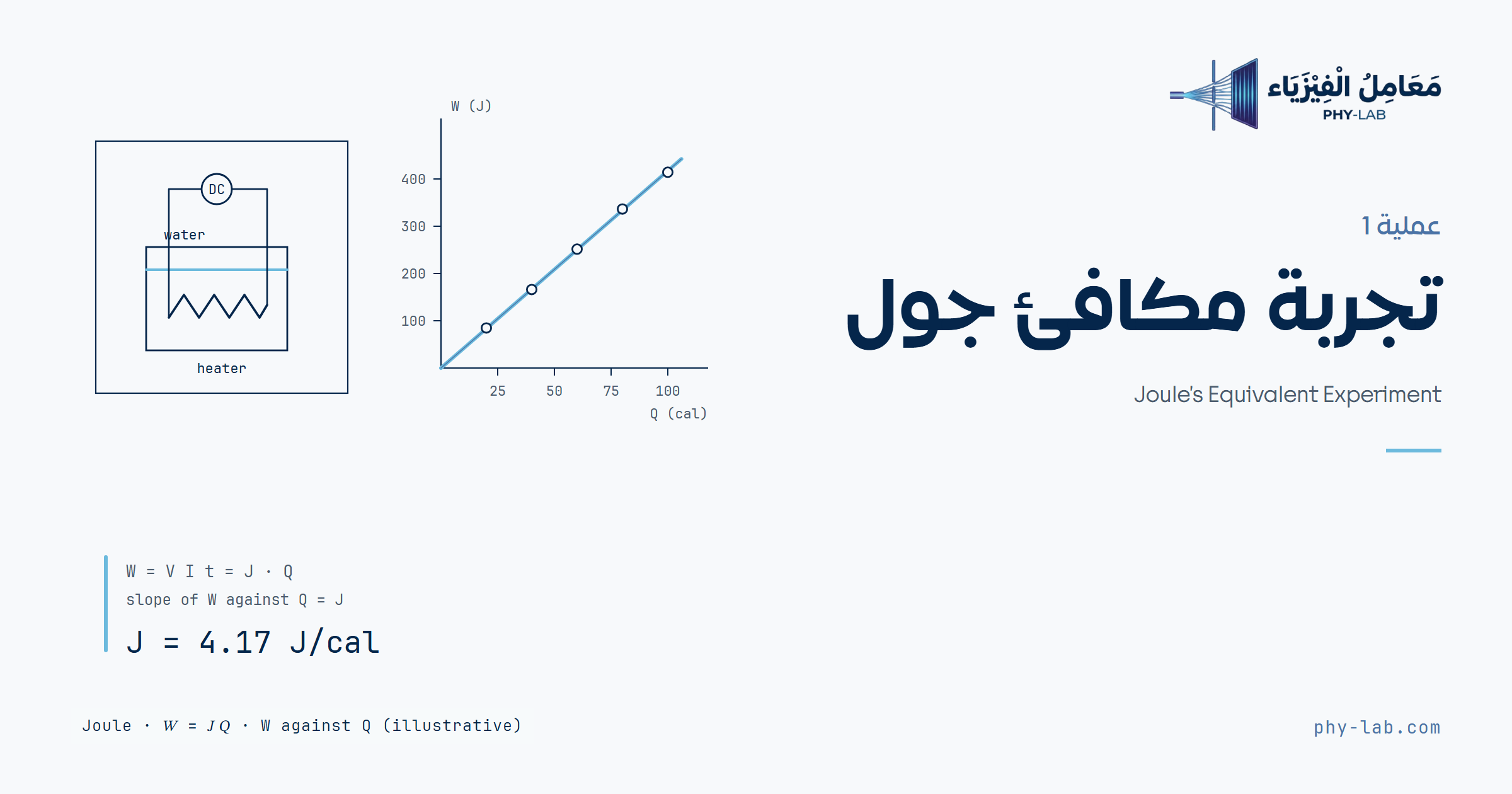
ووحدة J هي J/cal. فإذا كررنا التجربة وحسبنا W وQ في كل مرة، فرسم W مع Q خط مستقيم يمر بنقطة الأصل وميله J:
The unit of J is J/cal. If we repeat the experiment and compute W and Q each time, a plot of W against Q is a straight line through the origin of slope J:
الثوابت: Cw = 1.00 cal/(g·°C)، وCc = 0.092 cal/(g·°C) لمسعر من النحاس، والقيمة المقبولة J = 4.186 J/cal.
Constants: Cw = 1.00 cal/(g·°C), Cc = 0.092 cal/(g·°C) for a copper calorimeter, and the accepted value J = 4.186 J/cal.
خطوات العملProcedure
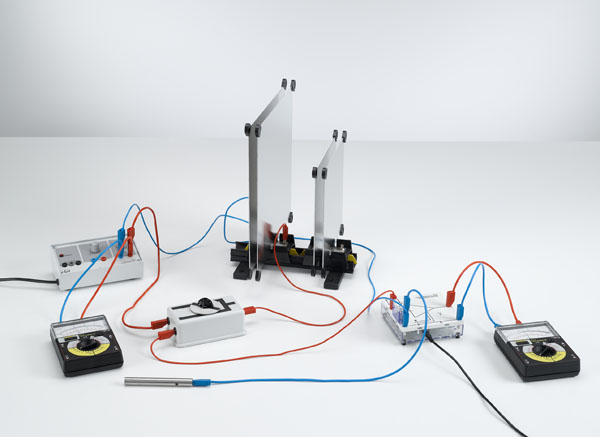
- صل الدائرة كما في الشكل 1.
- زن المسعر فارغاً وجافاً، ولتكن كتلته Mc.
- ضع كمية من الماء في المسعر حتى تصل إلى نصفه أو أقل، بحيث تنغمر المقاومة في الماء تماماً، ثم سجّل الكتلة الكلية للمسعر والماء، ولتكن Mcw.
- جد كتلة الماء: Mw = Mcw − Mc.
- ضع المسعر داخل الغلاف المخصص له.
- اضبط مصدر الجهد على 14 V.
- شغّل مصدر التيار واضبط التيار I على 1 A بتحريك الريوستات، ثم أغلق المصدر، وحرّك تحريكاً خفيفاً، وسجّل درجة الحرارة الابتدائية T1. احرص على أن تتم هذه الخطوة بسرعة حتى لا ترتفع درجة الحرارة الابتدائية.
- شغّل مصدر التيار، وفي الوقت نفسه شغّل ساعة الإيقاف، مع التأكد من أن قيمة التيار ثابتة.
- حرّك الماء بلطف كل دقيقتين، حتى لا ترتفع درجة الحرارة بسبب الاحتكاك.
- سجّل قراءة شدة التيار وفرق الجهد. وإذا كانت القيمة تتردد بين أكثر من قيمة بشكل متكرر ومنتظم، فخذ المتوسط.
- عندما ترتفع درجة حرارة النظام نحو خمس درجات عن الحرارة الابتدائية، سجّل درجة الحرارة T2، وفي الوقت نفسه أغلق مصدر التيار وسجّل قراءة الزمن t.
- عوّض عن القيم المقاسة في العلاقة (6) وجد قيمة J.
- Connect the circuit as in figure 1.
- Weigh the calorimeter empty and dry, and let its mass be Mc.
- Put an amount of water in the calorimeter up to half of it or less, so that the resistor is fully immersed, then record the total mass of the calorimeter and water, Mcw.
- Find the mass of the water: Mw = Mcw − Mc.
- Put the calorimeter in its jacket.
- Set the voltage supply to 14 V.
- Switch on the supply and set the current I to 1 A with the rheostat, then switch off the supply, stir gently, and record the initial temperature T1. Do this step quickly, so that the initial temperature does not rise.
- Switch on the supply and at the same moment start the stopwatch, making sure that the current is steady.
- Stir the water gently every two minutes, so that the temperature does not rise because of friction.
- Record the current and the potential difference. If a reading moves between more than one value in a regular way, take the mean.
- When the temperature of the system has risen about five degrees above the initial temperature, record the temperature T2, and at the same moment switch off the supply and record the time t.
- Substitute the measured values in relation (6) and find J.
أخطاء شائعةCommon errors
- ساعة متأخرة: إذا بدأت الساعة بعد المصدر، كان الزمن المسجل أقل من الحقيقي، وخرجت J أقل.
- التحريك الشديد: يضيف حرارة بالاحتكاك لا يقيسها الأميتر والفولتميتر، فتخرج J أقل.
- ترك التحريك: يبقى الماء حول الملف أسخن من الماء عند مقياس الحرارة، فتُقرأ T2 ناقصة، وتخرج J أكبر.
- ملف غير مغمور: جزء من الحرارة يذهب إلى الهواء، فتخرج J أكبر، وقد يتلف الملف.
- دون غلاف، أو ماء أدفأ من الغرفة: يفقد المسعر حرارة إلى الغرفة، فتخرج J أكبر.
- Late stopwatch: if the stopwatch starts after the supply, the recorded time is below the true time, and J comes out too low.
- Strong stirring: it adds frictional heat that the ammeter and voltmeter do not measure, so J comes out too low.
- No stirring: the water around the coil stays hotter than the water at the thermometer, so T2 is read too low, and J comes out too high.
- Coil not immersed: part of the heat goes to the air, so J comes out too high, and the coil may be damaged.
- No jacket, or water warmer than the room: the calorimeter loses heat to the room, so J comes out too high.
المحاكاة التفاعليةInteractive simulation
المسعر على الميزان: سجّل كتلته فارغاً، وصب الماء وسجّل الكتلة، ثم انقله إلى الغلاف. شغّل المصدر واضبط التيار على 1 A بزري الريوستات، ثم أطفئه وانتظر قليلاً وسجّل T1. اضغط «ابدأ التسخين»، وسجّل التيار والجهد كل دقيقتين، فتدخل الأداة متوسطها في الجدول. وعند ارتفاع الحرارة نحو خمس درجات سجّل T2، واضغط «أوقف التسخين»، وسجّل الزمن.
The calorimeter is on the scale: record its empty mass, pour the water and record the mass, then move it to the jacket. Switch on the supply and set the current to 1 A with the rheostat buttons, then switch it off, wait a little and record T1. Press “Start heating”, and record the current and voltage every two minutes, and the tool enters their mean in the table. When the temperature has risen about five degrees record T2, press “Stop heating”, and record the time.
النموذج: ملف تتغير مقاومته قليلاً مع الحرارة، ومصدر يتردد جهده قليلاً، وماء يتجانس بالتحريك، ومسعر له سعة حرارية، وتبادل بطيء مع الغرفة. والزمن يتقدم بالأزرار فقط. المحاكاة نموذج لا قياس.Model: a coil whose resistance changes slightly with temperature, a supply whose voltage moves slightly, water that becomes uniform with stirring, a calorimeter with a heat capacity, and slow exchange of heat with the room. Time advances only with the buttons. The simulation is a model, not a measurement.
إدخال البياناتData entry
صف لكل تجربة. تكفي تجربة واحدة، وتكرارها بارتفاعات مختلفة في الحرارة يعطي متوسطاً وخط W–Q.
One row for each trial. One trial is enough, and repeating it with different temperature rises gives a mean and the W–Q line.
| رقمNo | Mc (g) | Mcw (g) | T1 (°C) | T2 (°C) | I (A) | V (V) | t (s) |
|---|
البيانات الحالية توضيحية من نموذج المحاكاة؛ وليست قياساً.Current data are illustrative, from the simulation model; not a measurement.
لصق بيانات أو تحميل ملف CSVPaste data or load a CSV file
سطر لكل تجربة بالترتيب: Mc، Mcw بالغرام، ثم T1، T2 بالدرجة المئوية، ثم I بالأمبير، V بالفولت، t بالثانية.
One line per trial in order: Mc, Mcw in grams, then T1, T2 in degrees Celsius, then I in amperes, V in volts, t in seconds.
النتائجResults
| رقمNo | Mw (g) | Q (cal) | W (J) | J (J/cal) |
|---|
خطوات الحلSolution steps
التفسيرInterpretation