
Objective
To measure the resistivity ρ or sheet resistance Rs of a semiconductor or thin film sample using the four-probe method, and to determine the voltage–current relationship accurately.
Theory
The four-probe method eliminates contact resistance by using two outer probes to source current and two inner probes to measure voltage. The formulas differ depending on whether the sample is a thick bulk material or a thin film.
-
Bulk Sample (Thick material):
ρ = 2π · s · (V / I)where s is probe spacing (m), V the measured voltage, and I the applied current. -
Thin Film Sample:
Rs = (π / ln 2) · (V / I)ρ = Rs · twhere t is the film thickness (m).
Multiple (I, V) readings are recommended to create a linear V–I plot and determine the slope (V/I) using linear regression for accuracy.
Apparatus
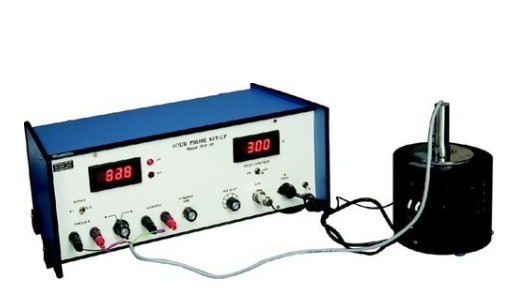
- Four-probe head with equal probe spacing.
- DC current source or source-meter.
- High-impedance voltmeter or voltage measurement terminal of a source-meter.
- Sample holder and insulating stage.
- Micrometer for measuring probe spacing s and film thickness t.
- Connection wires and cleaning materials (e.g., IPA).
Procedure
- Clean the sample surface to ensure good electrical contact with the probes.
- Place the sample on the insulating stage and gently lower the four probes onto the surface.
- Measure and record the probe spacing s and the film thickness t if applicable.
- Set a series of current values (e.g., 4–8 steps). Ensure the current is low enough to avoid heating the sample.
- For each current value, apply current through the outer probes (1 and 4) and measure voltage across the inner probes (2 and 3). Record (I, V).
- Repeat the measurement for positive and negative currents, then average the results to minimize thermal EMF errors.
- Plot V versus I and determine the slope m = V/I using linear fitting for highest accuracy.
- Use the appropriate formula:
• For thin films: Rs = (π / ln 2)·(V/I) then ρ = Rs·t
• For bulk samples: ρ = 2π s · (V/I) - Repeat the measurement at multiple positions on the sample to evaluate uniformity.
- Report uncertainties due to probe spacing, contact issues, sample edge effects, and measurement noise.
Safety and Practical Notes
- Avoid using high currents to prevent sample heating.
- Ensure proper grounding to reduce electrical noise.
- Handle thin films carefully to avoid surface damage.