تجربة قانون بويل: علاقة الضغط بالحجم في الغازات
Boyle’s Law: Pressure-Volume Relationship in Gases


تجربة قانون بويل
قانون بويل: علاقة الضغط بالحجم في الغازاتBoyle’s Law: Pressure-Volume Relationship in Gases
اضغط الهواء المحبوس في الأسطوانة، وسجّل الحجم والضغط. تحسب الأداة ثابت القانون، وتكشف الحجم الميت في الوصلات، وتختبر هل بقيت درجة الحرارة ثابتة فعلاً.Compress the air confined in the cylinder, and record the volume and pressure. The tool computes the constant of the law, reveals the dead volume in the connections, and tests whether the temperature really stayed constant.
الهدف والأجهزةObjective and apparatus
تعيين العلاقة بين ضغط غاز محبوس وحجمه. والغاز المستخدم هو الهواء.
To determine the relationship between the pressure and volume of a confined gas. The gas used is air.
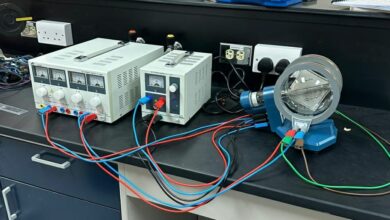
- أسطوانة بمكبس ومقياس حجم
- صنبور
- مانومتر
- مقياس حرارة رقمي
- بارومتر لقراءة الضغط الجوي
- Cylinder with piston and volume scale
- Tap
- Manometer
- Digital thermometer
- Barometer to read the atmospheric pressure
الأساس النظريTheory
ينص قانون بويل على أن حجم كمية ثابتة من الغاز، عند درجة حرارة ثابتة، يتناسب عكسياً مع ضغطها:
Boyle’s law states that at constant temperature the volume occupied by a fixed amount of gas is inversely proportional to its pressure:
وP هنا هو الضغط المطلق. فإذا كان المانومتر يقرأ الزيادة على الضغط الجوي Pm، أضفنا إليها الضغط الجوي:
Here P is the absolute pressure. If the manometer reads the excess over atmospheric pressure, Pm, we add the atmospheric pressure to it:
والحجم المقروء V لا يشمل الهواء في الوصلة والمانومتر. فإذا كان حجمه V₀، فالحجم الحقيقي V + V₀، ويصبح القانون:
The volume read, V, does not include the air in the connection and the manometer. If its volume is V₀, the true volume is V + V₀, and the law becomes:
فرسم V مع 1/P خط مستقيم ميله C، ويقطع محور الحجم عند −V₀ (الشكل 2). والمنحنى وحده لا يثبت التناسب العكسي، أما استقامة هذا الخط فتثبته. ومن قانون الغاز المثالي نجد كمية الهواء n:
So the plot of V against 1/P is a straight line of slope C, meeting the volume axis at −V₀ (figure 2). The curve alone does not prove inverse proportion, while the straightness of this line does. From the ideal gas law we find the amount of air n:
والضغط السريع يسخّن الهواء لأن الشغل لا يجد وقتاً ليخرج حرارةً عبر الجدار. لذلك تحسب الأداة الأس q، وهو 1 في التغير متساوي الحرارة، ويقترب من 1.4 للهواء في التغير الكظوم:
Fast compression heats the air, because the work has no time to leave as heat through the wall. So the tool computes the exponent q, which is 1 for an isothermal change and approaches 1.4 for air in an adiabatic change:
وإذا سُجّلت درجة الحرارة وتغيرت، تُستعمل المعادلة العامة، وT فيها بالكلفن:
If the temperature was recorded and it changed, the general equation is used, with T in kelvin:
الثابت: ثابت الغازات R = 8.314 J/(mol K).
Constant: the gas constant R = 8.314 J/(mol K).
خطوات التجربةProcedure
- ثبّت المكبس في موضع علوي اختياري والصنبور مفتوح.
- شغّل مقياس الحرارة الرقمي بوضع المفتاح على ON.
- سجّل الحجم الابتدائي والضغط الجوي ودرجة الحرارة قبل الإغلاق.
- أغلق الصنبور وأنزل المكبس ببطء. وأثناء الضغط تابع مؤشر المانومتر حتى يصل إلى قيمة معينة للضغط.
- انتظر حتى تعود درجة الحرارة إلى قيمتها، ثم اقرأ الحجم المقابل والضغط ودرجة الحرارة.
- تابع الضغط، والصنبور مغلق دائماً، حتى تصل إلى قيمة أخرى للضغط، ثم دوّن الحجم المقابل. وكرر حتى تملأ الجدول.
- ارسم P مع V، ثم V مع 1/P، واحسب PV لكل قراءة.
- Hold the piston in an arbitrary upper position with the tap open.
- Activate the digital thermometer with the switch in the ON position.
- Record the initial volume, the atmospheric pressure and the temperature before closing.
- Close the tap and slowly lower the piston. During the compression, follow the manometer indicator until a certain pressure value is reached.
- Wait until the temperature returns to its value, then read the corresponding volume, the pressure and the temperature.
- Proceed, always keeping the tap closed, with the compression until another pressure value is reached, then note the corresponding volume. Repeat until the table is full.
- Plot P against V, then V against 1/P, and compute PV for each reading.
المحاكاة التفاعليةInteractive simulation
حدّد موضع المكبس والصنبور مفتوح، ثم أغلق الصنبور وحرّك المكبس بالمنزلق أو الأزرار. المانومتر هنا يقرأ الزيادة على الضغط الجوي. راقب مقياس الحرارة بعد كل حركة، واستعمل «انتظر 30 s» قبل القراءة، ثم اضغط «سجّل في الجدول».
Set the piston position with the tap open, then close the tap and move the piston with the slider or the buttons. The manometer here reads the excess over atmospheric pressure. Watch the thermometer after each move, use “Wait 30 s” before reading, then press “Record in table”.
النموذج: هواء مثالي كميته ثابتة بعد إغلاق الصنبور، يسخن بالضغط السريع ثم يعود إلى حرارة الغرفة تدريجياً، وفي الوصلة حجم لا يقرؤه المقياس. والزمن يتقدم مع حركة المكبس وزر الانتظار فقط. المحاكاة نموذج لا قياس.Model: ideal air of fixed amount after the tap is closed, which heats on fast compression then gradually returns to room temperature, with a volume in the connection that the scale does not read. Time advances only with the piston motion and the wait button. The simulation is a model, not a measurement.
إدخال البياناتData entry
اختر وحدتي V وP بجوار δV وδP. وعمود T اختياري، ويفيد في التأكد من ثبات الحرارة. وحدّد نوع القراءة وPatm، لأن القانون يحتاج الضغط المطلق. والعمود الأخير يُحسب بالضغط المطلق.
Choose the units of V and P next to δV and δP. The column T is optional, and helps to confirm a constant temperature. Set the reading type and Patm, because the law needs the absolute pressure. The last column is computed with the absolute pressure.
| رقمNo | V | P | T (°C) | PV (kPa·cm³) |
|---|
البيانات الحالية توضيحية من نموذج المحاكاة؛ وليست قياساً.Current data are illustrative, from the simulation model; not a measurement.
لصق بيانات أو تحميل ملف CSVPaste data or load a CSV file
سطر لكل قراءة بالترتيب: V ثم P بالوحدتين المختارتين، ثم T إن وُجدت.
One line per reading in order: V then P in the chosen units, then T if available.
النتائجResults
خطوات الحلSolution steps
التفسيرInterpretation