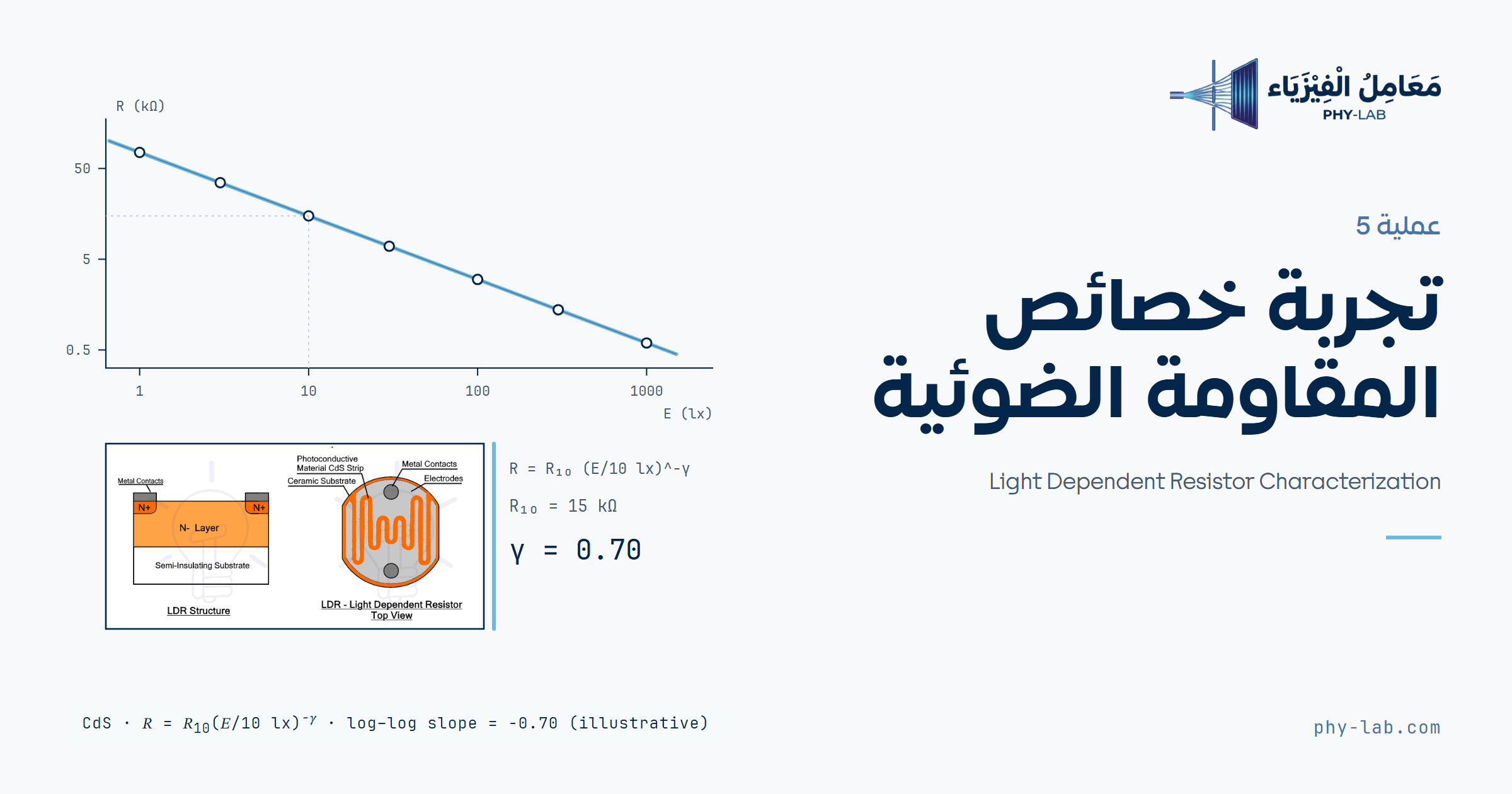
خصائص المقاومة الضوئية (LDR)Light-Dependent Resistor Characterization
أدخل شدة الإضاءة ومقاومة LDR أو جهده في مجزّئ، وتحسب الأداة علاقة القوة بين المقاومة والإضاءة، ومعامل γ، والمقاومة عند 10 و100 lux، ومقاومة الظلام، وتتنبأ بالمقاومة عند أي إضاءة.Enter the illuminance and the LDR resistance, or its voltage in a divider; the tool fits the power law between resistance and illuminance, the γ factor, the resistance at 10 and 100 lux and the dark resistance, and predicts the resistance at any illuminance.
الهدف والأجهزةObjective and apparatus
دراسة تغيّر مقاومة المقاومة الضوئية (LDR) مع شدة الإضاءة، وإيجاد العلاقة الدالية بين الإضاءة (lux) والمقاومة.
To investigate how the resistance of a light-dependent resistor (LDR) changes with illuminance and to determine the functional relationship between illuminance (lux) and resistance.
- مقاومة ضوئية LDR
- ملتيميتر (لقياس المقاومة أو الجهد)
- مزود قدرة مستمر أو بطارية
- مقاومة ثابتة لمجزّئ الجهد (اختياري)
- مصدر ضوء (مصباح أو LED أو كشاف)
- مقياس شدة إضاءة (أو تطبيق في الهاتف)
- لوحة توصيل وأسلاك
- مسطرة أو شريط قياس
- صندوق مظلم أو قماش حاجب للضوء المحيط
- Light-dependent resistor (LDR)
- Multimeter (resistance or voltage)
- DC power supply or battery
- Fixed resistor for a voltage divider (optional)
- Light source (lamp, LED or torch)
- Lux meter (or a smartphone app)
- Breadboard and jumper wires
- Ruler or measuring tape
- Dark enclosure or blackout cloth
الأساس النظريTheory
المقاومة الضوئية شريحة من شبه موصل (غالباً كبريتيد الكادميوم CdS). الفوتون الممتص يولّد زوج إلكترون–ثقب، فتزداد الموصلية وتقل المقاومة كلما اشتدت الإضاءة. العلاقة غير خطية، وتُكتب عادة بقانون قوة:
A photoresistor is a strip of semiconductor (usually cadmium sulfide, CdS). Each absorbed photon creates an electron–hole pair, so the conductivity rises and the resistance falls as the illumination increases. The relation is non-linear and is usually written as a power law:
بأخذ اللوغاريتم يصبح الرسم log R مقابل log L خطاً مستقيماً، ميله b ومقطعه log a:
Taking logarithms, the plot of log R against log L becomes a straight line with slope b and intercept log a:
قيمة γ تحمل معنى فيزيائياً: الموصلية تتناسب مع تركيز الحاملات الزائدة Δn. إذا كان إعادة الاتحاد خطياً (عبر مراكز ومصائد) فإن Δn ∝ L وγ ≈ 1؛ وإذا كان ثنائياً (إلكترون مع ثقب مباشرة) فإن Δn ∝ L1/2 وγ ≈ 0.5. والقيم الوسطى تدل على مزيج من الآليتين.
The value of γ has physical meaning: the conductivity is proportional to the excess carrier concentration Δn. With linear recombination (through centres and traps) Δn ∝ L and γ ≈ 1; with bimolecular recombination (electron directly with hole) Δn ∝ L1/2 and γ ≈ 0.5. Intermediate values indicate a mix of both.
المعادلة (3) لمجزّئ الجهد: مقاومة ثابتة على التوالي مع LDR، وVout الجهد المقيس على LDR. وفي الظلام التام لا تصل المقاومة إلى ما لا نهاية بل إلى مقاومة الظلام، وهي حد يُضعف علاقة القوة عند الإضاءات المنخفضة.
Equation (3) is for the voltage divider: a fixed resistor in series with the LDR, with Vout measured across the LDR. In complete darkness the resistance does not become infinite but reaches the dark resistance, a limit that weakens the power law at low illuminance.
خطوات التجربةProcedure
- ثبّت LDR على لوحة التوصيل وصِله بالملتيميتر على وضع المقاومة، أو في مجزّئ جهد مع مقاومة ثابتة ومزود قدرة.
- ضع مقياس الإضاءة بجوار LDR وفي الاتجاه نفسه نحو المصدر.
- غيّر شدة الإضاءة بتغيير بُعد المصباح أو شدته، وسجّل الإضاءة والمقاومة (أو الجهد) لكل حالة. انتظر بضع ثوانٍ بعد كل تغيير حتى تستقر القراءة.
- غطِّ LDR بالقماش الحاجب لقياس مقاومة الظلام، وسجّلها بإضاءة 0 lux.
- اضغط «احسب النتائج» لرسم R مقابل L وlog R مقابل log L وإيجاد a وb وR².
- Mount the LDR on the breadboard and connect it to the multimeter on the resistance range, or in a voltage divider with a fixed resistor and a power supply.
- Place the lux meter next to the LDR, facing the source in the same direction.
- Vary the illuminance by changing the lamp distance or brightness, and record the illuminance and resistance (or voltage) each time. Wait a few seconds after each change for the reading to settle.
- Cover the LDR with the blackout cloth to measure the dark resistance, and record it at 0 lux.
- Press “Compute results” to plot R against L and log R against log L and find a, b and R².
استجابة LDR بطيئة: تنخفض المقاومة خلال أجزاء من الثانية عند الإضاءة، لكنها تحتاج ثوانيَ لتعود في الظلام. مقاييس الإضاءة في الهواتف تقريبية، وحساسية LDR الطيفية (قمتها نحو 540 nm لـ CdS) تختلف عن حساسية مقياس الإضاءة، فاستعمل المصدر نفسه في كل القراءات. وتتأثر المقاومة بدرجة الحرارة أيضاً.
The LDR responds slowly: its resistance drops within fractions of a second when lit but takes seconds to recover in the dark. Smartphone lux meters are approximate, and the LDR’s spectral sensitivity (peaking near 540 nm for CdS) differs from the lux meter’s, so use the same source for all readings. The resistance also depends on temperature.
إدخال البياناتData entry
| # | L (lux) | R (kΩ) |
|---|
البيانات الحالية توضيحية مولّدة من نموذج LDR من CdS (R10 = 15 kΩ، γ يتغير من نحو 0.62 إلى 0.75 مع الإضاءة، مقاومة ظلام 1 MΩ على التوازي، ضجيج ±2%) وليست قياساً.Current data are illustrative, generated from a CdS LDR model (R10 = 15 kΩ, γ varying from about 0.62 to 0.75 with illuminance, 1 MΩ dark resistance in parallel, ±2% noise), not a measurement.
لصق بيانات أو تحميل ملف CSVPaste data or load a CSV file
النتائجResults
التفسيرInterpretation