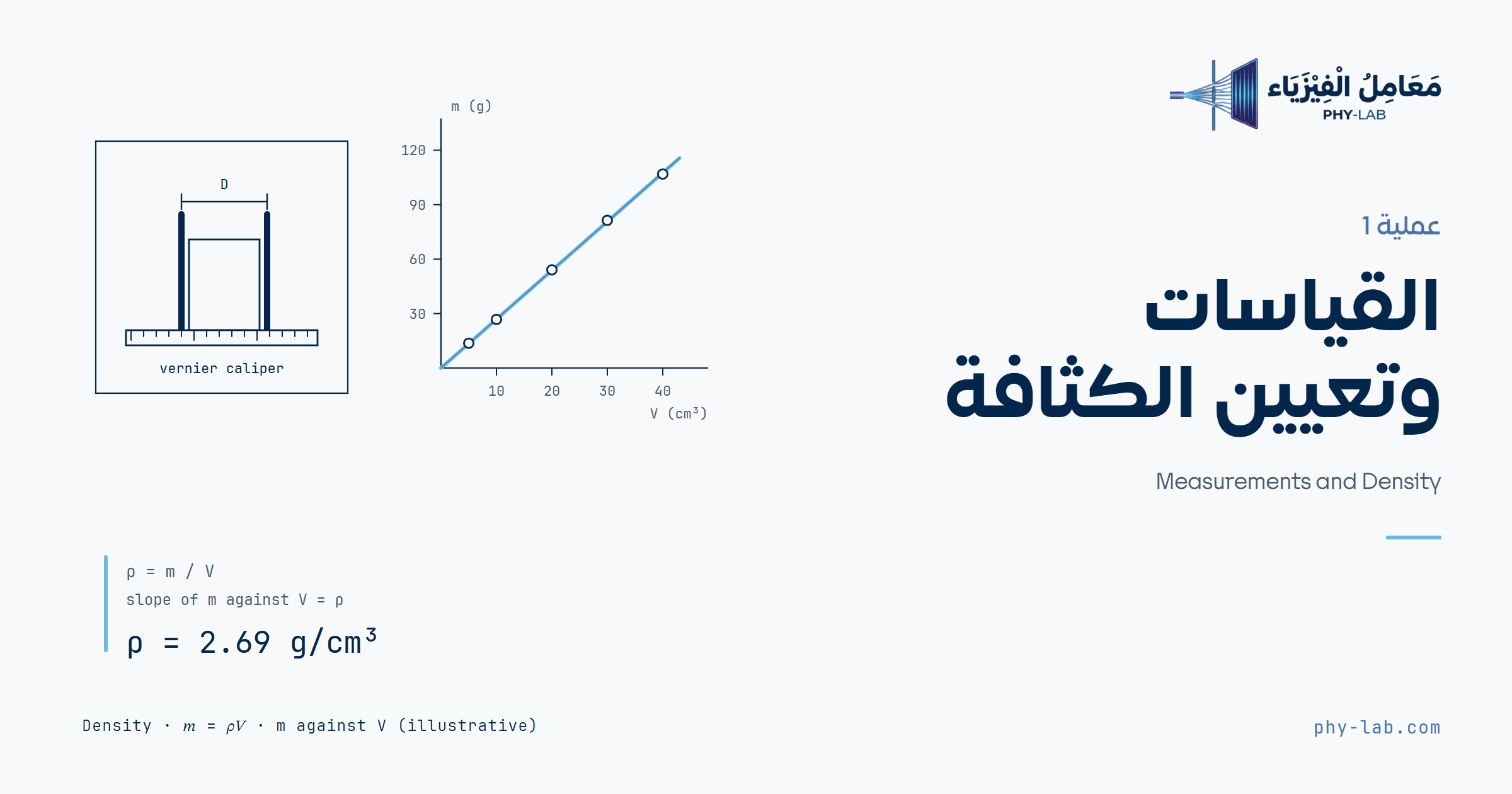
القياسات وتعيين الكثافةMeasurements and Density
قس أبعاد مكعب وأسطوانة وكرة بالقدمة الرقمية والمسطرة، وزن كل جسم بالميزان. تحسب الأداة الحجم والكثافة والانحراف المعياري والخطأ النسبي بالأرقام المعنوية الصحيحة، وتساعدك على معرفة مادة الجسم.Measure the dimensions of a cube, a cylinder and a sphere with the electronic caliper and the meter stick, and weigh each object on the balance. The tool computes the volume, the density, the standard deviation and the percent error with the correct significant figures, and helps you identify the material of the object.
الهدف والأجهزةObjective and apparatus
قياس حجم أجسام صلبة مختلفة، وحساب كثافتها، وإيجاد الانحراف المعياري والخطأ النسبي المئوي.
To measure the volume of different solid objects, calculate their density, and find the standard deviation and the percent error.
- قدمة رقمية
- مسطرة مترية
- ميزان
- أجسام صلبة: مكعب وأسطوانة وكرة
- Electronic caliper
- Meter stick
- Balance
- Solid objects: a cube, a cylinder and a sphere
نظرية التجربةTheory
لكل قياس علمي حد من الدقة تسمح به الأجهزة المستعملة، وقد ينشأ هذا الحد من الجهاز نفسه أو من الشخص الذي يجري القياس. ولكي تتقارب نتائج شخصين يقيسان الكمية نفسها، تُضبط هذه الشكوك باستعمال الأرقام المعنوية.
فالعدد 1117 فيه أربعة أرقام معنوية، والعدد 11 فيه رقمان. أما العدد 20 ففيه رقم معنوي واحد، ونكتبه بالصيغة العلمية 2 × 10¹. وعند الضرب أو القسمة نأخذ في الناتج عدد الأرقام المعنوية للعدد الأقل منها، لأنه الأقل دقة:
Every scientific measurement has a limit of precision set by the instruments used, and this limit may come from the instrument itself or from the person measuring. So that the results of two people measuring the same quantity agree, these uncertainties are regulated by using significant figures.
The number 1117 has four significant figures, and 11 has two. The number 20 has one significant figure, and we write it in scientific notation as 2 × 10¹. When multiplying or dividing, the answer keeps the number of significant figures of the number with the fewest, as it is the least accurate:
وعند الجمع أو الطرح نأخذ في الناتج عدد المنازل العشرية للعدد الأقل منها:
When adding or subtracting, the answer keeps the number of decimal places of the number with the fewest:
ويبين الانحراف المعياري مقدار تفرق القيم حول متوسطها، ويبين الخطأ النسبي المئوي بُعد نتيجة التجربة عن القيمة القياسية المعتمدة:
The standard deviation shows the dispersion of the values about their mean, and the percent error shows how far the result of the experiment is from the accepted standard value:
حيث x̄ المتوسط، وN عدد المحاولات، وxs القيمة القياسية. والمعادلة (2) هي الانحراف المعياري لعدد قليل من المحاولات. أما الكثافة والحجوم فتعطيها المعادلات:
Here x̄ is the mean, N is the number of trials, and xs is the standard value. Equation (2) is the standard deviation for a small number of trials. The density and the volumes are given by:
تدريب على الأرقام المعنويةPractice on significant figures
أجرِ العمليات الآتية، واكتب الناتج بالعدد الصحيح من الأرقام المعنوية. ويمكنك كتابة الصيغة العلمية هكذا: 1.2e2.
Perform the following operations, giving the answer to the correct number of significant figures. You can write scientific notation like this: 1.2e2.
طريقة العملProcedure
أبعاد الجسم (تعيين الحجم)Dimensions of the object (determining the volume)
- يقيس عضوان من المجموعة أبعاد الجسم بالقدمة الرقمية: القطر أو الطول والعرض والارتفاع.
- يقيس العضوان الآخران الأبعاد نفسها بالمسطرة المترية.
- يسجل الجميع قيم كل عضو في الجدول 1 لكل جسم.
- احسب حجم الجسم من المعادلات (5) و(6) و(7).
- جد من بيانات المجموعة أفضل قيمة للحجم، وهي المتوسط، والانحراف المعياري فيها.
- Two group members measure the dimensions of the object with the electronic caliper: the diameter, or the length, width and height.
- The other two members measure the same dimensions with the meter stick.
- Everyone records the values of each member in table 1 of each object.
- Calculate the volume of the object from equations (5), (6) and (7).
- From the data of the group, find the best value of the volume, which is the mean, and its standard deviation.
كتلة الجسم (تعيين الكثافة)Mass of the object (determining the density)
- يقيس الأعضاء الأربعة أبعاد الجسم بالقدمة، وتُسجل في الجدول 2 لكل جسم.
- جد كتلة الجسم بالميزان.
- احسب الحجم، ثم جد الكثافة من الكتلة المقيسة والحجم المحسوب.
- جد من بيانات المجموعة أفضل قيمة للكثافة، وهي المتوسط، والانحراف المعياري، ومتوسط الانحراف.
- جد الخطأ النسبي المئوي باستعمال القيمة القياسية للكثافة.
- حدد مادة الجسم.
- All four members measure the dimensions of the object with the caliper, and the values go in table 2 of each object.
- Obtain the mass of the object with the balance.
- Calculate the volume, then find the density from the measured mass and the calculated volume.
- From the data of the group, find the best value of the density, which is the mean, with the standard deviation and the average deviation.
- Find the percent error using the standard value of the density.
- Identify the material of the object.
كثافات بعض الموادDensities of some materials
| المادةMaterial | ρ (g/cm³) |
|---|
أخطاء شائعةCommon errors
- قدمة غير مصفّرة: إذا لم تقرأ القدمة صفراً عند إطباق فكيها، زادت كل الأبعاد بالمقدار نفسه، فتخرج الكثافة أقل.
- ميزان غير مصفّر: تزيد الكتلة بمقدار ثابت، فتخرج الكثافة أكبر.
- الخلط بين القطر ونصف القطر: المعادلتان (6) و(7) فيهما r، والمقيس هو D.
- خطأ الوحدات: إذا أُدخلت الأبعاد بالسنتيمتر في خانة المليمتر، خرجت الكثافة أكبر بألف مرة.
- قياس الكرة بالمسطرة: يصعب تحديد أعرض موضع في الكرة، فيكبر الخطأ.
- أرقام زائدة: لا يكتب الناتج بكل ما تظهره الآلة الحاسبة، بل بما تسمح به دقة القياس.
- Caliper not zeroed: if the caliper does not read zero with its jaws closed, all dimensions grow by the same amount, so the density comes out too low.
- Balance not zeroed: the mass grows by a fixed amount, so the density comes out too high.
- Confusing the diameter and the radius: equations (6) and (7) use r, while what is measured is D.
- Unit error: if the dimensions are entered in centimetres in a millimetre cell, the density comes out a thousand times too large.
- Measuring the sphere with a ruler: the widest place on a sphere is hard to locate, so the error grows.
- Extra digits: the answer is not written with all the digits on the calculator, only with those the measurement allows.
المحاكاة التفاعليةInteractive simulation
صفّر القدمة والميزان أولاً. ثم اختر الجسم والجدول والعضو والقياس، واضغط «قس»، ثم «سجّل القراءة». ينتقل الاختيار بعدها إلى الخانة التالية. في الجدول 1 يقيس العضوان 1 و2 بالقدمة، والعضوان 3 و4 بالمسطرة، وفي الجدول 2 يقيس الجميع بالقدمة ويزنون الجسم.
Zero the caliper and the balance first. Then choose the object, the table, the member and the measurement, press “Measure”, then “Record reading”. The choice then moves to the next cell. In table 1 members 1 and 2 use the caliper and members 3 and 4 the meter stick, and in table 2 everyone uses the caliper and weighs the object.
النموذج: أجسام صنعتها غير مثالية، وقدمة تقرأ إلى 0.01 mm، ومسطرة تقرأ إلى 0.5 mm ويختلف نظر كل عضو إليها، وميزان يقرأ إلى 0.01 g. المحاكاة نموذج لا قياس.Model: objects that are not perfectly made, a caliper read to 0.01 mm, a meter stick read to 0.5 mm with a different line of sight for each member, and a balance read to 0.01 g. The simulation is a model, not a measurement.
إدخال البياناتData entry
أدخل الأبعاد بالمليمتر والكتلة بالجرام، كما قرأتها تماماً، لأن الأرقام المعنوية تُؤخذ مما تكتبه. ويكفي جسم واحد. وإن تركت أبعاد صف في الجدول 2 فارغة وكتبت الكتلة، استُعمل متوسط حجم الجدول 1. والقيمة القياسية اختيارية، وإن تُركت قورنت الكثافة بأقرب مادة.
Enter the dimensions in millimetres and the mass in grams, exactly as you read them, since significant figures are taken from what you write. One object is enough. If you leave the dimensions of a row in table 2 empty and write the mass, the mean volume of table 1 is used. The standard value is optional, and if it is left empty the density is compared with the nearest material.
البيانات الحالية توضيحية من نموذج المحاكاة؛ وليست قياساً.Current data are illustrative, from the simulation model; not a measurement.
لصق بيانات أو تحميل ملف CSVPaste data or load a CSV file
سطر لكل قراءة بالترتيب: الجسم (1 مكعب، 2 أسطوانة، 3 كرة)، والجدول (1 أو 2)، والعضو (1 إلى 4)، ثم ثلاثة أبعاد، ثم الكتلة، تفصل بينها فواصل. فالمكعب L, W, H، والأسطوانة D, H، والكرة D، واترك الباقي فارغاً.
One line per reading in order: the object (1 cube, 2 cylinder, 3 sphere), the table (1 or 2), the member (1 to 4), then three dimensions, then the mass, separated by commas. The cube takes L, W, H, the cylinder D, H, and the sphere D, and the rest stay empty.
النتائجResults
| الجسمObject | عضوNo | V₁ (cm³) | m (g) | V₂ (cm³) | ρ (g/cm³) |
|---|
| الجسمObject | ρ̄ | σ | متوسط الانحرافAvg dev. | ρs | % error | أقرب مادةNearest |
|---|
خطوات الحلSolution steps
التفسيرInterpretation