زاوية انفراج شعاع الليزرLaser Beam Divergence Angle
قِس نصف قطر بقعة شعاع الليزر على شاشة عند عدة مسافات، ثم بعدسة في بؤرتها. تحسب الأداة زاوية الانفراج θ = [w(z₂) − w(z₁)]/(z₂ − z₁) لكل زوج ومتوسطها، وθ = wf/f من العدسة، وتطابق القياسات بمعادلة الشعاع الغاوسي لتعطي نصف قطر الخصر w₀، مع عدم اليقين وخطوات الحل.Measure the radius of the laser spot on a screen at several distances, then with a lens at its focal plane. The tool computes the divergence angle θ = [w(z₂) − w(z₁)]/(z₂ − z₁) for each pair and its mean, and θ = wf/f from the lens, and fits the Gaussian-beam equation to the readings to give the waist radius w₀, with the uncertainty and the solution steps.
الهدف والأجهزةObjective and apparatus
- دراسة إحدى خصائص شعاع الليزر: انفراج الشعاع.
- التعرف على طريقة لتقليل انفراج الشعاع.
- To study one of the characteristics of a laser beam: beam divergence.
- To learn a way to reduce beam divergence.
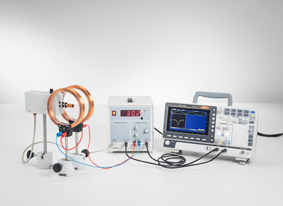
- ليزر هيليوم-نيون
- شاشة عليها ورق مليمتري
- مسطرة وشريط قياس
- عدسة بعدها البؤري طويل
- He-Ne laser
- Screen with millimetre paper on it
- Ruler and measuring tape
- Lens with a long focal length
الأساس النظريTheory
الليزر (تضخيم الضوء بالانبعاث المحفَّز للإشعاع) جهاز يُنتج شعاعاً قوياً من فوتونات مترابطة بالانبعاث المحفَّز. وشعاعه مترابط وضيق جداً وشديد. ويُعبَّر عن اتجاهية الشعاع بزاوية الانفراج الكاملة، وهي ضعف الزاوية θ₀ التي تصنعها حافة الشعاع الخارجية مع محوره (الشكل 1). وتبين زاوية الانفراج مدى سرعة اتساع الشعاع بعد خروجه من الليزر. وتُقاس بالدرجات أو بالراديان، حيث 2π rad = 360° و1 rad = 57.3° و1 mrad = 0.0573°.
The laser (light amplification by stimulated emission of radiation) is a device that produces a strong beam of coherent photons by stimulated emission. Its beam is coherent, very narrow and intense. The directionality of the beam is expressed by the full divergence angle, which is twice the angle θ₀ that the outer edge of the beam makes with its axis (figure 1). The divergence tells how quickly the beam widens after it leaves the laser. It is measured in degrees or radians, where 2π rad = 360°, 1 rad = 57.3° and 1 mrad = 0.0573°.
شعاع الليزر في نمطه الأساسي شعاع غاوسي: شدته تقل مع البعد r عن المحور بالعلاقة I = I₀ exp(−2r²/w²)، ويُعرَّف نصف القطر w بأنه البعد الذي تنخفض عنده الشدة إلى 1/e² ≈ 0.135 من شدة المركز. ويتغير نصف القطر مع المسافة z المقيسة من خصر الشعاع، وهو موضع أصغر نصف قطر w₀:
A laser beam in its fundamental mode is a Gaussian beam: its intensity falls with the distance r from the axis as I = I₀ exp(−2r²/w²), and the radius w is defined as the distance at which the intensity drops to 1/e² ≈ 0.135 of the central intensity. The radius changes with the distance z measured from the beam waist, the place of the smallest radius w₀:
حيث λ الطول الموجي لليزر. قرب الخصر يكاد الشعاع يكون متوازياً، وبعيداً عنه (z ≫ zR = πw₀²/λ) يتسع خطياً، w ≈ θ₀ z، كأنه صادر من نقطة، بنصف زاوية انفراج:
where λ is the wavelength of the laser. Near the waist the beam is almost parallel, and far from it (z ≫ zR = πw₀²/λ) it widens linearly, w ≈ θ₀ z, as if it came from a point, with a half divergence angle:
لحساب w(z) وθ₀ نحتاج إلى w₀، لكن الخصر يقع عادة داخل غلاف الليزر فلا يمكن قياسه مباشرة. وبتربيع المعادلة (1) نجد w² = w₀² + θ₀² z²، فيمكن التعبير عن w₀ بنصفي قطرين مقيسين w(z₁) وw(z₂) عند موضعين خارج الليزر:
To compute w(z) and θ₀ we need w₀, but the waist usually lies inside the laser casing, so it cannot be measured directly. Squaring equation (1) gives w² = w₀² + θ₀² z², so w₀ can be expressed through two measured radii w(z₁) and w(z₂) at two positions outside the laser:
ومن المعادلة (2) تكون نصف زاوية الانفراج:
and from equation (2) the half divergence angle is:
وفي التجربة نقدّر الانفراج بطريقة هندسية كما في الشكل 2: ميل حافة الشعاع بين موضعين.
In the experiment we estimate the divergence geometrically, as in figure 2: the slope of the beam edge between two positions.
ولأن الزاوية صغيرة جداً:
Since the angle is very small:
وطريقة أخرى: يمر الشعاع في عدسة بعدها البؤري f معروف، ويُقاس نصف قطر البقعة wf في المستوى البؤري للعدسة. العدسة تحوّل كل اتجاه في الشعاع إلى نقطة في مستواها البؤري، فنصف القطر هناك يساوي f θ₀ أياً كان بعد العدسة عن الليزر:
Another way: the beam passes through a lens of known focal length f, and the spot radius wf is measured in the focal plane of the lens. The lens maps every direction in the beam to a point in its focal plane, so the radius there equals f θ₀ whatever the distance of the lens from the laser:
الزاوية θ في المعادلات (2) و(4) و(6) و(7) نصف زاوية الانفراج، والزاوية الكاملة 2θ. والمعادلة (6) لا تصح إلا بعيداً عن الخصر؛ فقربه يتسع الشعاع أبطأ من خطه المقارب، فتعطي (6) قيمة أصغر من θ₀. ولتقليل الانفراج (الهدف 2) نكبّر w₀، لأن θ₀ = λ/(πw₀): موسِّع الشعاع (عدستان، تلسكوب) يكبّر نصف القطر M مرة فيقسم الانفراج على M.
The angle θ in equations (2), (4), (6) and (7) is the half divergence angle; the full angle is 2θ. Equation (6) holds only far from the waist; near it the beam widens more slowly than its asymptote, so (6) gives a value smaller than θ₀. To reduce the divergence (objective 2) we enlarge w₀, since θ₀ = λ/(πw₀): a beam expander (two lenses, a telescope) that enlarges the radius M times divides the divergence by M.
خطوات التجربةProcedure
أفضل مكان لهذه التجربة ممر طويل والأنوار مطفأة.
This experiment is best done in a long corridor with the lights off.
- ضع ليزر هيليوم-نيون على الطاولة، وتأكد أن المنطقة التي يتجه إليها الشعاع خالية.
- ضع الشاشة أمام الليزر بحيث يسقط الضوء عليها عمودياً.
- ضع الشاشة عند z₁ = 1.5 m وقِس نصف قطر البقعة w(z₁).
- ضع الشاشة عند z₂ = 2.5 m وقِس نصف قطر البقعة w(z₂).
- احسب زاوية الانفراج بالمعادلة (6).
- ضع الشاشة في مواضع أخرى، تبدأ قرب الليزر وتنتهي على بعد عدة أمتار منه (كلما بعدت كان أفضل).
- سجّل في الجدول بعد الشاشة عن الليزر ونصف قطر البقعة لكل زوج من المواضع.
- احسب زاوية الانفراج بالمعادلة (6) لكل زوج.
- أوجد متوسط زاوية الانفراج.
- ضع عدسة أمام الشعاع وسجّل بعدها البؤري، ثم قِس نصف قطر البقعة في المستوى البؤري واحسب زاوية الانفراج بالمعادلة (7).
- Put the He-Ne laser on the table and make sure the area where the beam points is clear.
- Place the screen in front of the laser so that the light falls on it perpendicularly.
- Place the screen at z₁ = 1.5 m and measure the radius of the spot w(z₁).
- Place the screen at z₂ = 2.5 m and measure the radius of the spot w(z₂).
- Calculate the divergence angle using equation (6).
- Place the screen at other positions, starting close to the laser and finishing a few metres away (the further the better).
- Record in the table the distance of the screen from the laser and the spot radius for each pair of positions.
- Calculate the divergence angle using equation (6) for each pair.
- Find the mean divergence angle.
- Place a lens in front of the beam and record its focal length, then measure the spot radius in the focal plane and calculate the divergence angle using equation (7).
نصف القطر w هو البعد الذي تصير عنده الشدة 13.5% من شدة المركز، والعين ترى حافة البقعة أبعد من ذلك عادة. فقِس دائماً إلى الحد نفسه، واجعل z من مخرج الليزر.
The radius w is the distance at which the intensity becomes 13.5% of the central intensity, and the eye usually sees the spot edge further out. So always measure to the same edge, and take z from the laser output.
المحاكاة التفاعليةInteractive simulation
حرّك الشاشة إلى بعد z، ثم وسّع دائرة القياس على الشاشة حتى تصير الشدة عند حافتها 0.135 من شدة المركز، فنصف قطرها حينئذ w. «سجّل القراءة» يملأ z₁ وw(z₁) ثم z₂ وw(z₂) في الجدول. ومع العدسة ضع الشاشة في المستوى البؤري، فتذهب القراءة إلى خانتي f وwf. خصائص الشعاع غير معروضة، والمطلوب تعيينها.
Move the screen to a distance z, then widen the measuring circle on the screen until the intensity at its edge is 0.135 of the central intensity; its radius is then w. “Record reading” fills z₁ and w(z₁), then z₂ and w(z₂), in the table. With the lens, put the screen in the focal plane and the reading goes to the f and wf fields. The beam properties are not shown; finding them is the task.
النموذج: شعاع غاوسي من ليزر هيليوم-نيون، خصره داخل الليزر، والعدسة على بعد 0.30 m من مخرجه وتُحسب البقعة بعدها بمصفوفات الشعاع. مقياس الشدة عند حافة الدائرة فيه ضجيج صغير. المحاكاة نموذج لا قياس.Model: a Gaussian beam from a He-Ne laser with its waist inside the laser; the lens is 0.30 m from the output and the spot after it is computed with beam matrices. The intensity meter at the circle edge has a small noise. The simulation is a model, not a measurement.
إدخال البياناتData entry
الجدول 1: لكل زوج من المواضع z₁ وz₂ بالمتر ونصفا القطر w(z₁) وw(z₂). الأعمدة الثلاثة الأخيرة تُحسب تلقائياً. واختر وحدة نصف القطر؛ الدليل يكتبها بالمتر، والمليمتر أنسب للقراءة من الورق المليمتري.
Table 1: for each pair of positions, z₁ and z₂ in metres and the radii w(z₁) and w(z₂). The last three columns are computed automatically. Choose the unit of the radius; the manual writes it in metres, while millimetres suit reading from millimetre paper better.
| رقمNo. | z₁ (m) | w(z₁) (mm) | z₂ (m) | w(z₂) (mm) | z₂ − z₁ (m) | w(z₂) − w(z₁) (mm) | θ (mrad) |
|---|
طريقة العدسة، المعادلة (7)Lens method, equation (7)
البيانات الحالية توضيحية من نموذج المحاكاة: ثمانية أزواج متتالية من z = 0.5 إلى 6.0 m وعدسة f = 1.00 m، بنصف قطر مقروء لأقرب 0.02 mm؛ وليست قياساً.Current data are illustrative, from the simulation model: eight consecutive pairs from z = 0.5 to 6.0 m and a lens f = 1.00 m, with the radius read to the nearest 0.02 mm; not a measurement.
لصق بيانات أو تحميل ملف CSVPaste data or load a CSV file
كل سطر إما أربعة أرقام z₁, w(z₁), z₂, w(z₂)، وإما رقمان z, w لكل موضع، فتُرتب المواضع وتُجعل أزواجاً متتالية. وسطر يبدأ بالحرف f ثم البعد البؤري ونصف القطر يملأ خانتي العدسة. نصف القطر بالوحدة المختارة أعلاه.
Each line is either four numbers z₁, w(z₁), z₂, w(z₂), or two numbers z, w for one position; positions are then sorted and paired consecutively. A line starting with the letter f, then the focal length and the radius, fills the lens fields. The radius is in the unit chosen above.
النتائجResults
خطوات الحلSolution steps
التفسيرInterpretation