اعتماد ليزر شبه الموصل على درجة الحرارة
Temperature Dependence of a Semiconductor Laser

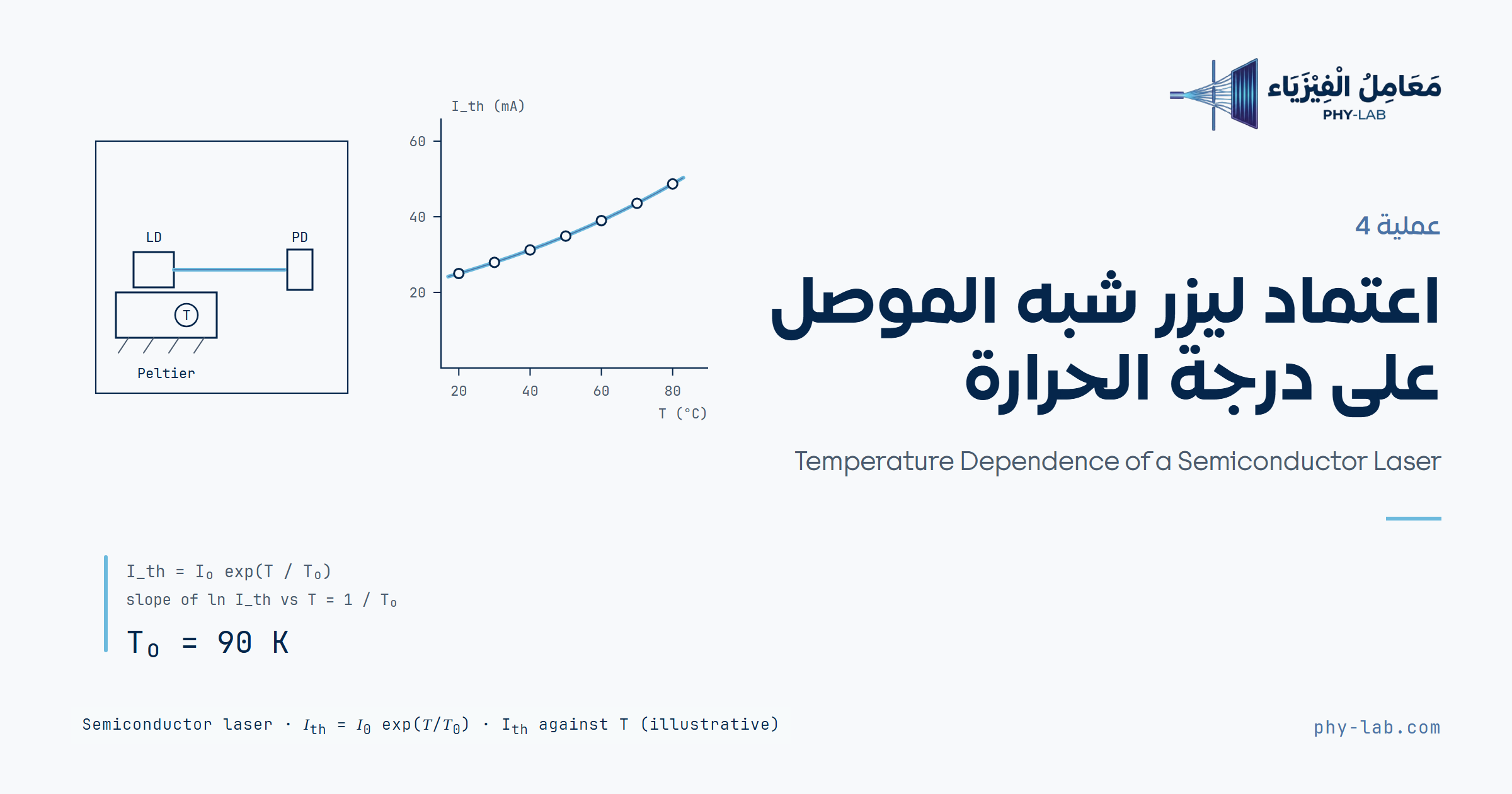
اعتماد ليزر شبه الموصل على درجة الحرارةTemperature Dependence of a Semiconductor Laser
سجّل قراءة الكاشف الضوئي مقابل تيار ثنائي الليزر عند درجتي حرارة. تعيّن الأداة تيار العتبة Ith لكل درجة من الجزء الخطي لمنحنى الضوء والتيار، ثم درجة الحرارة المميزة T₀ = (T₂ − T₁)/ln(Ith2/Ith1)، مع عدم اليقين وخطوات الحل.Record the photodetector reading against the laser diode current at two temperatures. The tool finds the threshold current Ith at each temperature from the linear part of the light-current curve, then the characteristic temperature T₀ = (T₂ − T₁)/ln(Ith2/Ith1), with the uncertainty and the solution steps.
الهدف والأجهزةObjective and apparatus
- دراسة اعتماد ليزر شبه الموصل على درجة الحرارة.
- To study the temperature dependence of a semiconductor laser.
- ثنائي ليزر مع وحدة التحكم في درجة الحرارة
- وحدة التحكم في تيار ثنائي الليزر
- ثنائي ضوئي (كاشف) لقياس قدرة خرج الليزر، وفولتميتر
- عدسة لتجميع الشعاع على الكاشف
- Laser diode with a temperature control unit
- Current control unit for the laser diode
- Photodiode (detector) for measuring the laser output power, and a voltmeter
- Lens to collect the beam on the detector
الأساس النظريTheory
ثنائي ليزر شبه الموصل وصلة p-n كثيفة التطعيم في انحياز أمامي، مصنوعة من مادة ذات فجوة طاقة مباشرة. التيار المحقون كبير بما يكفي ليعطي كسباً بصرياً. والتغذية الراجعة تأتي من شطر البلورة على مستوياتها، فيتغير معامل الانكسار بحدة بين البلورة والهواء، ويعمل السطح المشطور مرآة جزئية الانعكاس تكوّن مع السطح المقابل تجويفاً بصرياً.
A semiconductor laser diode is a forward-biased, heavily doped p-n junction made of a direct band-gap material. The injected current is large enough to give optical gain. The feedback comes from cleaving the crystal along its planes, which creates a sharp change of refractive index between the crystal and the air; the cleaved face acts as a partially reflecting mirror that forms an optical cavity with the opposite face.
يشبه ثنائي الليزر الثنائي الباعث للضوء LED في أن كليهما يُنتج الضوء من تيار يمر عبر الوصلة. لكن ضوء LED ينشأ من الانبعاث التلقائي، وضوء ثنائي الليزر من الانبعاث المحفَّز. تحت تيار العتبة Ith يكون الضوء ضعيفاً من الانبعاث التلقائي، وفوقها يزيد الضوء خطياً وبسرعة مع التيار (الشكل 1). ويُعرَّف تيار العتبة بمدّ الجزء الخطي حتى يلتقي بخط الانبعاث التلقائي.
The laser diode resembles the light-emitting diode (LED) in that both produce light from a current flowing through the junction. But the light of an LED comes from spontaneous emission, and that of a laser diode from stimulated emission. Below the threshold current Ith the light is weak, from spontaneous emission; above it the light rises linearly and quickly with the current (figure 1). The threshold current is defined by extending the linear part until it meets the spontaneous-emission line.
ارتفاع درجة الحرارة يُضعف أداء ثنائي الليزر: يزيد تيار العتبة، ويقل ميل الجزء الخطي (الكفاءة)، ويزيد الطول الموجي المنبعث قليلاً (نحو 0.2 nm/K). ويقصر العمر التشغيلي للثنائي كلما ارتفعت حرارته. وقد وُجد تجريبياً أن تيار العتبة يزيد أسياً مع درجة الحرارة (الشكل 2):
Raising the temperature degrades the laser diode: the threshold current increases, the slope of the linear part (the efficiency) decreases, and the emitted wavelength increases slightly (about 0.2 nm/K). The operating life of the diode also shortens as its temperature rises. It has been found experimentally that the threshold current increases exponentially with temperature (figure 2):
حيث T درجة حرارة الليزر وT₀ درجة الحرارة المميزة، وهي تحدد مدى تدهور أداء الثنائي مع الحرارة: كلما كبرت T₀ قلّ تأثر الثنائي بالحرارة. وتُكتب المعادلة (1):
where T is the laser temperature and T₀ the characteristic temperature, which sets how much the diode degrades with temperature: the larger T₀, the less the diode is affected by temperature. Equation (1) can be written:
حيث I⁰th ثابت يساوي ما تعطيه المعادلة عند T = 0. وبقسمة المعادلة (2) عند T₂ على نفسها عند T₁ يختفي I⁰th:
where I⁰th is a constant equal to what the equation gives at T = 0. Dividing equation (2) at T₂ by itself at T₁ removes I⁰th:
المعادلة (3) تحتاج إلى فرق درجتي الحرارة فقط، فهو واحد بالسيلزيوس والكلفن. أما I⁰th فليس تيار العتبة عند الصفر المطلق، لأن العلاقة الأسية تجريبية ولا تصح إلا في مدى محدود حول حرارة الغرفة. لذلك فهو ثابت حسابي ويتغير بحسب اختيار وحدة T. يقيس الدليل عند 25 °C و45 °C بدل 85 °C.
Equation (3) needs only the difference of the two temperatures, which is the same in Celsius and kelvin. I⁰th, however, is not the threshold current at absolute zero, because the exponential law is empirical and holds only in a limited range around room temperature. So it is a numerical constant that changes with the unit chosen for T. The manual measures at 25 °C and 45 °C instead of 85 °C.
خطوات التجربةProcedure
- صِل مكونات الدائرة كما في الشكل 3.
- صِل ثنائي الليزر بمصدر القدرة وبوحدة التحكم في درجة الحرارة.
- ضع الكاشف الضوئي مقابل ثنائي الليزر على المحور نفسه.
- ضع العدسة بين مصدر الليزر والكاشف، بحيث تكون المسافة بين ثنائي الليزر والعدسة نحو 13 cm، وبين الكاشف والعدسة 3.5 cm.
- شغّل وحدة التحكم، واضبط موضع الليزر حتى تصل قراءة الفولتميتر إلى أكبر قيمة.
- اضبط درجة حرارة الليزر على 25 °C، ثم زِد التيار من 50 mA إلى 120 mA بخطوات صغيرة قدرها 5 mA، وسجّل قراءة الجهد المقابلة في الجدول 1.
- اضبط درجة حرارة الليزر على 45 °C، ثم زِد التيار من 50 mA إلى 120 mA بخطوات قدرها 5 mA، وسجّل قراءة الجهد المقابلة في الجدول 2.
- ارسم التيار على المحور الأفقي والجهد على المحور الرأسي لدرجتي الحرارة.
- عيّن من الرسمين قيمتي تيار العتبة Ith1 وIth2.
- أوجد درجة الحرارة المميزة T₀ من المعادلة (3).
- Connect the components of the circuit as shown in figure 3.
- Connect the laser diode to the power source and to the temperature controller unit.
- Align the photodiode detector in front of the laser diode.
- Insert the given lens between the laser source and the detector; make the distance between the laser diode and the lens about 13 cm and between the detector and the lens 3.5 cm.
- Run the control unit and adjust the laser position to get the maximum output reading on the voltmeter.
- Set the laser temperature to 25 °C, then increase the current from 50 mA to 120 mA in small increments of 5 mA and record the corresponding voltage reading in table 1.
- Set the laser temperature to 45 °C, then increase the current from 50 mA to 120 mA in increments of 5 mA and record the corresponding voltage reading in table 2.
- Plot the current on the x-axis and the voltage on the y-axis for both temperatures.
- From the plots, determine the two threshold currents Ith1 and Ith2.
- Find the characteristic temperature T₀ using equation (3).
لا تغيّر موضع الليزر أو الكاشف بين درجتي الحرارة. ولا يتأثر تيار العتبة بمقدار ما يصل من الضوء إلى الكاشف، أما ميل الخط فيتأثر به. وانتظر حتى تستقر درجة الحرارة على وحدة التحكم قبل تسجيل القراءات.
Do not move the laser or the detector between the two temperatures. The threshold current does not depend on how much of the light reaches the detector, but the slope of the line does. Wait until the temperature on the control unit settles before recording.
المحاكاة التفاعليةInteractive simulation
اضبط موضع الليزر لأكبر قراءة، ثم اختر درجة الحرارة وغيّر التيار، واضغط «سجّل القراءة» عند كل خطوة. تذهب القراءة إلى الجدول الذي تساوي درجة حرارته درجة حرارة الليزر. تيار العتبة ودرجة الحرارة المميزة غير معروضين، والمطلوب تعيينهما.
Adjust the laser position for the largest reading, then choose the temperature, change the current, and press “Record reading” at each step. The reading goes to the table whose temperature equals the laser temperature. The threshold current and the characteristic temperature are not shown; finding them is the task.
النموذج: ثنائي ليزر يزيد تيار عتبته أسياً مع الحرارة، ويقل ميل خطه قليلاً. الكاشف يقرأ جهداً يتناسب مع القدرة التي تصل إليه، ويتغير بالمحاذاة. في القراءة ضجيج صغير. المحاكاة نموذج لا قياس.Model: a laser diode whose threshold current rises exponentially with temperature and whose slope falls slightly. The detector reads a voltage proportional to the power reaching it, which changes with the alignment. The reading has a small noise. The simulation is a model, not a measurement.
إدخال البياناتData entry
الجدولان 1 و2: قراءة الكاشف V بالمللي فولت والتيار I بالمللي أمبير، ودرجة حرارة كل جدول في خانته. لا يلزم ترتيب الصفوف.
Tables 1 and 2: the detector reading V in millivolts and the current I in milliamperes, with the temperature of each table in its field. The rows need not be in order.
| رقمNo. | V (mV) | I (mA) |
|---|
| رقمNo. | V (mV) | I (mA) |
|---|
البيانات الحالية توضيحية من نموذج المحاكاة: التيار من 50 إلى 120 mA بخطوة 5 mA عند 25 و45 °C مع ضجيج صغير؛ وليست قياساً.Current data are illustrative, from the simulation model: currents from 50 to 120 mA in 5 mA steps at 25 and 45 °C with a small noise; not a measurement.
لصق بيانات أو تحميل ملف CSVPaste data or load a CSV file
كل سطر: الجهد V (mV) ثم التيار I (mA). في الملف ضع سطراً فيه T2 أو 45 وحده قبل بيانات الجدول 2.
Each line: the voltage V (mV) then the current I (mA). In a file, put a line with T2 or the temperature alone before the data of table 2.
النتائجResults
خطوات الحلSolution steps
التفسيرInterpretation