قياس الطول الموجي وسرعة الصوت باستخدام أنبوب كوندت
Kundt’s Tube Experiment

الطول الموجي وسرعة الصوت بأنبوبة كونتWavelength and Speed of Sound with Kundt’s Tube
أدخل التردد وعدد العقد والمسافة بين العقدة الأولى والأخيرة، وتحسب الأداة الطول الموجي وسرعة الصوت لكل تردد، وتستخرج السرعة من ميل λ مقابل 1/f، وتقارنها بالقيمة المتوقعة عند حرارة الهواء، وتستنتج منها نسبة الحرارتين النوعيتين γ.Enter the frequency, the number of nodes and the distance between the first and last node; the tool computes the wavelength and speed of sound at each frequency, extracts the speed from the slope of λ against 1/f, compares it with the value expected at the air temperature, and infers the heat-capacity ratio γ.
الأهداف والأجهزةObjectives and apparatus
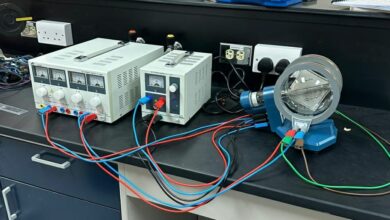
- إظهار عقد الموجة الصوتية الموقوفة وبطونها بمسحوق الفلين.
- تعيين الطول الموجي λ من أشكال المسحوق.
- تعيين سرعة الصوت في الهواء من v = f λ.
- To show the nodes and antinodes of a standing sound wave with cork powder.
- To determine the wavelength λ from the powder figures.
- To determine the speed of sound in air from v = f λ.
- أنبوبة زجاجية (أنبوبة كونت) على حاملين
- قمع بسمّاعة يُركَّب على طرف الأنبوبة
- مكبس ضبط يُدخل من الطرف الآخر
- مسحوق فلين
- مولد إشارة جيبية
- مسطرة مترية، ومحرار لقياس حرارة الهواء
- Glass tube (Kundt’s tube) on two supports
- Funnel with loudspeaker attached to one end of the tube
- Tuning plunger inserted from the other end
- Cork powder
- Sine-wave generator
- Metre rule, and a thermometer for the air temperature
الأساس النظريTheory
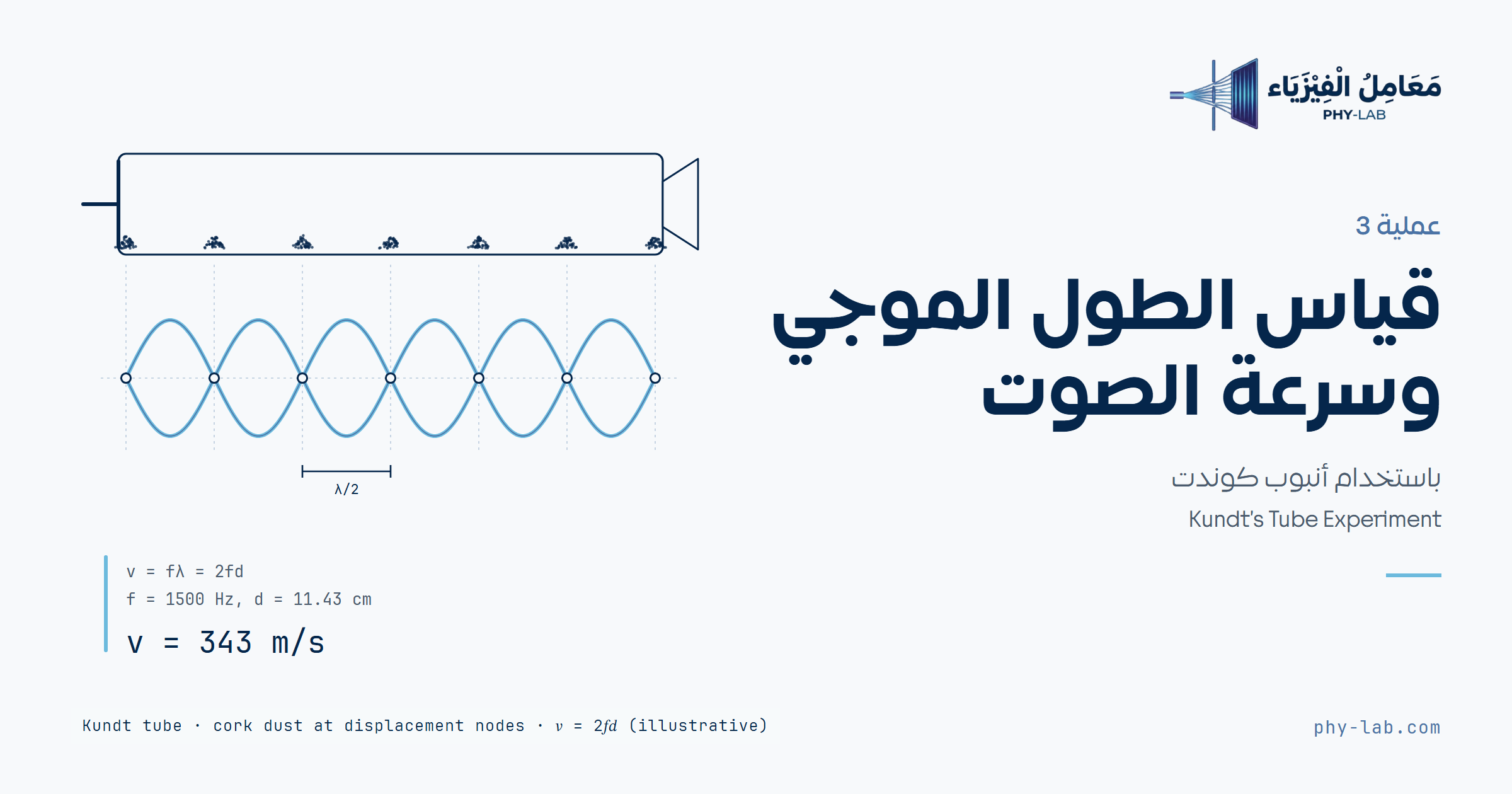
تنتشر الموجة الصوتية في الأنبوبة موجةً مستوية على امتداد محورها ما دام قطرها صغيراً بالنسبة إلى الطول الموجي، وتنعكس عند طرف الأنبوبة (المكبس). تتداخل الموجتان المتعاكستان فتتكون موجة موقوفة: في بطون الإزاحة تهتز جزيئات الهواء بقوة فتثير مسحوق الفلين وترسم عليه خطوطاً عرضية، وفي العقد يبقى المسحوق ساكناً. المسافة بين عقدتين متتاليتين (أو بطنين) نصف طول موجي، فإذا كانت d المسافة بين العقدة الأولى والعقدة رقم n:
The sound wave travels along the tube as a plane wave as long as the tube diameter is small compared with the wavelength, and it is reflected at the tube end (the plunger). The two counter-propagating waves form a standing wave: at displacement antinodes the air molecules oscillate strongly, stir up the cork powder and draw transverse ridges in it, while at the nodes the powder stays at rest. Adjacent nodes (or antinodes) are half a wavelength apart, so if d is the distance between the first node and node number n:
ولأن λ = v/f، فرسم λ مقابل 1/f خط مستقيم يمر بنقطة الأصل وميله v؛ والمقطع غير الصفري يدل على خطأ منتظم في قياس d. وتعتمد سرعة الصوت في غاز مثالي على درجة الحرارة المطلقة لا على التردد:
Since λ = v/f, a plot of λ against 1/f is a straight line through the origin with slope v; a non-zero intercept indicates a systematic error in measuring d. In an ideal gas the speed of sound depends on the absolute temperature, not on the frequency:
حيث θ حرارة الهواء بالسلسيوس، وv0 سرعة الصوت في الهواء الجاف (343.2 m/s عند 20 °C)؛ الرطوبة تزيدها قليلاً (نحو 0.1–0.2% في رطوبة الغرفة المعتادة). وفي الأنبوبة يبطئ الاحتكاك والتبادل الحراري مع الجدار الموجة قليلاً، ويقل هذا الأثر بزيادة التردد وقطر الأنبوبة (تصحيح كيرشهوف):
where θ is the air temperature in degrees Celsius and v0 the speed of sound in dry air (343.2 m/s at 20 °C); humidity raises it slightly (about 0.1–0.2% at usual room humidity). In the tube, friction and heat exchange with the wall slow the wave slightly, an effect that shrinks with higher frequency and wider tube (Kirchhoff correction):
D القطر الداخلي للأنبوبة، وν ≈ 1.5×10⁻⁵ m²/s اللزوجة الحركية للهواء، وPr ≈ 0.71 عدد برانتل. وفوق التردد fc يظهر أول نمط عرضي فلا تبقى الموجة مستوية؛ أي أن الشرط الدقيق D < 0.586 λ.
D is the inner tube diameter, ν ≈ 1.5×10⁻⁵ m²/s the kinematic viscosity of air and Pr ≈ 0.71 the Prandtl number. Above fc the first transverse mode appears and the wave is no longer plane; the exact condition is D < 0.586 λ.
الثوابت: R = 8.314462618 J/(mol·K) (CODATA 2018، قيمة مضبوطة)، والكتلة المولية للهواء الجاف M = 28.965 g/mol.
Constants: R = 8.314462618 J/(mol·K) (CODATA 2018, exact), and the molar mass of dry air M = 28.965 g/mol.
خطوات التجربةProcedure
- ضع قليلاً من مسحوق الفلين في الأنبوبة، وهزّها حتى يتوزع المسحوق خطاً متساوياً على طولها كله.
- ضع الأنبوبة على حامليها وركّب القمع (السمّاعة) على طرفها.
- أدِر الأنبوبة قليلاً حول محورها حتى يلتصق المسحوق بجانبها بالكاد.
- أدخل مكبس الضبط في الطرف الآخر.
- اضبط تردد المولد الجيبي على قيمة مناسبة (نحو 2600 Hz)، ثم حرّك المكبس ببطء حتى يحدث الرنين ويظهر نمط المسحوق أوضح ما يكون.
- عُدّ العقد n، وقِس المسافة d بين العقدة الأولى والأخيرة. قِس من منتصف العقدة لا من حافتها.
- احسب الطول الموجي من المعادلة (1)، ثم السرعة v = f λ.
- كرّر الخطوات 5–7 بترددات مختلفة، مع إعادة ضبط المكبس للرنين عند كل تردد، وأعد توزيع المسحوق إذا تكدّس.
- سجّل حرارة الهواء، وعيّن متوسط سرعة الصوت وقارنه بالقيمة المتوقعة.
- Put a small quantity of cork powder in the tube and shake it so the powder lies in an even line along the whole tube.
- Place the tube on its supports and attach the funnel (loudspeaker) to its end.
- Turn the tube slightly about its axis so that the powder just adheres to its side.
- Insert the tuning plunger at the other end.
- Set the sine generator to a suitable frequency (about 2600 Hz), then move the plunger slowly until resonance, when the powder pattern is clearest.
- Count the nodes n and measure the distance d between the first and last node, from the middle of each node, not its edge.
- Compute the wavelength from equation (1), then the speed v = f λ.
- Repeat steps 5–7 at different frequencies, re-tuning the plunger for resonance each time, and redistribute the powder if it piles up.
- Record the air temperature, and find the mean speed of sound and compare it with the expected value.
الصوت عند 2–3 kHz مزعج للأذن وقد يؤذيها عند الشدة العالية؛ ابدأ بشدة منخفضة وارفعها حتى يتحرك المسحوق فقط. تعامل مع الأنبوبة الزجاجية بحذر، ولا تنفخ المسحوق ولا تستنشقه.
Sound at 2–3 kHz is unpleasant and can harm hearing at high level; start at low amplitude and raise it only until the powder moves. Handle the glass tube with care, and do not blow or inhale the powder.
إدخال البياناتData entry
| # | f (Hz) | n | d (cm) | λ (cm) | v (m/s) |
|---|
البيانات الحالية توضيحية مولّدة من نموذج: هواء جاف عند 22 °C (v₀ = 344.4 m/s) في أنبوبة قطرها الداخلي 4.0 cm مع تصحيح الجدار، وطول نمط نحو 86 cm، وتشتت ±0.4 cm في d؛ وليست قياساً.Current data are illustrative, generated from a model: dry air at 22 °C (v₀ = 344.4 m/s) in a tube of 4.0 cm inner diameter with the wall correction, a pattern length of about 86 cm and ±0.4 cm scatter in d; not a measurement.
لصق بيانات أو تحميل ملف CSVPaste data or load a CSV file
النتائجResults
خطوات الحلSolution steps
التفسيرInterpretation