جمع المتجهات باستخدام طاولة القوى
Vector Force Table


جمع المتجهات باستخدام طاولة القوىAdding Vectors Using the Force Table
وازِن قوتين بقوة ثالثة على طاولة القوى، وأدخل الكتل والزوايا. تحسب الأداة المحصلة بطريقة المركبات، وتقارنها بما وجدته تجريبياً مقداراً واتجاهاً.Balance two forces with a third on the force table and enter the masses and angles. The tool computes the resultant by the component method and compares it with your experimental value, in magnitude and direction.
الهدف والأجهزةObjective and apparatus
- دراسة الخصائص العامة للمتجهات: تحليلها إلى مركبات وجمعها، باستخدام متجهات القوة.
- تعيين القوة التي توازن قوتين أخريين تجريبياً بطاولة القوى.
- التحقق من النتيجة بجمع القوتين بطريقة المركبات.
- To study the general properties of vectors, their resolution into components and their addition, using force vectors.
- To determine experimentally, with the force table, the force that balances two other forces.
- To check the result by adding the two forces by the component method.
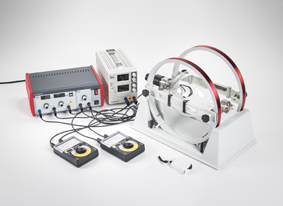
- طاولة قوى مدرّجة بالدرجات
- ثلاث بكرات بمشابك
- حلقة مربوط بها ثلاثة خيوط
- ثلاث علّاقات
- مجموعة أثقال
- Force table graduated in degrees
- Three clamp-mounted pulleys
- Ring with three strings attached
- Three hangers
- Set of masses
الأساس النظريTheory
الكمية القياسية لها مقدار فقط، مثل الكتلة والزمن ودرجة الحرارة. أما الكمية المتجهة فلها مقدار واتجاه، مثل السرعة والتسارع والقوة. ويُمثَّل المتجه بسهم يشير إلى اتجاهه، وطوله يتناسب مع مقداره. وتُجمع المتجهات بالرسم أو بالحساب.
A scalar quantity has magnitude only, such as mass, time and temperature. A vector quantity has both magnitude and direction, such as velocity, acceleration and force. A vector is represented by an arrow pointing in its direction, with a length proportional to its magnitude. Vectors can be added graphically or analytically.
المحصلة لمتجهين أو أكثر متجه واحد له الأثر نفسه؛ فإذا أثرت قوى في نقطة، فمحصلتها قوة واحدة لو أثرت في تلك النقطة لأحدثت الأثر نفسه. والموازِنة قوة تساوي المحصلة مقداراً وتعاكسها اتجاهاً.
The resultant of two or more vectors is a single vector with the same effect; if forces act at a point, their resultant is the one force that would have the same effect at that point. The equilibrant is the force equal and opposite to the resultant.
طاولة القوى جهاز لتعيين محصلة القوى تجريبياً. حافة الطاولة الدائرية مدرّجة بالدرجات، وتؤثر القوى عبر خيوط في حلقة حول مسمار معدني في المركز. وتمر الخيوط فوق بكرات مثبتة على الحافة وتنتهي بعلّاقات. ويُضبط اتجاه القوة بتحريك البكرة، ومقدارها بإضافة أثقال أو إنقاصها.
The force table is an apparatus for finding the resultant of forces experimentally. The rim of the circular table is graduated in degrees, and the forces act through strings on a ring around a metal peg at the centre. The strings pass over pulleys clamped to the rim and end in hangers. The direction of a force is set by moving the pulley, and its magnitude by adding or removing masses.
القوة التي تؤثر في الحلقة هي الشد في الخيط. فإذا كانت الكتلة الكلية المعلقة m ساكنة والبكرة عديمة الاحتكاك، ساوى الشد وزنها:
The force acting on the ring is the tension in the string. If the total hanging mass m is at rest and the pulley is frictionless, the tension equals its weight:
وm هنا تشمل كتلة العلّاقة نفسها. وتُستعمل في التجربة طريقتان للجمع: التجريبية بالطاولة، وطريقة المركبات.
Here m includes the mass of the hanger itself. Two methods of addition are used in this experiment: the experimental one with the table, and the component method.
الطريقة التجريبيةExperimental method
تُطبَّق قوتان بتعليق كتل فوق بكرتين عند زاويتين معينتين، ثم تُضبط زاوية البكرة الثالثة وكتلتها حتى توازن القوتين. وتسمى هذه القوة الثالثة الموازِنة E، والمحصلة R تساويها مقداراً وتعاكسها اتجاهاً (الشكل 2):
Two forces are applied by hanging masses over two pulleys at given angles, then the angle and the mass of the third pulley are adjusted until it balances them. This third force is called the equilibrant E, and the resultant R is equal to it in magnitude and opposite in direction (figure 2):
طريقة المركباتComponent method
تُجمع القوتان بجمع مركباتهما في اتجاهي x وy. فكل قوة تُحلَّل أولاً إلى مركبتين (الشكل 3)، حيث î وĵ متجها الوحدة في الاتجاهين:
The two forces are added by adding their components in the x and y directions. Each force is first resolved into two components (figure 3), where î and ĵ are the unit vectors in the two directions:
ثم تُجمع المركبات لتعطي مركبتي المحصلة:
The components are then added to give the components of the resultant:
ولإكمال الحل تُكتب المحصلة بمقدارها واتجاهها:
To complete the analysis, the resultant is written as a magnitude and a direction:
لكن tan⁻¹ في الآلة الحاسبة يعطي زاوية بين −90° و+90° فقط، فلا يفرّق بين الربعين المتقابلين. لذلك إذا كانت Rx < 0 أضف 180° إلى ما تعطيه الآلة، وإذا بقيت الزاوية سالبة أضف 360°. واتجاه المحصلة التجريبي يعاكس اتجاه الموازِنة، وتُبقى النتيجة بين 0° و360°:
But tan⁻¹ on a calculator gives an angle between −90° and +90° only, so it cannot tell opposite quadrants apart. So if Rx < 0 add 180° to what the calculator gives, and if the angle is still negative add 360°. The experimental direction of the resultant is opposite to the equilibrant, with the result kept between 0° and 360°:
ولمقارنة الطريقتين يلزم عدم اليقين. فإذا كان a = δF = g δm لكل قوة، وbi = Fi δθ مع δθ بالراديان، وφi = θi − θ، فإن:
Comparing the two methods needs the uncertainty. If a = δF = g δm for each force, bᵢ = Fᵢ δθ with δθ in radians, and φᵢ = θᵢ − θ, then:
خطوات التجربةProcedure
جمع متجهين: الطريقة التجريبيةAddition of two vectors: experimental method
المطلوب محصلة قوتين: كتلة 40 g عند 30°، وكتلة 40 g عند 120°.
Find the resultant of two forces: a mass of 40 g at 30° and a mass of 40 g at 120°.
- زِن إحدى العلّاقات وسجّل كتلتها mh.
- ضع بكرة عند 30° والأخرى عند 120°.
- ضع كتلة 40 g على كل خيط.
- وازِن القوتين بالبكرة الثالثة والأثقال: حرّك البكرة أولاً لتجد اتجاه القوة الموازِنة، ثم أضف أثقالاً إلى العلّاقة الثالثة حتى تتمركز الحلقة حول المسمار دون أن تلمسه. واجعل كل خيط متجهاً نحو مركز الطاولة.
- انقر الطاولة نقراً خفيفاً لتخفيف احتكاك البكرات. ولا تتوقف عند أول كتلة تتمركز عندها الحلقة، بل جد أصغر كتلة وأكبر كتلة تبقيانها متمركزة، وخذ منتصفهما.
- القوة الموازِنة هي التي حصلت عليها، والمحصلة تساويها مقداراً. ولتعيين اتجاه المحصلة اطرح 180° من اتجاه الموازِنة إذا زاد على 180°، وأضف 180° إذا قل عنها.
- Weigh one of the hangers and note its mass mₕ.
- Place one pulley at 30° and the other at 120°.
- On each string, place a mass of 40 g.
- Balance the two forces with the third pulley and masses: first move the pulley to find the direction of the balancing force, then add masses to the third hanger until the ring is centred around the peg without touching it. Keep each string pointing to the centre of the table.
- Tap the table lightly to relieve the friction of the pulleys. Do not stop at the first mass that centres the ring: find the smallest and the largest mass that keep it centred, and take their midpoint.
- The force obtained is the equilibrant, and the resultant has the same magnitude. To find the direction of the resultant, subtract 180° from the direction of the equilibrant if it is above 180°, and add 180° if it is below.
طريقة المركباتComponent method
- احسب كل قوة بالمعادلة (1) مستعملاً الكتلة الكلية، وحللها بالمعادلة (4).
- اجمع المركبات بالمعادلة (6)، واحسب R وθ بالمعادلتين (7) و(8) مع مراعاة الربع.
- قارن النتيجة بالطريقة التجريبية، وكرر التجربة بقوى وزوايا أخرى.
- Compute each force by equation (1) with the total mass, and resolve it by equation (4).
- Add the components by equation (6), and compute R and θ by equations (7) and (8), taking care of the quadrant.
- Compare the result with the experimental method, and repeat with other forces and angles.
المحاكاة التفاعليةInteractive simulation
اختر الخيط، ثم غيّر زاويته وكتلته المضافة. المكبّر يبيّن الحلقة حول المسمار، والمقياس يعطي إزاحتها. اضبط E حتى تصبح الإزاحة صفراً، واضغط «انقر الطاولة» قبل كل قراءة، ثم «سجّل في الجدول». وزر «زن العلّاقة» يعطي كتلتها.
Choose a string, then change its angle and its added mass. The magnifier shows the ring around the peg, and the gauge gives its displacement. Adjust E until the displacement is zero, press “Tap the table” before each reading, then “Record in table”. The “Weigh hanger” button gives the mass of a hanger.
النموذج: ثلاثة خيوط شعاعية تماماً، وعلّاقات متساوية الكتلة، واحتكاك في البكرات يبقي الحلقة متمركزة ضمن مدى من القوة المتبقية، ويضيق هذا المدى بعد النقر. وتتناسب إزاحة الحلقة خارج المدى مع القوة المتبقية حتى تلامس المسمار، تسهيلاً للضبط. المحاكاة نموذج لا قياس.Model: three exactly radial strings, hangers of equal mass, and pulley friction that keeps the ring centred within a range of residual force, a range that narrows after tapping. Outside this range the displacement of the ring is proportional to the residual force until it touches the peg, to make adjustment easier. The simulation is a model, not a measurement.
إدخال البياناتData entry
صف لكل محاولة: الكتلتان والزاويتان للقوتين، ثم كتلة الموازِنة وزاويتها. أدخل الكتل المضافة بالغرام والزوايا بالدرجات كما تُقرأ على الطاولة. اجعل mh صفراً إذا كانت كتلك تشمل العلّاقة.
One row per trial: the masses and angles of the two forces, then the mass and angle of the equilibrant. Enter the added masses in grams and the angles in degrees as read on the table. Set mₕ to zero if your masses include the hanger.
| رقمNo | m₁ (g) | θ₁ (°) | m₂ (g) | θ₂ (°) | mE (g) | θE (°) |
|---|
البيانات الحالية توضيحية من نموذج المحاكاة؛ وليست قياساً.Current data are illustrative, from the simulation model; not a measurement.
لصق بيانات أو تحميل ملف CSVPaste data or load a CSV file
سطر لكل محاولة، فيه ست قيم بالترتيب: m₁ ثم θ₁ ثم m₂ ثم θ₂ ثم mE ثم θE.
One line per trial with six values in order: m₁, θ₁, m₂, θ₂, mE, θE.
النتائجResults
مقارنة الطريقتين لكل محاولةThe two methods compared for each trial
| رقمNo | Rexp (N) | θexp (°) | Rcalc (N) | θcalc (°) | ΔR (%) | Δθ (°) |
|---|
خطوات الحلSolution steps
التفسيرInterpretation