تجربة قانون نيوتن للتبريد
newtons-law-of-cooling

قناة تجارب المقررات العملية أ.محمد المالكي
قانون نيوتن للتبريدNewton’s Law of Cooling
سجّل درجة حرارة الماء الساخن في المسعر مع الزمن، وأدخل درجة حرارة الغرفة. تحسب الأداة ثابت التبريد من ميل الخط، وتختبر هل يتبع التبريد القانون فعلاً.Record the temperature of hot water in the calorimeter against time, and enter the room temperature. The tool computes the cooling constant from the slope of the line, and tests whether the cooling really follows the law.
الهدف والأجهزةObjective and apparatus
- التحقق من قانون نيوتن للتبريد.
- تعيين ثابت التبريد.
- To verify Newton’s law of cooling.
- To find the cooling constant.
- ماء ساخن
- مقياسا حرارة: للماء وللغرفة
- ساعة إيقاف
- مسعر بغطاء ومحرّك
- Hot water
- Two thermometers: for the water and the room
- Stopwatch
- Calorimeter with lid and stirrer
الأساس النظريTheory
تتغير درجة حرارة النظام عندما تنتقل إليه طاقة أو تنتقل منه إلى المحيط، والانتقال نفسه سببه فرق درجة الحرارة بين النظام والمحيط. فالانتقال إلى النظام يسخّنه، والانتقال منه يبرّده.
The temperature of a system changes when energy flows into it or from it to the surroundings, and this flow is itself driven by the temperature difference between the system and the surroundings. Flow into the system heats it, and flow out of it cools it.
ينص قانون نيوتن للتبريد على أن معدل فقد الجسم الساخن للحرارة يتناسب طردياً مع الفرق بين درجة حرارته ودرجة حرارة محيطه، ويعتمد ثابت التناسب على مساحة سطح الجسم وطبيعة هذا السطح. وهو قانون تقريبي، يصح جيداً عندما يكون الفرق صغيراً، ولا يدخل فيه التبخر.
Newton’s law of cooling states that the rate at which a hot body loses heat is directly proportional to the difference between its temperature and that of its surroundings, with a constant of proportionality that depends on the surface area of the body and the nature of that surface. It is an approximate law, which holds well when the difference is small, and it does not include evaporation.
لجسم كتلته m وحرارته النوعية s ودرجة حرارته θ في لحظة ما، أعلى من درجة حرارة المحيط θ₀، ليكن Q المحتوى الحراري للجسم، فيكون dQ/dt سالباً أثناء التبريد:
For a body of mass m and specific heat s, at temperature θ at a given moment, above the temperature of the surroundings θ₀, let Q be the heat content of the body, so that dQ/dt is negative during cooling:
حيث dθ/dt معدل تغير درجة الحرارة مع الزمن، وK ثابت موجب وحدته W/°C. ومن المعادلتين:
where dθ/dt is the rate of change of temperature with time, and K is a positive constant in W/°C. From the two equations:
وk هو ثابت التبريد، وهو موجب ووحدته مقلوب الزمن. وبفصل المتغيرين والتكامل:
Here k is the cooling constant, positive and with the unit of inverse time. Separating the variables and integrating:
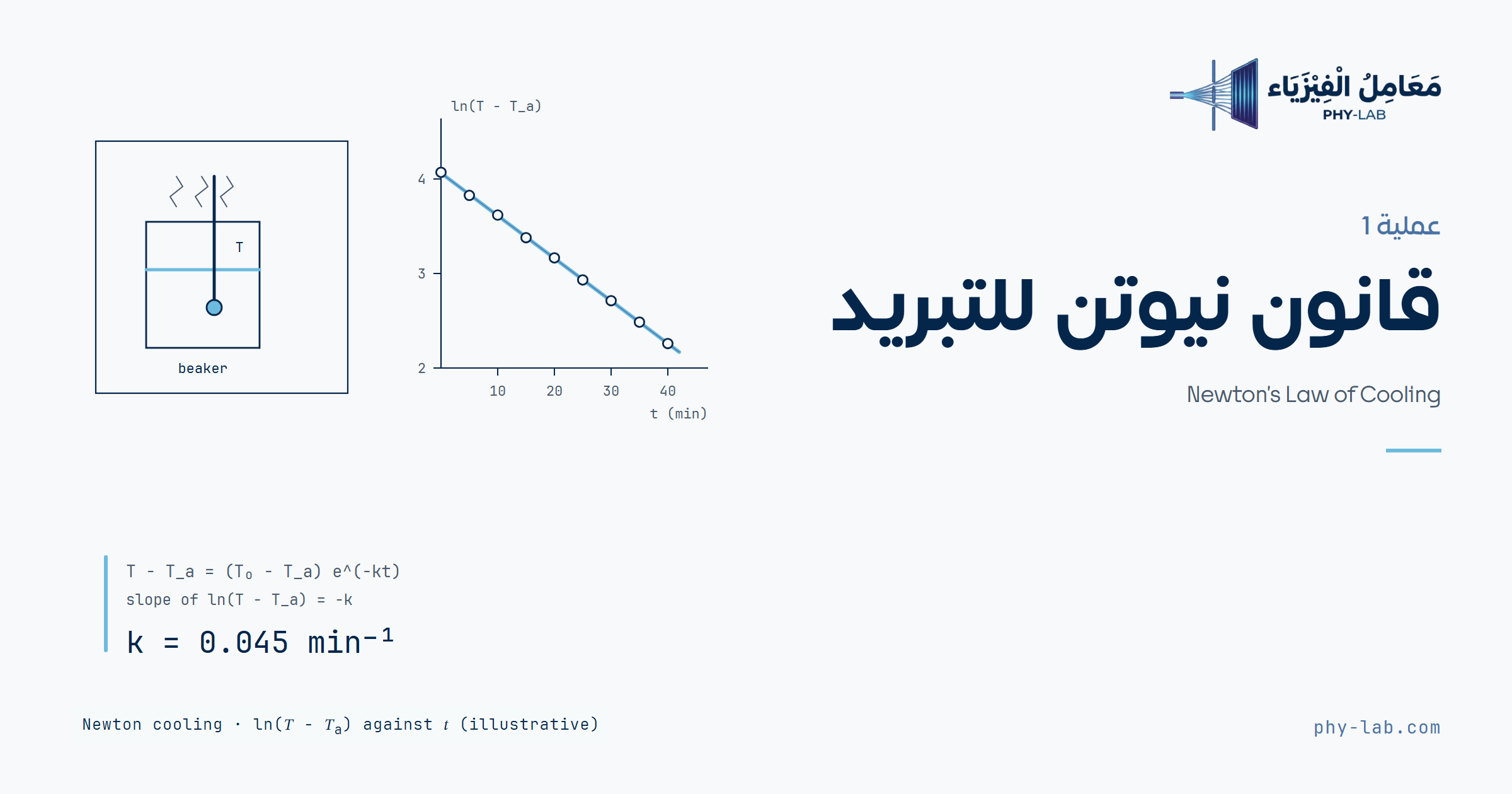
حيث c ثابت التكامل، ويساوي ln(θi − θ₀) عند t = 0. والفرق يؤخذ بالدرجة المئوية قبل حساب اللوغاريتم. فرسم ln(θ − θ₀) مع t خط مستقيم ميله −k (الشكل 2)، أي أن:
where c is the constant of integration, equal to ln(θᵢ − θ₀) at t = 0. The difference is taken in degrees Celsius before the logarithm. So the plot of ln(θ − θ₀) against t is a straight line of slope −k (figure 2), that is:
والزمن اللازم لينقص الفرق إلى نصفه، وثابت الفقد K مع إدخال السعة الحرارية Cc للمسعر الذي يبرد مع الماء:
The time for the difference to fall to half, and the loss constant K including the heat capacity Cc of the calorimeter, which cools with the water:
وخطية الرسم وحدها اختبار ضعيف، لأن خطأ θ₀ يثنيها، ولأن المعدل قد لا يتناسب مع الفرق تماماً. لذلك تحسب الأداة معدل التبريد مباشرة من القراءات المتجاورة، وتوجد الأس n، ويساوي 1 إذا صح القانون:
The straightness of the plot alone is a weak test, because an error in θ₀ bends it, and the rate may not be exactly proportional to the difference. So the tool also computes the cooling rate directly from neighbouring readings and finds the exponent n, which equals 1 if the law holds:
الثابت: الحرارة النوعية للماء s = 4.186 J/(g °C).
Constant: the specific heat of water s = 4.186 J/(g °C).
خطوات التجربةProcedure
- سجّل درجة حرارة الغرفة θ₀ بالمقياس الثاني، بعيداً عن الماء الساخن.
- سخّن الماء، وضع الماء الساخن في المسعر، ثم أغلقه.
- ضع مقياس الحرارة في المسعر لقياس درجة الحرارة، وحرّك الماء قبل كل قراءة.
- سجّل قراءة المقياس θ، كل دقيقة أولاً، ثم كل دقيقتين.
- أوجد فرق درجة الحرارة (θ − θ₀) وكذلك ln(θ − θ₀) لكل قراءة، وسجّلهما في عموديهما في الجدول.
- ارسم العلاقة بين الزمن t (المحور الأفقي) وln(θ − θ₀) (المحور الرأسي).
- احسب ثابت التبريد من الميل: k = −الميل، ووحدته min⁻¹ إذا كان الزمن بالدقائق.
- Record the room temperature θ₀ with the second thermometer, away from the hot water.
- Heat the water, put the hot water in the calorimeter, then close it.
- Put a thermometer in the calorimeter to measure the temperature, and stir the water before each reading.
- Record the thermometer reading θ, first every minute, then every two minutes.
- Find the excess of temperature (θ − θ₀) and also ln(θ − θ₀) for each reading, and record them in their columns in the table.
- Plot time t (x-axis) against ln(θ − θ₀) (y-axis).
- Calculate the cooling constant from the slope: k = −slope, in min⁻¹ if the time is in minutes.
المحاكاة التفاعليةInteractive simulation
اختر حرارة الماء وكتلته والغطاء، ثم اضغط «صبّ الماء». الماء يبرد قليلاً عند الصب لأنه يسخّن المسعر. شغّل الساعة أو تقدّم بالأزرار، واضغط «سجّل في الجدول» عند كل قراءة. وتُطبَّق الحرارة والكتلة والغطاء عند الصب التالي.
Choose the temperature and mass of the water and the lid, then press “Pour water”. The water cools a little on pouring because it warms the calorimeter. Run the clock or step with the buttons, and press “Record in table” at each reading. The temperature, mass and lid apply at the next pour.
النموذج: الماء والمسعر يبردان معاً. مع الغطاء يتبع التبريد المعادلة (3). ودون الغطاء يزيد فقد الحرارة ويضاف إليه تبخر يقوى كثيراً عند الفرق الكبير. ودون تحريك تتذبذب القراءة. وتمر الدقيقة في ثانية عند تشغيل الساعة. المحاكاة نموذج لا قياس.Model: the water and the calorimeter cool together. With the lid, the cooling follows equation (3). Without the lid, the heat loss is larger and evaporation is added, which grows strongly at a large difference. Without stirring the reading fluctuates. A minute passes in one second when the clock runs. The simulation is a model, not a measurement.
إدخال البياناتData entry
أدخل الزمن بالدقائق ودرجة الحرارة بالدرجة المئوية؛ والعمودان الأخيران يُحسبان. والخانتان m وCc اختياريتان، وتلزمان لحساب K فقط.
Enter the time in minutes and the temperature in degrees Celsius; the last two columns are computed. The fields m and Cc are optional, needed only to compute K.
| رقمNo | t (min) | θ (°C) | θ − θ₀ (°C) | ln(θ − θ₀) |
|---|
البيانات الحالية توضيحية من نموذج المحاكاة؛ وليست قياساً.Current data are illustrative, from the simulation model; not a measurement.
لصق بيانات أو تحميل ملف CSVPaste data or load a CSV file
سطر لكل قراءة، فيه قيمتان بالترتيب: الزمن t بالدقائق ثم θ بالدرجة المئوية. واكتب θ₀ في خانته.
One line per reading with two values in order: the time t in minutes, then θ in degrees Celsius. Write θ₀ in its field.
النتائجResults
خطوات الحلSolution steps
التفسيرInterpretation