تعيين الحرارة النوعية لجسم صلب بطريقة الخلط
Specific Heat of a Solid by the Method of Mixtures

تعيين الحرارة النوعية لجسم صلب بطريقة الخلطSpecific Heat of a Solid by the Method of Mixtures
سخّن جسماً صلباً في ماء يغلي، وانقله بسرعة إلى ماء بارد في المسعر، وقس الكتل والحرارة. تحسب الأداة الحرارة النوعية مع عدم اليقين، وتقارنها بالقيمة المقبولة، وتحدد أقرب مادة إليها، وتكشف أخطاء التجربة الشائعة.Heat a solid in boiling water, move it quickly into cold water in a calorimeter, and measure the masses and temperatures. The tool computes the specific heat with its uncertainty, compares it with the accepted value, finds the nearest material, and reveals the common errors of the experiment.
الهدف والأجهزةObjective and apparatus
تعيين الحرارة النوعية لجسم صلب بطريقة الخلط: الحرارة التي يفقدها الجسم الساخن تساوي الحرارة التي يكتسبها الماء والمسعر.
To determine the specific heat of a solid by the method of mixtures: the heat lost by the hot body equals the heat gained by the water and the calorimeter.
- مسعر بكأس ألمنيوم وغطاء ومحرك
- عينة صلبة (ألمنيوم أو نحاس) معلقة بخيط
- كأس غليان وموقد وحامل
- مقياسا حرارة
- ميزان رقمي
- ماء بارد
- Calorimeter with an aluminium cup, lid and stirrer
- Solid sample (aluminium or copper) hung on a thread
- Boiling beaker, burner and stand
- Two thermometers
- Digital scale
- Cold water
الأساس النظريTheory
الحرارة النوعية C لمادة هي كمية الحرارة اللازمة لرفع حرارة 1 g منها درجة مئوية واحدة، ووحدتها cal/(g·°C). فالحرارة التي تكسبها أو تفقدها كتلة M عند تغير حرارتها بمقدار ΔT هي:
The specific heat C of a substance is the quantity of heat needed to raise the temperature of 1 g of it by one degree Celsius, and its unit is cal/(g·°C). So the heat gained or lost by a mass M when its temperature changes by ΔT is:
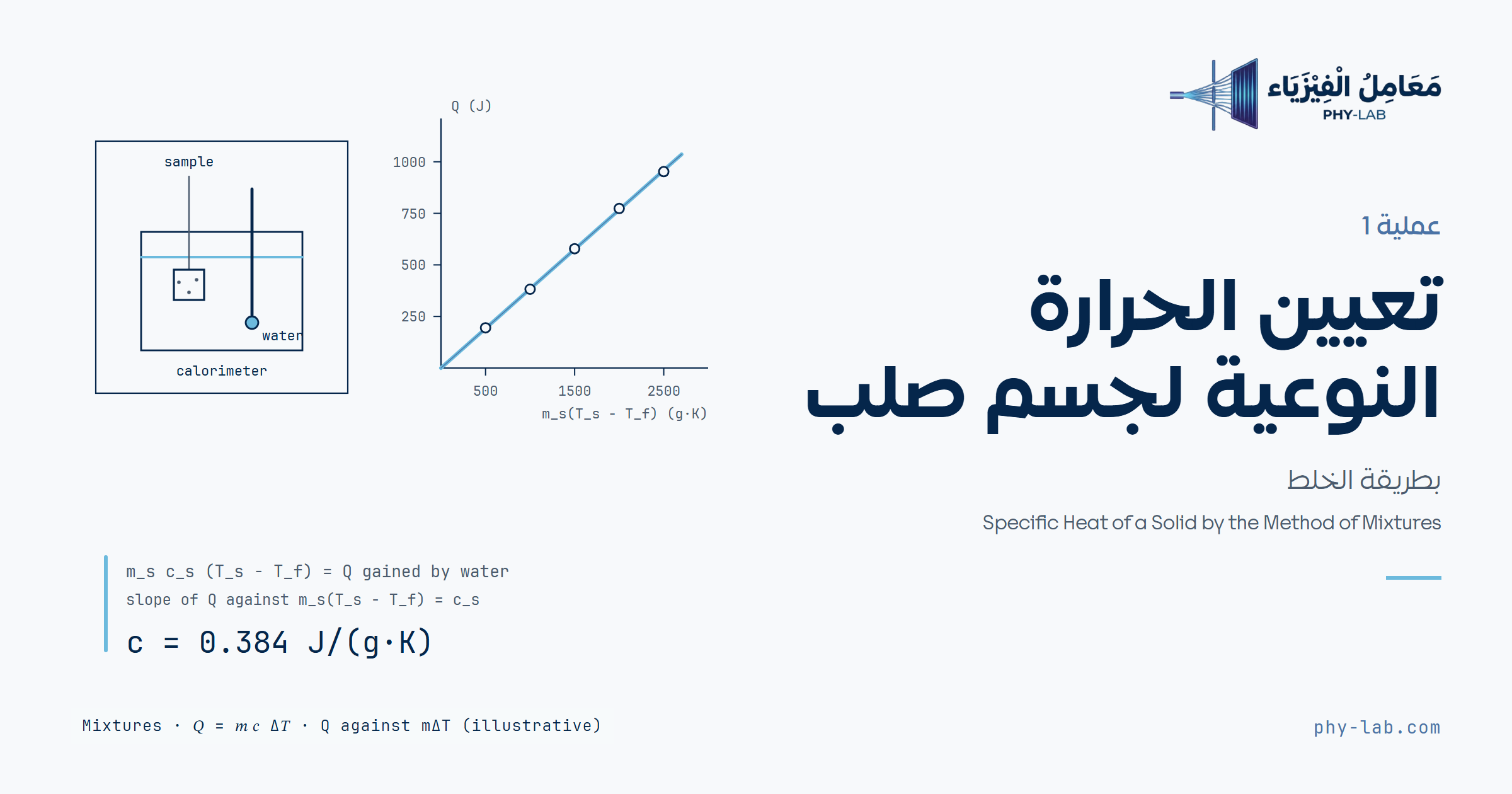
وعند وضع جسم ساخن في ماء بارد داخل المسعر تنتقل الحرارة من الجسم إلى الماء والكأس حتى تتساوى حرارتها جميعاً عند حرارة الاتزان Tf، كما في الشكل 2. وإذا أهملنا تبادل الحرارة مع الغرفة، فالحرارة المفقودة تساوي الحرارة المكتسبة:
When a hot body is put into cold water in the calorimeter, heat flows from the body to the water and the cup until they all reach the equilibrium temperature Tf, as in figure 2. If we neglect the exchange of heat with the room, the heat lost equals the heat gained:
حيث Mm وCm كتلة الجسم وحرارته النوعية، وMw وCw كتلة الماء وحرارته النوعية، وMc وCc كتلة كأس المسعر وحرارتها النوعية، وTm حرارة الجسم الابتدائية، وTw حرارة الماء والكأس الابتدائية، وTf حرارة الاتزان. وبحل المعادلة (2):
Here Mm and Cm are the mass and specific heat of the body, Mw and Cw are the mass and specific heat of the water, Mc and Cc are the mass and specific heat of the calorimeter cup, Tm is the initial temperature of the body, Tw is the initial temperature of the water and cup, and Tf is the equilibrium temperature. Solving equation (2):
فإذا سمينا الحرارة المكتسبة Q وسمينا X = Mm(Tm−Tf)، فرسم Q مع X لعدة تجارب خط مستقيم يمر بنقطة الأصل وميله Cm:
If we call the heat gained Q and write X = Mm(Tm−Tf), a plot of Q against X for several trials is a straight line through the origin of slope Cm:
ولأن المسعر يتبادل الحرارة مع الغرفة، نبدأ بماء أبرد من الغرفة قليلاً وننتهي أدفأ منها قليلاً، فيقارب ما يكسبه أولاً ما يفقده بعد ذلك.
As the calorimeter exchanges heat with the room, we start with water slightly colder than the room and end slightly warmer than it, so what it gains first nearly equals what it loses afterwards.
الثوابت: Cw = 1.00 cal/(g·°C)، و1 cal = 4.184 J. والقيم المقبولة بوحدة cal/(g·°C): الألمنيوم 0.215، والحديد 0.107، والنحاس 0.092، والرصاص 0.031.
Constants: Cw = 1.00 cal/(g·°C), and 1 cal = 4.184 J. Accepted values in cal/(g·°C): aluminium 0.215, iron 0.107, copper 0.092, and lead 0.031.
خطوات التجربةProcedure
- عيّن بالميزان كتلة العينة Mm، وسجّلها.
- علّق العينة بخيط في ماء كأس الغليان، وأشعل الموقد.
- عيّن كتلة كأس المسعر فارغة Mc، وسجّلها.
- املأ الكأس إلى نصفها تقريباً بماء أبرد من الغرفة ببضع درجات، ثم عيّن كتلة الكأس والماء Mcw، وسجّلها.
- احسب كتلة الماء: Mw = Mcw − Mc.
- ضع الكأس في المسعر، وانتظر حتى يغلي الماء وتثبت حرارة العينة، وسجّل حرارة الماء المغلي Tm.
- قس حرارة ماء المسعر Tw قبيل النقل، وسجّلها.
- ارفع العينة وانفضها من الماء العالق بها، وانقلها بسرعة إلى المسعر، وأغلقه.
- حرّك الماء باستمرار، وسجّل أعلى حرارة يبلغها Tf.
- احسب Cm بالمعادلة (3)، وقارنها بالقيمة المقبولة.
- Use the digital scale to determine the mass of the sample Mm, and record it.
- Hang the sample on a thread in the water of the boiling beaker, and light the burner.
- Determine the mass of the empty calorimeter cup Mc, and record it.
- Fill the cup to about half with water a few degrees colder than the room, then determine the mass of the cup and water Mcw, and record it.
- Calculate the mass of the water: Mw = Mcw − Mc.
- Put the cup in the calorimeter, wait until the water boils and the temperature of the sample is steady, and record the temperature of the boiling water Tm.
- Measure the temperature of the calorimeter water Tw just before the transfer, and record it.
- Lift the sample, shake off the water clinging to it, move it quickly into the calorimeter, and close it.
- Stir the water all the time, and record the highest temperature it reaches Tf.
- Calculate Cm by equation (3), and compare it with the accepted value.
أخطاء شائعةCommon errors
- بطء النقل: تبرد العينة في الهواء قبل دخول المسعر، فتكون حرارتها أقل من Tm المسجلة، وتخرج Cm أقل.
- الماء العالق: الماء الساخن على العينة يحمل معه حرارة إضافية إلى المسعر، فتخرج Cm أكبر.
- التسخين القصير: إذا نُقلت العينة قبل أن تبلغ حرارة الماء المغلي، كانت حرارتها أقل من المسجلة، وخرجت Cm أقل.
- التحريك: دون تحريك يبطؤ التجانس، فقد يُقرأ Tf قبل بلوغ الاتزان، وتخرج Cm أقل.
- Slow transfer: the sample cools in the air before entering the calorimeter, so its temperature is below the recorded Tm, and Cm comes out too low.
- Clinging water: hot water on the sample carries extra heat into the calorimeter, so Cm comes out too high.
- Short heating: if the sample is moved before it reaches the temperature of the boiling water, its temperature is below the recorded one, and Cm comes out too low.
- Stirring: without stirring the water becomes uniform slowly, so Tf may be read before equilibrium, and Cm comes out too low.
المحاكاة التفاعليةInteractive simulation
العينة على الميزان: سجّل كتلتها، ثم ضعها في كأس الغليان وشغّل الموقد. انقل الكأس الفارغة إلى الميزان وسجّل كتلتها، وصب الماء وسجّل الكتلة، ثم أعد الكأس إلى المسعر. وعندما يغلي الماء وتمر دقائق، سجّل حرارة الغليان وحرارة المسعر، وانقل العينة، وانتظر وسجّل أعلى حرارة. ويمكنك إبطاء النقل أو ترك الماء العالق أو إيقاف التحريك لترى أثر كل خطأ.
The sample is on the scale: record its mass, then put it in the boiling beaker and switch on the burner. Move the empty cup to the scale and record its mass, pour the water and record the mass, then return the cup to the calorimeter. When the water boils and some minutes pass, record the boiling temperature and the calorimeter temperature, move the sample, wait and record the highest temperature. You can slow the transfer, leave the clinging water, or stop the stirring, to see the effect of each error.
النموذج: عينة تسخن في ماء يغلي وتبرد في الهواء أثناء النقل، وماء يتجانس بالتحريك، وكأس لها سعة حرارية، وتبادل بطيء مع الغرفة. والزمن يتقدم بالأزرار فقط. المحاكاة نموذج لا قياس.Model: a sample heats in boiling water and cools in the air during the transfer, the water becomes uniform with stirring, the cup has a heat capacity, and heat is exchanged slowly with the room. Time advances only with the buttons. The simulation is a model, not a measurement.
إدخال البياناتData entry
صف لكل تجربة. تكفي تجربة واحدة، وتكرارها بكميات مختلفة من الماء يعطي متوسطاً وخط Q–X.
One row for each trial. One trial is enough, and repeating it with different amounts of water gives a mean and the Q–X line.
| رقمNo | Mm (g) | Mc (g) | Mcw (g) | Tm (°C) | Tw (°C) | Tf (°C) |
|---|
البيانات الحالية توضيحية من نموذج المحاكاة؛ وليست قياساً.Current data are illustrative, from the simulation model; not a measurement.
لصق بيانات أو تحميل ملف CSVPaste data or load a CSV file
سطر لكل تجربة بالترتيب: Mm، Mc، Mcw بالغرام، ثم Tm، Tw، Tf بالدرجة المئوية.
One line per trial in order: Mm, Mc, Mcw in grams, then Tm, Tw, Tf in degrees Celsius.
النتائجResults
| رقمNo | Mw (g) | Q (cal) | X (g·°C) | Cm |
|---|
خطوات الحلSolution steps
التفسيرInterpretation