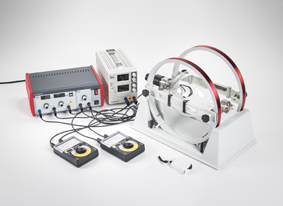
تأثير زيمانZeeman Effect
قِس بالتلسكوب ومؤشر القياس المسافة Δs بين خطي تداخل دون مجال مغناطيسي، والانفصال ds في وجوده، للخط الأحمر للكادميوم. تحسب الأداة dλ لكل قراءة، ثم الشحنة النوعية e/m من ميل ds/Δs مقابل B، مع عدم اليقين وخطوات الحل.With the telescope and dial gauge, measure the distance Δs between two interference lines without a magnetic field and the splitting ds in its presence, for the red line of cadmium. The tool computes dλ for each reading, then the specific charge e/m from the slope of ds/Δs against B, with the uncertainty and the solution steps.
الهدف والأجهزةObjective and apparatus
- تعيين المسافة بين خطي تداخل للكادميوم في غياب المجال المغناطيسي.
- تعيين انفصال زيمان في وجود المجال المغناطيسي.
- تعيين الإزاحة dλ في الطول الموجي لذرة الكادميوم.
- To determine the distance between two interference lines of cadmium in the absence of a magnetic field.
- To determine the Zeeman splitting in the presence of a magnetic field.
- To determine the wavelength shift dλ of the cadmium atom.
- مصدر قدرة
- جهاز زيمان (مغناطيس كهربائي، مصباح كادميوم، مرشح استقطاب، لوح لومر-غيركه، تلسكوب بمؤشر قياس)
- جهاز قياس المجال المغناطيسي
- أسلاك توصيل
- Power supply
- Zeeman device (electromagnet, cadmium lamp, polarizer, Lummer-Gehrcke plate, telescope with dial gauge)
- Magnetic field meter
- Connection wires
الأساس النظريTheory
طول موجة الخط الطيفي الأحمر لذرة الكادميوم 643.8 nm. فإذا سُلّط مجال مغناطيسي انقسم الخط إلى عدة خطوط، لأن تفاعل العزم المغناطيسي μ للذرة مع المجال B يزيح طاقة المستويات الذرية قليلاً:
The red spectral line of the cadmium atom has a wavelength of 643.8 nm. When a magnetic field is applied the line splits into several lines, because the interaction of the magnetic moment μ of the atom with the field B slightly shifts the energy of the atomic levels:
حيث L الزخم الزاوي المداري وm كتلة الإلكترون، وL = ħ√(l(l+1)) وl العدد الكمي المداري. ومركّبة L على اتجاه المجال L_z = ħ m_l، وm_l يأخذ القيم من −l إلى +l، فيكون:
where L is the orbital angular momentum and m the electron mass, L = ħ√(l(l+1)) with l the orbital quantum number. The component of L along the field is L_z = ħ m_l, where m_l takes the values from −l to +l, so that:
وإزاحة الطاقة بين مستويين:
The shift of the energy between two levels is:
وقاعدة الاختيار Δm_l = 0, ±1. وتوافق هذه الإزاحة تغيراً في التردد والطول الموجي:
The selection rule is Δm_l = 0, ±1. This shift corresponds to a change in frequency and wavelength:
إذا نُظر إلى الضوء في اتجاه المجال انقسم الخط إلى مركّبتين، وإذا نُظر إليه عمودياً على المجال انقسم إلى ثلاث مركّبات (الشكل 4.1). والموجة المستوية مستقطبة خطياً إذا لم يكن بين مركّبتي مجالها الكهربائي (E_x, E_y, 0) فرق في الطور، ومستقطبة دائرياً إذا تساوت سعتا المركّبتين وكان فرق الطور بينهما 90°.
If the light is viewed along the field the line splits into two components, and if viewed perpendicular to the field it splits into three components (figure 4.1). A plane wave is linearly polarized if there is no phase difference between the components of its electric field (E_x, E_y, 0), and circularly polarized if the two components have equal amplitudes and a phase difference of 90°.
ينشأ الخط الأحمر من الانتقال 5¹D₂ → 5¹P₁ (L = 2 إلى L = 1). المستويان أحاديان (S = 0)، فالعزم مداري خالص ويظهر تأثير زيمان العادي: ينقسم المستويان إلى خمسة وثلاثة، لكن تساوي المسافات يجمع الانتقالات التسعة في ثلاثة خطوط (الشكل 4.3).
The red line comes from the transition 5¹D₂ → 5¹P₁ (L = 2 to L = 1). Both levels are singlets (S = 0), so the moment is purely orbital and the normal Zeeman effect appears: the levels split into five and three, but their equal spacing gathers the nine transitions into three lines (figure 4.3).
الانقسام صغير جداً، فيُفصل بلوح لومر-غيركه (الشكل 4.5): لوح زجاجي سمكه d ومعامل انكساره n، يعكس الضوء داخله مرات كثيرة، فيتكوّن بدل الخط الواحد نظام خطوط تداخل، لكل منها رتبة. Δs هي المسافة بين خطي تداخل متجاورين دون مجال، وds بُعد الخط المنقسم عن الخط الأوسط (الشكل 4.4). وتُقرآن بالتلسكوب ومؤشر القياس.
The splitting is very small, so it is resolved with a Lummer-Gehrcke plate (figure 4.5): a glass plate of thickness d and refractive index n that reflects the light many times inside it, so that a system of interference lines, each of its own order, forms in place of the single line. Δs is the distance between two neighbouring interference lines without a field, and ds the distance of a split line from the middle line (figure 4.4). They are read with the telescope and the dial gauge.
حيث dλ إزاحة الطول الموجي. والكسر الثاني هو المدى الطيفي الحر للوح، أي فرق الطول الموجي الذي ينقل الخط مسافة Δs كاملة، ويساوي λ²/(2d√(n²−1)). ومن المعادلات (5.4) و(5.5) و(5.6) عند Δm_l = 1، بأخذ مقدار الإزاحة:
where dλ is the wavelength shift. The second fraction is the free spectral range of the plate, the wavelength difference that moves a line by a full Δs, and equals λ²/(2d√(n²−1)). From equations (5.4), (5.5) and (5.6) with Δm_l = 1, taking the size of the shift:
وبما أن ds/Δs يتناسب مع B، فالأفضل رسمهما وأخذ ميل الخط بدل قراءة واحدة. وتهمل المعادلة (5.6) تغيّر n مع الطول الموجي؛ وبإدخاله يصبح المدى الطيفي الحر:
Since ds/Δs is proportional to B, it is better to plot the two and take the slope of the line than to rely on one reading. Equation (5.6) neglects the change of n with wavelength; including it, the free spectral range becomes:
الثوابت: d = 4.04 mm وn = 1.4567، وهي قيمة الكوارتز المصهور عند هذا الطول الموجي، وله dn/dλ ≈ −0.0278 µm⁻¹. فالمدى الطيفي الحر نحو 48.4 pm من (5.6) و47.3 pm من (5.8). والقيمة المرجعية e/m = 1.7588 × 10¹¹ C/kg، وعندها dλ/B = 19.35 pm/T.
Constants: d = 4.04 mm and n = 1.4567, which is the value of fused silica at this wavelength, with dn/dλ ≈ −0.0278 µm⁻¹. So the free spectral range is about 48.4 pm from (5.6) and 47.3 pm from (5.8). The reference value is e/m = 1.7588 × 10¹¹ C/kg, for which dλ/B = 19.35 pm/T.
خطوات التجربةProcedure
مصباح الكادميوم يسخن كثيراً ويعمل بجهد عالٍ، فلا تلمسه وهو يعمل. وارفع تيار المغناطيس وخفضه تدريجياً، ولا تقرّب الساعات والبطاقات الممغنطة من قطبيه.
The cadmium lamp gets very hot and runs at high voltage, so do not touch it while it is on. Raise and lower the magnet current gradually, and keep watches and magnetic cards away from its poles.
- وصّل الأجهزة كما في الشكل 4.2.
- ضع مصباح الكادميوم وأغلق الدائرة لتشغيله، فيظهر الخط الطيفي خلال خمس دقائق.
- عيّن Δs دون مجال: ضع مؤشر التلسكوب على الخط المراد قياسه واضبط مؤشر القياس على الصفر، ثم حرّك التلسكوب إلى الخط التالي واكتب القراءة. والخطوط الوسطى أنسب للقياس لأن المسافة بينها أكبر.
- عيّن الانفصال ds، وهو المسافة بين خطين متجاورين من الخطوط الثلاثة، بعد تشغيل دائرة المغناطيس.
- قِس Δs وds عند الخطوط نفسها، لأن المسافات بين مجموعات الخطوط غير متساوية (الشكل 4.4).
- كرر الخطوات لتعيين الانفصال الثاني.
- خفّض التيار تدريجياً، ولاحظ اعتماد الانفصال على المجال المغناطيسي عند موضع المصباح بين القطبين.
- Connect the equipment as in figure 4.2.
- Place the cadmium lamp and close its circuit; the spectral line appears within five minutes.
- Find Δs with no field: put the telescope index on the line to be measured and set the dial gauge to zero, then move the telescope to the next line and write down the reading. The middle lines suit the measurement best because the distance between them is larger.
- Find the splitting ds, the distance between two neighbouring lines of the three, after switching on the magnet circuit.
- Measure Δs and ds at the same lines, since the distances between the groups of lines are not equal (figure 4.4).
- Repeat the steps to find the second split.
- Lower the current gradually and note how the splitting depends on the magnetic field at the position of the lamp between the poles.
المحاكاة التفاعليةInteractive simulation
شغّل المصباح. دون تيار ضع التقاطع على خط واضغط «صفّر المؤشر»، ثم حرّك التلسكوب إلى الخط التالي واضغط «سجّل Δs». بعدها ارفع التيار، واختر مرشح الاستقطاب العمودي ليبقى خطا σ، وصفّر عند أحدهما، وانتقل إلى الآخر واضغط «سجّل 2ds»، أو قِس من الخط الأوسط واضغط «سجّل ds». ثم اضغط «سجّل القراءة». التلسكوب يتحرك بدرجات مؤشر القياس (0.01 mm).
Switch the lamp on. With no current put the crosshair on a line and press “Zero the gauge”, then move the telescope to the next line and press “Record Δs”. Then raise the current, choose the perpendicular polarizer so that the two σ lines remain, zero on one of them, move to the other and press “Record 2ds”, or measure from the middle line and press “Record ds”. Then press “Record reading”. The telescope moves in divisions of the dial gauge (0.01 mm).
النموذج: خطوط لوح لومر-غيركه تتقارب مع الرتبة، وتنزاح مركّبات زيمان بالقدر الذي يعطيه e/m والمعادلة (5.8)، وعرض الخط ثابت بالنسبة إلى الرتبة. ومجال المغناطيس يتشبع مع التيار. وقد اختُصر انتظار تسخين المصباح. المحاكاة نموذج لا قياس.Model: the lines of the Lummer-Gehrcke plate draw closer with order, the Zeeman components shift by the amount given by e/m and equation (5.8), and the line width is fixed relative to the order. The field of the magnet saturates with current. The wait for the lamp to warm up has been cut. The simulation is a model, not a measurement.
إدخال البياناتData entry
الجدول 1: الصف الأول للانفصال الأول والثاني للانفصال الثاني، والصفوف التالية لخفض التيار في الخطوة 7. أدخل Δs وds بدرجات مؤشر القياس. والمعادلة (5.7) تحتاج قيمة B، وبدونها تُحسب dλ فقط. وخانة δs هي عدم يقين القراءة.
Table 1: the first row is for the first split, the second for the second split, and the following rows for lowering the current in step 7. Enter Δs and ds in divisions of the dial gauge. Equation (5.7) needs B; without it only dλ is computed. The field δs is the reading uncertainty.
| رقمNo | B (T) | Δs (div) | ds (div) | ds/Δs | dλ (pm) | e/m (10¹¹ C/kg) |
|---|
البيانات الحالية توضيحية من نموذج المحاكاة؛ وليست قياساً.Current data are illustrative, from the simulation model; not a measurement.
لصق بيانات أو تحميل ملف CSVPaste data or load a CSV file
سطر لكل قراءة: B ثم Δs ثم ds، مثل 0.85, 52, 17. ولترك B فارغة اكتب ,52,17.
One line per reading: B then Δs then ds, such as 0.85, 52, 17. To leave B empty write ,52,17.
النتائجResults
خطوات الحلSolution steps
التفسيرInterpretation