خصائص الخلية الشمسيةCharacteristics of the Solar Cell
أدخل أزواج الجهد والتيار عند مقاومات حمل مختلفة، وتحسب الأداة تيار القصر وجهد الدائرة المفتوحة والقدرة العظمى وعامل التعبئة والكفاءة ومقاومة الحمل المثلى.Enter voltage–current pairs at different load resistances; the tool computes the short-circuit current, open-circuit voltage, maximum power, fill factor, efficiency and optimum load resistance.
الهدف والأجهزةObjective and apparatus
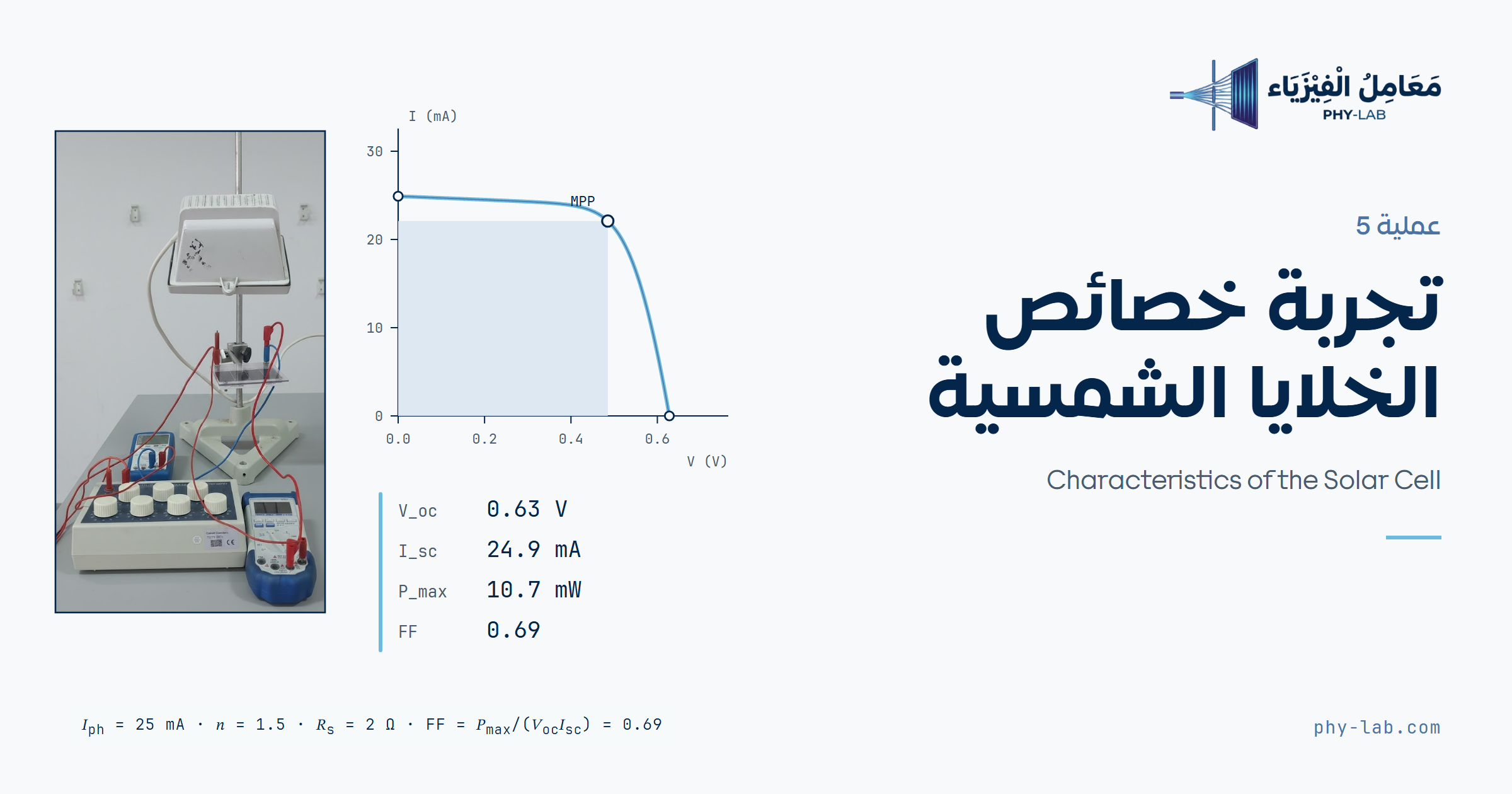
إيجاد خصائص الخلية الشمسية من منحنى التيار والجهد: القدرة المثالية PI، والقدرة العظمى Pmax، وعامل التعبئة FF، والكفاءة η، ومقاومة الحمل RL.
To find the solar cell characteristics from its current–voltage curve: the ideal power PI, the maximum power Pmax, the fill factor FF, the efficiency η and the load resistance RL.
- خلية شمسية
- مقاومة متغيرة (صندوق مقاومات عشري)
- ملتيميتران رقميان (أميتر وفولتميتر)
- مصدر ضوء
- لوحة توصيل (Breadboard)
- أسلاك توصيل
- Solar cell
- Variable resistor (resistance decade box)
- Two digital multimeters (ammeter and voltmeter)
- Light source
- Breadboard
- Connecting wires
الأساس النظريTheory
الخلية الشمسية وصلة pn من شبه موصل تحوّل طاقة الضوء إلى طاقة كهربائية مباشرة بالأثر الكهروضوئي، وتغذي الحمل عند إضاءتها دون جهد انحياز خارجي. يولّد الضوء تياراً ضوئياً Iph، ويقابله تيار الثنائي في الاتجاه المعاكس، فيكون تيار الخلية في النموذج ذي الثنائي الواحد:
A solar cell is a semiconductor pn junction that converts light directly into electrical energy by the photovoltaic effect, supplying a load when illuminated without external bias. Light generates a photocurrent Iph, opposed by the diode current, so in the single-diode model the cell current is:
حيث Rs المقاومة المتوالية (التماسات والأسلاك) وRsh مقاومة التسرب، وVT = kT/e. عند V = 0 يمر تيار القصر Isc، وعند فتح الدائرة يظهر الجهد Voc؛ والقدرة صفر عند الطرفين وتبلغ أقصاها عند مقاومة حمل محددة:
where Rs is the series resistance (contacts and leads), Rsh the shunt resistance and VT = kT/e. At V = 0 the short-circuit current Isc flows; on open circuit the voltage Voc appears. The power is zero at both ends and peaks at a particular load resistance:
عامل التعبئة نسبة مساحة أكبر مستطيل تحت المنحنى إلى المستطيل Voc × Isc، والكفاءة نسبة القدرة العظمى إلى القدرة الضوئية الساقطة على مساحة الخلية A بشدة إشعاع G:
The fill factor is the ratio of the largest rectangle under the curve to the rectangle Voc × Isc; the efficiency is the maximum power divided by the light power falling on the cell area A at irradiance G:
ميل المنحنى عند Isc يقدّر Rsh، وميله عند Voc حدّ أعلى لـ Rs لأنه يشمل المقاومة الديناميكية للثنائي. كلاهما يحدد عامل التعبئة.
The slope at Isc estimates Rsh; the slope at Voc is an upper bound on Rs because it includes the diode’s dynamic resistance. Both limit the fill factor.
خطوات التجربةProcedure
- صِل الخلية على التوالي مع صندوق المقاومات والأميتر، والفولتميتر على طرفَي الخلية مباشرة.
- ضع مصدر الضوء على مسافة مناسبة حتى تحصل على تيار مناسب، ولا تحرّكه بعد ذلك.
- غيّر المقاومة من الصفر (قصر) إلى الدائرة المفتوحة، وسجّل الجهد والتيار في كل مرة. أكثر القراءات قرب «الركبة» حيث يبدأ التيار بالهبوط.
- سجّل القراءات في الجدول؛ تحسب الأداة P = V × I وR = V/I لكل صف.
- قِس طول الخلية وعرضها، وشدة الإشعاع عند موضعها، لحساب الكفاءة.
- اضغط «احسب النتائج» لرسم منحنى I–V وإيجاد Voc وIsc وPmax وFF وη وRL.
- Connect the cell in series with the decade box and the ammeter, and the voltmeter directly across the cell.
- Place the light source at a suitable distance to obtain a suitable current, then do not move it.
- Vary the resistance from zero (short circuit) to open circuit, recording voltage and current each time. Take more readings near the “knee” where the current starts to fall.
- Record the readings in the table; the tool computes P = V × I and R = V/I for each row.
- Measure the cell length and width and the irradiance at its position to compute the efficiency.
- Press “Compute results” to plot the I–V curve and find Voc, Isc, Pmax, FF, η and RL.
الخلية تسخن تحت المصباح فينخفض جهدها (نحو 2 mV لكل درجة في خلية السيليكون)، فخذ القراءات بسرعة. لا تلمس سطح المصباح الساخن، ولا تنظر إليه مباشرة.
The cell heats under the lamp and its voltage drops (about 2 mV per degree for a silicon cell), so take the readings quickly. Do not touch the hot lamp surface or look into it directly.
إدخال البياناتData entry
| # | V (V) | I (mA) | P (mW) | R (Ω) |
|---|
البيانات الحالية توضيحية مولّدة من نموذج الثنائي الواحد (خلية سيليكون 5 × 5 cm تحت 500 W/m²، Iph = 0.44 A، n = 1.3، Rs = 0.2 Ω، Rsh = 40 Ω، 30 °C، ضجيج ±1 mV و±0.5 mA) وليست قياساً.Current data are illustrative, generated from the single-diode model (5 × 5 cm silicon cell at 500 W/m², Iph = 0.44 A, n = 1.3, Rs = 0.2 Ω, Rsh = 40 Ω, 30 °C, ±1 mV and ±0.5 mA noise), not a measurement.
لصق بيانات أو تحميل ملف CSVPaste data or load a CSV file
النتائجResults
التفسيرInterpretation