تأثير سيبك: الجهد الكهروحراري ومعامل سيبك
The Seebeck Effect: Thermoelectric Voltage and the Seebeck Coefficient

تأثير سيبك: الجهد الكهروحراري ومعامل سيبكThe Seebeck Effect: Thermoelectric Voltage and the Seebeck Coefficient
سخّن وصلة سلكين مختلفين في الماء، وسجّل الحرارة والجهد. تحسب الأداة معامل سيبك من الميل، وتكشف تأخر مقياس الحرارة، وتختبر هل يتغير المعامل مع الحرارة.Heat the junction of two dissimilar wires in water, and record the temperature and voltage. The tool computes the Seebeck coefficient from the slope, reveals the lag of the thermometer, and tests whether the coefficient changes with temperature.
الهدف والأجهزةObjective and apparatus
دراسة الظاهرة الكهروحرارية بتعيين الجهد الكهروحراري بدلالة فرق درجة الحرارة، ثم حساب معامل سيبك.
To study the thermoelectric phenomenon by determining the thermoelectric voltage as a function of the temperature difference, then to calculate the Seebeck coefficient.
- مزدوجة حرارية
- سلكا نحاس وكونستنتان، أو كروم ونيكل
- مقياس حرارة
- سخّان كهربائي مسطح
- كأس زجاجية متينة مملوءة بالماء
- فولتمتر يقرأ بالملّي فولت
- Thermocouple
- Copper and constantan wires, or chrome and nickel
- Thermometer
- Hot plate
- Hard glass beaker filled with water
- Voltmeter reading in millivolts
الأساس النظريTheory
تحوّل الظواهر الكهروحرارية الحرارة إلى كهرباء مباشرة، أو الكهرباء إلى حرارة. وتصفها ثلاث آليات مترابطة: تأثير سيبك وتأثير بلتييه وتأثير طومسون. وتركز هذه التجربة على تأثير سيبك.
Thermoelectric phenomena convert heat directly into electricity, or electricity into heat. They are described by three related mechanisms: the Seebeck, Peltier and Thomson effects. This experiment focuses on the Seebeck effect.
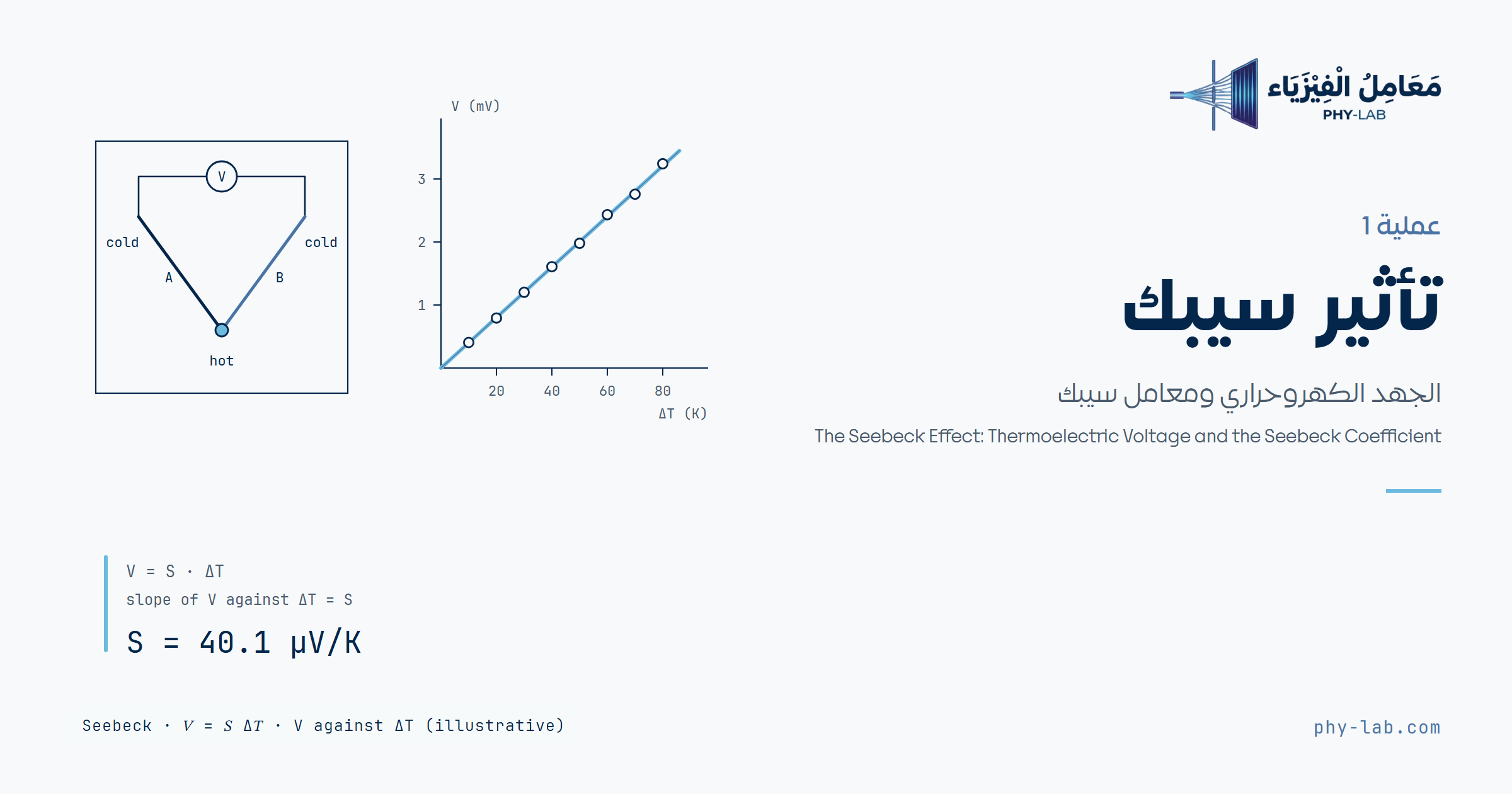
وجد توماس سيبك عام 1821 أن دائرة من معدنين مختلفين تنتج أثراً كهربائياً إذا اختلفت حرارة وصلتيها. فإذا سُخّن طرف سلك، انتشرت حاملات الشحنة داخله من الطرف الساخن إلى البارد، ونشأ بين طرفيه جهد صغير (الشكل 2). وهذا الجهد يختلف من مادة إلى أخرى، فلا يلغي السلكان أحدهما الآخر، ويقرأ الفولتمتر الفرق بينهما. وهو عادة بضعة ملّي فولتات أو أقل.
In 1821 Thomas Seebeck found that a circuit of two dissimilar metals produces an electrical effect when its two junctions are at different temperatures. If one end of a wire is heated, the charge carriers inside it diffuse from the hot end to the cold end, and a small voltage appears between its ends (figure 2). This voltage differs from one material to another, so the two wires do not cancel, and the voltmeter reads their difference. It is usually a few millivolts or less.
والجهد يتناسب مع فرق حرارة الوصلتين:
The voltage is proportional to the temperature difference between the two junctions:
وS هو معامل سيبك، أي الجهد الناتج لكل فرق حرارة مقداره 1 K، ويساوي 1 °C عند الحديث عن الفروق. ويعرّف عند حرارة معينة بالميل:
S is the Seebeck coefficient, the voltage produced per temperature difference of 1 K, which equals 1 °C when speaking of differences. At a given temperature it is defined by the slope:
والفولتمتر لا يقيس معامل سلك واحد، لأن الدائرة تحتاج سلكين. فما نقيسه هو معامل الزوج، وهو الفرق بين معاملي المادتين A وB:
The voltmeter does not measure the coefficient of one wire, because the circuit needs two wires. What we measure is the coefficient of the pair, the difference between the coefficients of materials A and B:
ويعتمد S على نوع المادتين وعلى درجة الحرارة نفسها. لذلك ينحني الخط قليلاً عند اتساع المدى (الشكل 3)، ونكتب:
S depends on the kind of the two materials and on the temperature itself. So the line bends slightly over a wide range (figure 3), and we write:
وتحسب الأداة الميل بمطابقة موزونة تترك للخط جزءاً مقطوعاً a. فالجزء المقطوع يكشف الخطأ الثابت، مثل تأخر مقياس الحرارة عن الوصلة أثناء التسخين، ولا يغير هذا الخطأ الميل ما دام معدل التسخين ثابتاً:
The tool computes the slope by a weighted fit that leaves the line an intercept a. The intercept reveals a fixed error, such as the lag of the thermometer behind the junction during heating, and this error does not change the slope as long as the heating rate is steady:
القيمة المرجعية تُحسب للزوج المختار بين أقل حرارة وأعلى حرارة في القراءات، من جداول المزدوجات القياسية: النوع T للنحاس والكونستنتان، والنوع K للكروم والنيكل.
The reference value is computed for the chosen pair between the lowest and highest temperatures of the readings, from the standard thermocouple tables: type T for copper and constantan, and type K for chrome and nickel.
خطوات التجربةProcedure
- اجدل طرفاً من سلك النحاس أو النيكل مع طرف من السلك الثابت، ثم صِل الطرفين الحرين بالفولتمتر، واضبطه على الملّي فولت.
- سجّل الحرارة الابتدائية Ti عند حرارة الغرفة، وقراءة الجهد المقابلة Vi. ستُطرح هاتان القيمتان من كل القراءات التالية.
- أدخل الطرف المجدول في الكأس المملوءة بالماء، وسخّنها على السخّان.
- سجّل جهد الفولتمتر مع كل زيادة أو نقصان في الحرارة بمقدار 5 °C.
- دوّن النتائج في الجدول.
- ارسم ΔV على المحور الرأسي مع ΔT على المحور الأفقي، واحسب الميل S.
- Twist one end of the copper or nickel wire with one end of the fixed wire, then connect the free ends to the voltmeter, and set it to read in millivolts.
- Record the initial temperature Ti at room temperature, and the corresponding voltage reading Vi. These two values will be subtracted from all the following readings.
- Insert the twisted end into the beaker filled with water, and heat it on the hot plate.
- Record the voltage shown on the voltmeter with each increase or decrease in temperature by 5 °C.
- Enter your results in the table.
- Plot ΔV on the vertical axis against ΔT on the horizontal axis, and calculate the slope S.
المحاكاة التفاعليةInteractive simulation
أدخل الوصلة في الماء، وسجّل القراءة الأولى قبل التسخين، ثم شغّل السخّان. استعمل أزرار الانتظار حتى تزيد الحرارة نحو 5 °C، واضغط «سجّل في الجدول». ويمكنك إطفاء السخّان وتسجيل قراءات التبريد أيضاً.
Insert the junction in the water, and record the first reading before heating, then switch on the hot plate. Use the wait buttons until the temperature rises by about 5 °C, and press “Record in table”. You may also switch off the hot plate and record cooling readings.
النموذج: ماء يسخن بقدرة السخّان ويفقد حرارة إلى الغرفة ويغلي عند ضغط المختبر، ووصلة تتبع الماء أسرع من مقياس الحرارة، وطرفان حران عند حرارة الغرفة، وفولتمتر فيه إزاحة صغيرة. والزمن يتقدم بأزرار الانتظار فقط. المحاكاة نموذج لا قياس.Model: water that heats with the hot plate power, loses heat to the room and boils at the laboratory pressure, a junction that follows the water faster than the thermometer does, free ends at room temperature, and a voltmeter with a small offset. Time advances only with the wait buttons. The simulation is a model, not a measurement.
إدخال البياناتData entry
أدخل Ti وVi، وإذا تركتهما فارغين أخذت الأداة أول صف. ثم أدخل T وV، ويُحسب العمودان الأخيران. واختر الزوج لمقارنة النتيجة بالقيمة المرجعية.
Enter Ti and Vi; if you leave them empty, the tool takes the first row. Then enter T and V, and the last two columns are computed. Choose the pair to compare the result with the reference value.
| رقمNo | T (°C) | V (mV) | ΔT = T − Ti (°C) | ΔV = V − Vi (mV) |
|---|
البيانات الحالية توضيحية من نموذج المحاكاة؛ وليست قياساً.Current data are illustrative, from the simulation model; not a measurement.
لصق بيانات أو تحميل ملف CSVPaste data or load a CSV file
سطر لكل قراءة بالترتيب: T بالدرجة المئوية ثم V بالوحدة المختارة. والسطر الأول هو Ti وVi إذا تُركت خانتاهما فارغتين.
One line per reading in order: T in degrees Celsius then V in the chosen unit. The first line is Ti and Vi if their fields are left empty.
النتائجResults
خطوات الحلSolution steps
التفسيرInterpretation