دراسة توزيع الشدة للنمط المستعرض لشعاع الليزر
Intensity Distribution of the Transverse Mode of a Laser Beam

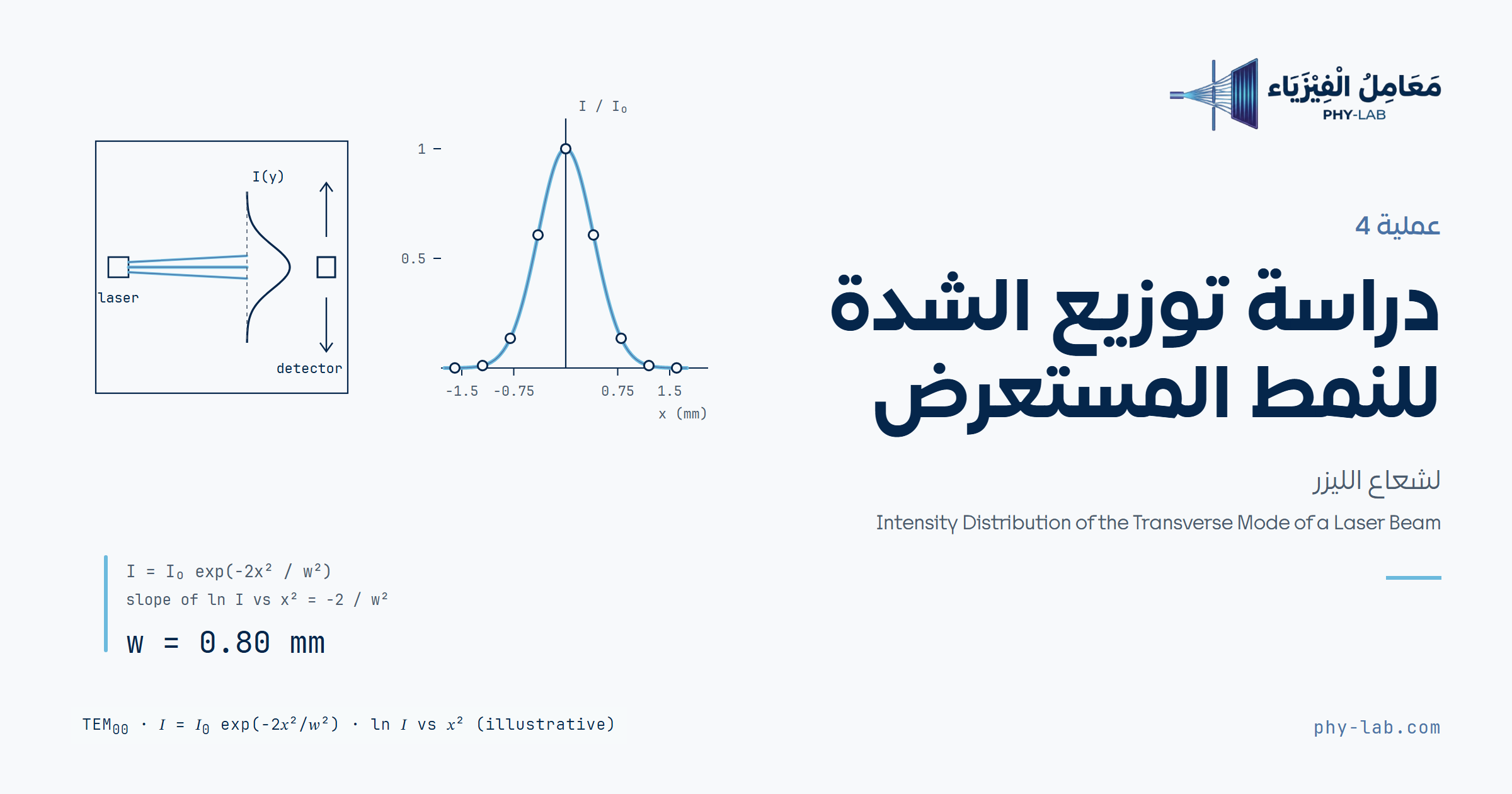
دراسة توزيع الشدة للنمط المستعرض لشعاع الليزرIntensity Distribution of the Transverse Mode of a Laser Beam
حرّك الخلية الضوئية عبر شعاع الليزر بالميكرومتر وسجّل قراءة الفولتميتر، وتحسب الأداة النسبة I/I₀ والبعد عن موضع الشدة العظمى، ثم نصف قطر الشعاع r₀ من الرسم ومن مطابقة المنحنى الغاوسي، مع عدم اليقين وخطوات الحل.Move the photocell across the laser beam with the micrometer and record the voltmeter reading, and the tool computes the ratio I/I₀ and the distance from the maximum, then the beam radius r₀ from the graph and from a Gaussian fit, with the uncertainty and the solution steps.
الهدف والأجهزةObjective and apparatus
- مشاهدة تغير شدة شعاع الليزر مع البعد عن محوره.
- تعيين نصف قطر الشعاع r₀ الذي تنخفض عنده الشدة إلى 1/e² ≈ 13.5% من قيمتها في المركز.
- Observing how the intensity of a laser beam changes with the distance from its axis.
- Determining the beam radius r₀ at which the intensity falls to 1/e² ≈ 13.5% of its value at the centre.
- ليزر هيليوم نيون
- خلية ضوئية أمامها شق ضيق
- ميكرومتر لتحريك الخلية عرضياً
- فولتميتر (ميكروفولتميتر) على وضع DC
- He-Ne laser
- Photocell with a narrow slit in front of it
- Micrometer to move the cell across the beam
- Voltmeter (microvoltmeter) on DC
الأساس النظريTheory
المجال الكهرومغناطيسي داخل تجويف الليزر يستقر في أنماط محددة. في الأنماط المستعرضة يكون المجالان الكهربائي والمغناطيسي عموديين على اتجاه الانتشار، وتسمى TEMpq. العددان الصحيحان p وq هما عدد خطوط الشدة الصفرية (العُقد) في المقطع العرضي للشعاع على المحورين x وy. الشكل 1 يبين مقاطع الشعاع لعدة أنماط. النمط الأساسي TEM₀₀ بقعة واحدة بلا عُقد، وهو نمط أغلب ليزرات الهيليوم نيون التعليمية. أما شكل «الكعكة» فيظهر من تراكب النمطين TEM₁₀ وTEM₀₁، ويُرمز له TEM₀₁*.
The electromagnetic field inside the laser cavity settles into definite modes. In the transverse modes the electric and magnetic fields are perpendicular to the direction of propagation, and they are labelled TEMpq. The integers p and q are the numbers of lines of zero intensity (nodes) in the cross-section of the beam along the x and y axes. Figure 1 shows cross-sections of the beam for several modes. The fundamental mode TEM₀₀ is a single spot with no nodes, and it is the mode of most teaching He-Ne lasers. The “doughnut” shape comes from the superposition of the TEM₁₀ and TEM₀₁ modes and is labelled TEM₀₁*.
الشعاع شديد الاتجاهية، لكن شدته موزعة في المستوى العمودي على اتجاه الانتشار z (الشكل 2). في النمط TEM₀₀ يكون التوزيع غاوسياً:
The beam is highly directional, but its intensity is spread over the plane perpendicular to the propagation direction z (figure 2). In the TEM₀₀ mode the distribution is Gaussian:
حيث I₀ الشدة في المركز (على المحور البصري لليزر)، وr البعد عن المركز، وr₀ البعد الذي تنخفض عنده الشدة إلى 1/e² من قيمتها في المركز:
where I₀ is the intensity at the centre (on the optical axis of the laser), r is the distance from the centre, and r₀ is the distance at which the intensity falls to 1/e² of its value at the centre:
وبأخذ اللوغاريتم تصبح العلاقة خطية في r²، فيُعيَّن r₀ من الميل بكل النقاط معاً لا بنقطتين فقط:
Taking the logarithm makes the relation linear in r², so r₀ is found from the slope using all the points together, not just two:
المعادلة (1) في الدليل مكتوبة I₀e^(−2r/r₀) بلا تربيع، وهذه دالة أسية لا غاوسية. الصحيح r²/r₀²، وبه وحده تتحقق المعادلة (2). والخلية ترى من خلال شق رأسي، فتقيس مجموع الشدة على طول الشق. هذا المجموع يتبع في x المنحنى الغاوسي نفسه وبقيمة r₀ نفسها، لأن التوزيع يُفصل إلى دالة في x مضروبة في دالة في y.
Equation (1) in the manual is written I₀e^(−2r/r₀) without the square, which is an exponential, not a Gaussian. The correct form has r²/r₀², and only with it does equation (2) hold. The cell sees the beam through a vertical slit, so it measures the sum of the intensity along the slit. That sum follows the same Gaussian in x with the same r₀, because the distribution separates into a function of x times a function of y.
خطوات التجربةProcedure
- شغّل الليزر وانظر إلى شاشة المشاهدة.
- ثبّت الخلية الضوئية على الميكرومتر وضعها على بعد نحو ستة أمتار من مصدر الليزر (الشكل 3).
- صِل الخلية بالفولتميتر واختر القراءة DC.
- حرّك الخلية بتدوير الميكرومتر لتعبر شعاع الليزر عرضياً، وسجّل قراءة الفولتميتر واعتبرها شدة الشعاع I.
- خذ القراءات كل 1 mm بدءاً من المنطقة المظلمة.
- توقف عن تحريك الميكرومتر حين تصل إلى المنطقة المظلمة مرة أخرى.
- أوجد الشدة العظمى I₀، ثم احسب النسبة I/I₀ وسجّلها في الجدول.
- اجعل قراءة r المقابلة للشدة العظمى صفراً، واجعل القراءات على يمينها موجبة وعلى يسارها سالبة.
- ارسم المسافات r على المحور الأفقي والنسبة I/I₀ على المحور الرأسي.
- عيّن قيمة r₀ من الرسم.
- Turn on the laser and look at the observation screen.
- Mount the photocell on the micrometer and place it about six metres from the laser source (figure 3).
- Connect the cell to a voltmeter and choose a DC reading.
- Move the photocell by turning the micrometer so that it crosses the laser beam transversely, and record the voltmeter reading as the beam intensity I.
- Take readings at intervals of 1 mm starting from the dark area.
- Stop moving the micrometer once you reach the dark area again.
- Find the maximum intensity I₀, then compute the ratio I/I₀ and record it in the table.
- Make the reading of r at the maximum intensity your zero, with the readings to its right positive and to its left negative.
- Plot the distances r on the x-axis and the ratio I/I₀ on the y-axis.
- From your plot, determine the value of r₀.
الفولتميتر يقرأ شيئاً حتى في الظلام، من ضوء الغرفة ومن تيار الخلية المظلم. لذلك احجب الليزر وسجّل «قراءة الظلام» ثم اطرحها من كل القراءات قبل حساب النسبة. وقرب حافتي الشعاع، حيث تتغير الشدة بسرعة، يفيد أخذ قراءات أدق (كل 0.5 mm).
The voltmeter reads something even in the dark, from room light and the dark current of the cell. So block the laser, record the “dark reading”, and subtract it from all readings before computing the ratio. Near the two edges of the beam, where the intensity changes quickly, finer readings (every 0.5 mm) help.
المحاكاة التفاعليةInteractive simulation
حرّك الخلية بأزرار الميكرومتر أو بالمنزلق، وراقب موضع الشق على بقعة الليزر وقراءة الفولتميتر. ابدأ من المنطقة المظلمة واضغط «سجّل القراءة» كل 1 mm حتى تصل إلى الظلام في الجهة الأخرى. واضغط «قراءة الظلام» لتسجيلها والليزر محجوب. نصف قطر الشعاع وموضع مركزه غير معروضين، والمطلوب تعيينهما. ويمكنك تغيير نمط الليزر لترى أثره في المقطع.
Move the cell with the micrometer buttons or the slider, and watch the position of the slit on the laser spot and the voltmeter reading. Start from the dark area and press “Record reading” every 1 mm until you reach the dark on the other side. Press “Dark reading” to record it with the laser blocked. The beam radius and the position of its centre are not shown; finding them is the task. You can change the laser mode to see its effect on the profile.
النموذج: شعاع ليزر على بعد 6 m، والخلية ترى من خلال شق عرضه 0.3 mm. في القراءة ضجيج صغير، وقراءة ظلام ثابتة من ضوء الغرفة. المحاكاة نموذج لا قياس.Model: a laser beam 6 m away, and the cell sees it through a slit 0.3 mm wide. The reading has a small noise and a constant dark reading from room light. The simulation is a model, not a measurement.
إدخال البياناتData entry
الجدول 1: أدخل الشدة I وقراءة الميكرومتر r، وتُحسب النسبة I/I₀ والبعد عن موضع الشدة العظمى تلقائياً. إن أدخلت قراءة الظلام طُرحت من كل القراءات.
Table 1: enter the intensity I and the micrometer reading r, and the ratio I/I₀ and the distance from the maximum are computed automatically. If you enter the dark reading, it is subtracted from all readings.
| رقمNo. | الشدةIntensity I (mV) | النسبةRatio I/I₀ | القراءةReading r (mm) | البعد عن العظمىFrom max r (mm) |
|---|
البيانات الحالية توضيحية من نموذج المحاكاة: قراءات كل 1 mm عبر شعاع TEM₀₀ مع ضجيج صغير وقراءة ظلام؛ وليست قياساً.Current data are illustrative, from the simulation model: readings every 1 mm across a TEM₀₀ beam with a small noise and a dark reading; not a measurement.
لصق بيانات أو تحميل ملف CSVPaste data or load a CSV file
النتائجResults
خطوات الحلSolution steps
التفسيرInterpretation