تجربة معامل انكسار سائل بطريقة العدسة السائلة
Determination of the refractive index of a liquid using a liquid-lens method

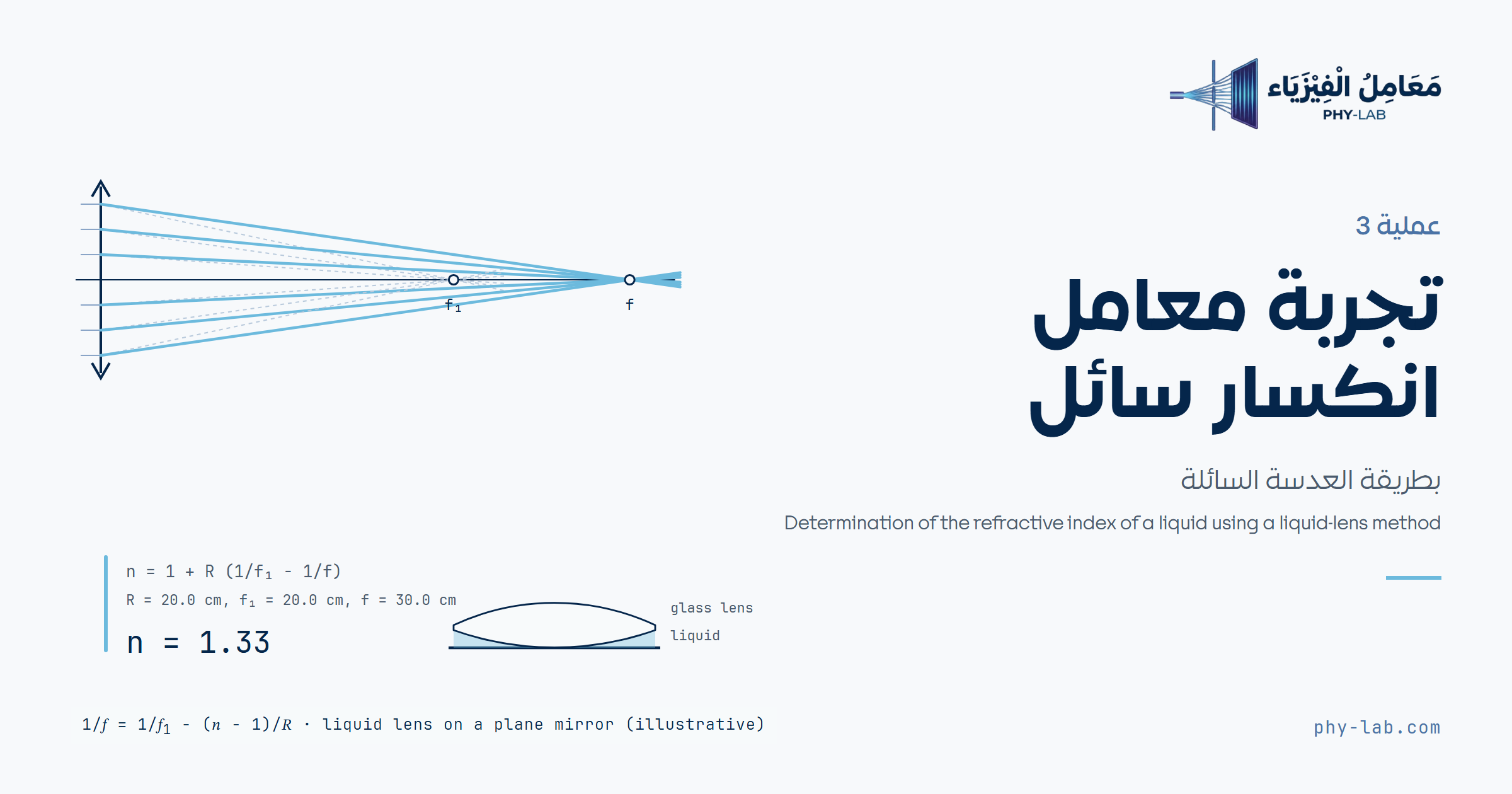
معامل انكسار سائل بطريقة العدسة السائلةRefractive Index of a Liquid by the Liquid-Lens Method
عيّن البعد البؤري للعدسة المحدبة وحدها f₁ ثم مع العدسة السائلة F بطريقة انعدام اختلاف المنظر، وقِس نصف قطر التقوس بالمقياس الكروي، وتحسب الأداة f₂ ومعامل انكسار السائل n مع عدم اليقين وخطوات الحل.Find the focal length of the convex lens alone f₁ and with the liquid lens F by the no-parallax method, measure the radius of curvature with the spherometer, and the tool computes f₂ and the refractive index of the liquid n with its uncertainty and the solution steps.
الهدف والأجهزةObjective and apparatus
تعيين معامل انكسار سائل.
To determine the refractive index of a liquid.
- عدسة محدبة الوجهين (زجاج)
- السائل المراد قياس معامل انكساره
- مرآة مستوية
- حامل بماسك ودبوس، أو جسم مضيء على شكل سهم (شق أمام مصباح)
- مقياس كروي (سفيرومتر)
- مسطرة مترية
- Bi-convex (glass) lens
- The liquid whose refractive index is measured
- Plane mirror
- Retort stand with clamp and pin, or a luminous arrow (a slit placed after a lamp)
- Spherometer
- Metre rule
الأساس النظريTheory
ينتقل الضوء في الفراغ بسرعة ثابتة 3 × 10⁸ m/s، وفي المواد الشفافة بسرعة أقل تعتمد على طبيعة المادة؛ لذلك يتغير اتجاهه عند انتقاله من وسط إلى آخر، وهذا هو الانكسار الذي يحكمه قانون سنل. ومعامل انكسار المادة n هو النسبة بين سرعة الضوء في الفراغ وسرعته في المادة.
Light travels in vacuum at the constant speed 3 × 10⁸ m/s, and in transparent materials at a lower speed that depends on the material; so its direction changes when it passes from one medium to another. This is refraction, governed by Snell’s law. The refractive index of a material n is the ratio of the speed of light in vacuum to its speed in the material.
إذا وُضعت قطرات من سائل بين عدسة محدبة ومرآة مستوية تكوّنت تحت العدسة عدسة سائلة مستوية مقعرة: وجهها العلوي يأخذ تقوس الوجه السفلي للعدسة الزجاجية، ووجهها السفلي مستوٍ على المرآة. فإذا كان البعد البؤري للعدسة الزجاجية f1، وللعدستين معاً F، فإن:
If a few drops of liquid are placed between a convex lens and a plane mirror, a plano-concave liquid lens forms under the lens: its upper face takes the curvature of the lower face of the glass lens, and its lower face is flat on the mirror. If the focal length of the glass lens is f₁ and of the two lenses together F, then:
العدسة السائلة مستوية مقعرة فبعدها البؤري f2 سالب، ولذلك يكون F أكبر من f1، ونأخذ القيمة المطلقة. ويرتبط f2 بنصف قطر تقوس الوجه المقعر r ومعامل انكسار السائل nl بمعادلة صانع العدسات (والوجه الآخر مستوٍ، نصف قطره لانهائي):
The liquid lens is plano-concave, so its focal length f₂ is negative; therefore F is larger than f₁, and we take the absolute value. f₂ is related to the radius of curvature of the concave face r and the refractive index of the liquid nₗ by the lens-maker’s equation (the other face is flat, with infinite radius):
حيث f2 وr سالبان معاً، فالنسبة بينهما موجبة. ويُقاس r بالمقياس الكروي: إذا كانت المسافة بين أي رجلين من أرجله الثلاث l، وارتفاع الرجل الوسطى عن مستوى الأرجل الثلاث على سطح العدسة h، فإن:
where f₂ and r are both negative, so their ratio is positive. r is measured with the spherometer: if the distance between any two of its three legs is l, and the height of the central leg above the plane of the three legs on the lens surface is h, then:
قيم مرجعية عند 20 °C وضوء الصوديوم: الماء 1.333، والجلسرين 1.473.
Reference values at 20 °C in sodium light: water 1.333, glycerine 1.473.
خطوات التجربةProcedure
- قِس نصف قطر تقوس سطح العدسة محدبة الوجهين بالمقياس الكروي (الوجه الذي سيلامس السائل)، وسجّل l وh في الجزء (أ).
- ضع المرآة على المقعد، والعدسة المحدبة فوقها، وثبّت الجسم (سهم مضيء أو دبوس) في ماسك الحامل بحيث يكون رأس السهم فوق منتصف العدسة.
- حرّك الجسم تدريجياً إلى أعلى؛ ستصغر صورته كلما ارتفع.
- حرّك رأسك يميناً ويساراً لترى هل رأس السهم وصورته في الموضع نفسه، أي هل وصل رأس السهم إلى البؤرة. عند انعدام اختلاف المنظر ثبّت لولب الماسك على الحامل.
- قِس بالمسطرة المترية المسافة من رأس السهم إلى سطح العدسة؛ هذه f1. كرّر الضبط والقياس عدة مرات.
- ارفع العدسة، وضع قطرات من السائل على المرآة، ثم أعد العدسة فوقها فتتكوّن العدسة السائلة.
- كرّر الخطوات 3 إلى 5 لإيجاد البعد البؤري للعدستين معاً F.
- احسب f2 من المعادلة (1)، وr من (3)، ثم nl من (2).
- Measure the radius of curvature of the surface of the bi-convex lens with the spherometer (the face that will touch the liquid), and record l and h in section A.
- Place the mirror on the bench and the convex lens on it, and clamp the object (a luminous arrow or a pin) on the stand so that the head of the arrow is over the middle of the lens.
- Move the object gradually upward; its image gets smaller as it rises.
- Move your head left and right to see whether the arrowhead and its image are at the same position, i.e. whether the arrowhead has reached the focus. At no parallax, tighten the clamp screw on the stand.
- Measure with the metre rule the distance from the arrowhead to the lens surface; this is f₁. Repeat the adjustment and measurement several times.
- Lift the lens, put a few drops of the liquid on the mirror, then put the lens back on it to form the liquid lens.
- Repeat steps 3 to 5 to find the focal length of the two lenses together F.
- Compute f₂ from equation (1), r from (3), then nₗ from (2).
قاعدة اختلاف المنظر: ما يتحرك مع حركة رأسك هو الأبعد عن عينك. إذا كانت الصورة أبعد من السهم (تتحرك مع رأسك) فالسهم فوق البؤرة فأنزله، وإذا كانت أقرب (تتحرك عكس رأسك) فارفعه. لا تضع سائلاً أكثر من بضع قطرات، وامسح المرآة والعدسة بعد التجربة.
Parallax rule: whatever moves with your head is the farther from your eye. If the image is farther than the arrow (moves with your head), the arrow is above the focus, so lower it; if it is nearer (moves against your head), raise it. Use only a few drops of liquid, and wipe the mirror and lens after the experiment.
المحاكاة التفاعليةInteractive simulation
ارفع السهم أو أنزله حتى ينطبق رأسه على صورته في نافذة العين، وحرّك العين يميناً ويساراً للتأكد من انعدام اختلاف المنظر، ثم سجّل المسافة. تذهب القراءة إلى عمود f1 بلا سائل، وإلى عمود F مع السائل. خصائص عدسة المحاكاة والسائل المجهول غير معروضة، والمطلوب تعيينها.
Raise or lower the arrow until its head coincides with its image in the eye window, move the eye left and right to check for no parallax, then record the distance. The reading goes to the f₁ column without liquid, and to the F column with liquid. The properties of the simulated lens and the unknown liquid are not shown; finding them is the task.
النموذج: عدسة رقيقة فوق مرآة، فالضوء يعبر العدسة مرتين وتعمل المجموعة كمرآة بعدها البؤري نصف البعد البؤري للعدسة؛ والصورة تنطبق على الجسم حين يكون في بؤرة العدسة. نافذة العين تعرض موضعي الرأس والصورة كما تراهما عين على ارتفاع 130 cm. المحاكاة نموذج لا قياس.Model: a thin lens on a mirror, so the light crosses the lens twice and the set acts as a mirror of half the lens focal length; the image coincides with the object when the object is at the lens focus. The eye window shows the head and image as seen by an eye 130 cm high. The simulation is a model, not a measurement.
إدخال البياناتData entry
(أ) المقياس الكروي(A) Spherometer
(ب) البعدان البؤريان(B) Focal lengths
| المحاولةTrial | f1 (cm) العدسة وحدهاlens alone | F (cm) مع السائلwith liquid |
|---|
البيانات الحالية توضيحية من نموذج المحاكاة: عدسة زجاجية n = 1.517 بنصفي قطر 30.0 cm وسائل هو الماء، مع خطأ عشوائي في ضبط انعدام اختلاف المنظر حتى ±0.4 cm؛ وليست قياساً.Current data are illustrative, from the simulation model: a glass lens n = 1.517 with radii 30.0 cm and water as the liquid, with a random no-parallax setting error up to ±0.4 cm; not a measurement.
لصق بيانات أو تحميل ملف CSVPaste data or load a CSV file
النتائجResults
خطوات الحلSolution steps
التفسيرInterpretation