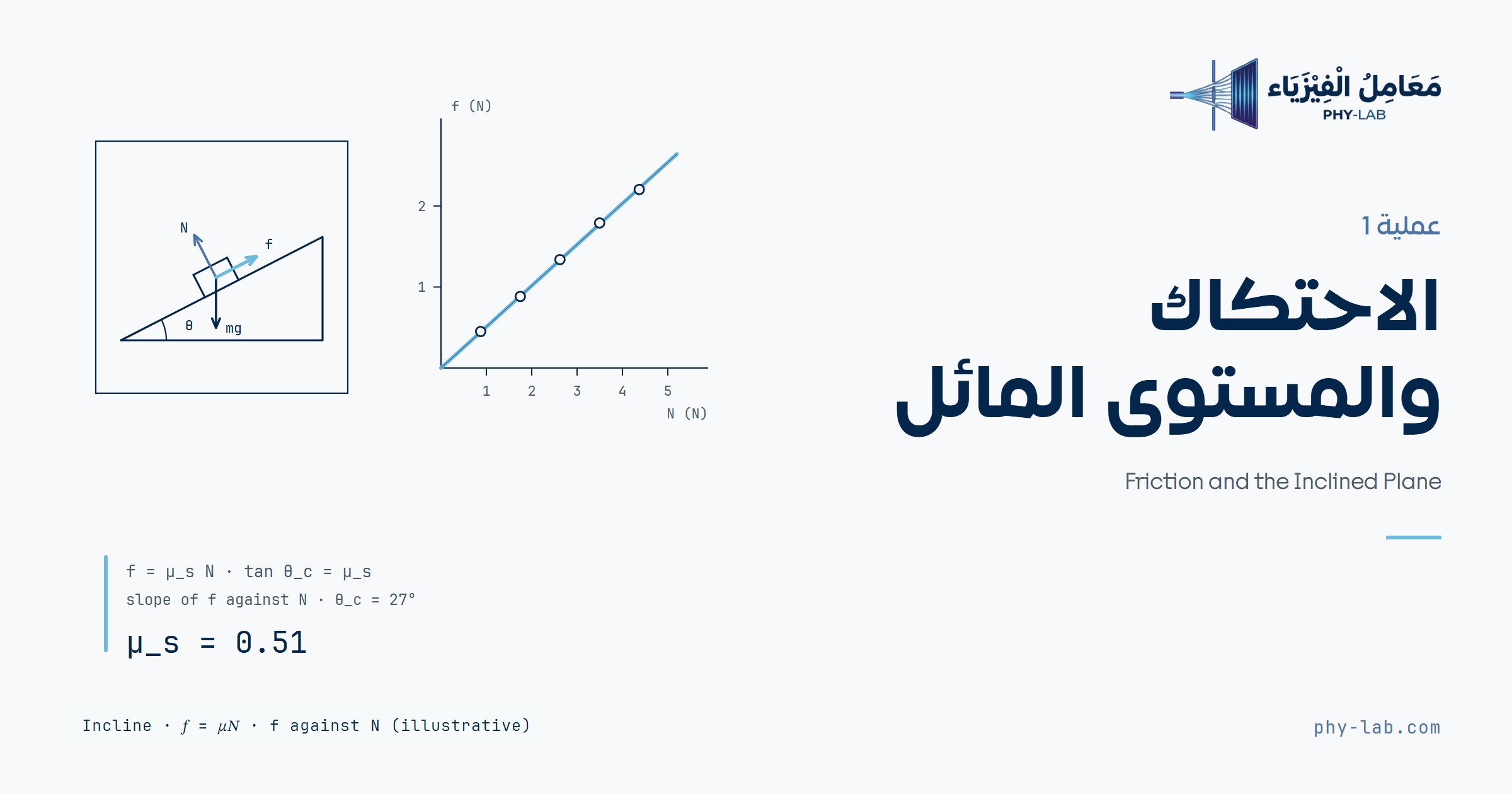
الاحتكاك والمستوى المائل
Friction and the inclined plane

الاحتكاك والمستوى المائلFriction and the Inclined Plane
زد الأثقال حتى يبدأ القالب بالحركة، ثم اضبطها حتى ينزلق بسرعة ثابتة. تحسب الأداة معاملَي الاحتكاك السكوني والحركي مع عدم اليقين، وتقارن تفرق القراءات بالخطأ المحسوب، وتكشف الخطأ المنتظم واعتماد المعامل على الوزن.Load the hanger until the block starts to move, then adjust it until the block slides at constant velocity. The tool computes the coefficients of static and kinetic friction with their uncertainties, compares the scatter of the readings with the calculated error, and reveals systematic error and any dependence of the coefficient on the weight.
الهدف والأجهزةObjective and apparatus
قياس معامل الاحتكاك لعدة أزواج من المواد باستعمال المستوى المائل.
To measure the coefficient of friction for several combinations of materials, making use of an inclined plane.
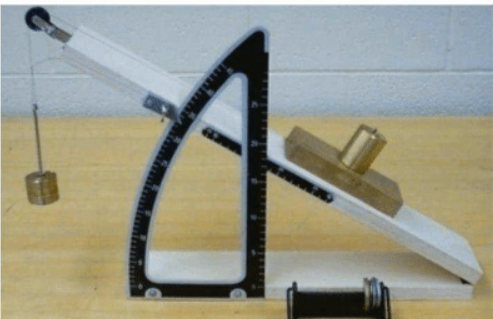
- مستوى مائل ببكرة ومقياس زاوية
- قالب خشبي
- عربة صغيرة بعجلات
- حامل أثقال
- مجموعة أثقال مشقوقة
- مؤقت
- مسطرة مترية
- Inclined plane with a pulley and an angle scale
- Wooden block
- Small cart with wheels
- Weight hanger
- Set of slotted weights
- Clock timer
- Meter stick
نظرية التجربةTheory
تقاوم قوة الاحتكاك انزلاق سطح على سطح آخر. فإذا كان الجسم ساكناً، زادت قوة الاحتكاك السكوني مع القوة المؤثرة حتى تبلغ قيمتها العظمى:
The force of friction opposes the sliding of one surface over another. If the body is at rest, static friction grows with the applied force until it reaches its maximum value:
وبعد بدء الانزلاق تصبح قوة الاحتكاك الحركي:
Once sliding has begun, the force of kinetic friction is:
حيث μs وμk ثابتا تناسب يسميان معامل الاحتكاك السكوني ومعامل الاحتكاك الحركي. ويبين الشكل 2 القوى المؤثرة في جسم على مستوى مائل: W وزن الجسم (W = mg)، وN القوة العمودية من المستوى، وf قوة الاحتكاك، وP القوة التي يسحب بها الخيط الجسم إلى أعلى المستوى. ونحلل القوى إلى مركبات موازية للمستوى وعمودية عليه، فتكون مركبتا الوزن:
Here μs and μk are proportionality constants, called the coefficient of static friction and the coefficient of kinetic friction. Figure 2 shows the forces on a body on an inclined plane: W is the weight of the body (W = mg), N is the normal force from the plane, f is the frictional force, and P is the force with which the string pulls the body up the plane. We resolve the forces into components parallel and perpendicular to the plane, so the components of the weight are:
وعند بدء الحركة إلى أعلى المستوى، أو عند الحركة بسرعة ثابتة، تتزن القوى فيكون:
When motion up the plane is about to start, or at constant velocity, the forces balance, so:
ومنه نجد معامل الاحتكاك، سكونياً كان أو حركياً:
From this we find the coefficient of friction, static or kinetic:
وعلى المستوى الأفقي (θ = 0) تصبح μ = P/W. أما P فهو وزن كل ما يتدلى من الخيط: P = (mhanger + mweights) g، فكتلة الحامل جزء منه.
ونظرياً يجب أن يكون كل معامل ثابتاً، غير أن القيم التجريبية تتفاوت. ولمعرفة سبب التفاوت نحسب الخطأ المحتمل في كل قيمة بقواعد انتشار الخطأ:
On a level plane (θ = 0) this becomes μ = P/W. Here P is the weight of all that hangs from the string: P = (mhanger + mweights) g, so the mass of the hanger is part of it.
Theory predicts that each coefficient should be constant, yet experimental values vary. To find the reason for the variation, we calculate the probable error of each value by the rules of error propagation:
وδθ هنا بالراديان. ثم نقارن δμ بمتوسط انحراف القيم عن متوسطها: فإن زاد متوسط الانحراف على الخطأ المحتمل، فالأرجح وجود خطأ منتظم. وأكبر مصدر للخطأ غالباً هو الفرق P − W sinθ، لأن طرح عددين متقاربين يكبّر الخطأ النسبي.
ومن أسباب الخطأ المنتظم احتكاك البكرة: فهو قوة f0 تضاف إلى ما يجب أن يتغلب عليه الخيط، فيصير:
Here δθ is in radians. We then compare δμ with the average deviation of the values from their mean: if the average deviation is greater than the probable error, a systematic error is probably present. The largest source of error is usually the difference P − W sinθ, since subtracting two close numbers magnifies the relative error.
One cause of systematic error is friction in the pulley: it is a force f0 on top of what the string must overcome, so that:
فرسم P − W sinθ مع N خط مستقيم ميله μ ومقطعه f0، ولا يتأثر ميله بهذه القوة الثابتة. أما القيمة المحسوبة من المعادلة (5) فتزيد بمقدار f0/N، فتبدو μ أكبر مع الأوزان الصغيرة.
وإذا تُرك القالب حراً بلا خيط، فزاوية الانزلاق المنتظم هي الزاوية التي ينزلق عندها بسرعة ثابتة، وزاوية بدء الانزلاق هي التي يبدأ عندها بالحركة:
So a plot of P − W sinθ against N is a straight line with slope μ and intercept f0, and its slope is not affected by this constant force. The value from equation (5), however, is too large by f0/N, so μ seems larger for small weights.
If the block is left free without a string, the angle of uniform slip is the angle at which it slides at constant velocity, and the starting angle is the one at which it begins to move:
طريقة العملProcedure
1. احتكاك بدء الحركة على المستوى الأفقي1. Starting friction on the level plane
- ضع القالب الخشبي على المستوى ووجهه الكبير إلى الأسفل.
- أثّر فيه بقوة P بخيط يمر على البكرة إلى حامل الأثقال.
- زد الأثقال على الحامل حتى يبدأ القالب بالحركة، فتعرف القيمة التقريبية لاحتكاك البدء.
- حدد القيمة بدقة أكبر: ابدأ من أقل منها بقليل، وزد الأثقال بزيادات صغيرة جداً.
- قدّر الخطأ بأصغر زيادة تُحدث الحركة.
- ضع 100 g ثم 200 g على القالب، وكرر القياس.
- Lay the wooden block on the plane with its large face down.
- Apply a force P to it by a string running over the pulley to the weight hanger.
- Add to the hanger until the block begins to move, which gives the approximate value of starting friction.
- Determine the value more accurately: start just below it, and increase the load in very small increments.
- Estimate the error from the smallest increment that produces motion.
- Place 100 g and then 200 g on the block, and repeat.
2. احتكاك الانزلاق على المستوى الأفقي2. Sliding friction on the level plane
- بالأحمال نفسها، ادفع القالب دفعة تتغلب على احتكاك البدء.
- أنقص الأثقال عن الحامل حتى ينزلق القالب بسرعة ثابتة تقريباً. وللحكم على ثبات السرعة قس بالمؤقت زمن قطع مسافتين متساويتين حددتهما بالمسطرة.
- حدد بعناية عدم اليقين في P الناتج عن صعوبة الحكم على ثبات السرعة.
- نظف المستوى بالمنظف عند الحاجة، ولا تلمسه بيديك، لأن زيت الجلد يترك بقعاً زلقة.
- With the same loads, give the block a push to overcome starting friction.
- Remove weights from the hanger until the block slides with nearly constant velocity. To judge this, time the block with the clock over two equal distances set with the meter stick.
- Determine carefully the uncertainty in P due to the difficulty of judging constant velocity.
- Clean the plane with detergent if necessary, and do not touch it with your hands, as body oil causes slick spots.
3. على المستوى المائل3. On the inclined plane
- ارفع المستوى إلى زاوية θ، وكرر الخطوتين 1 و2، واستعمل المعادلة (5).
- كرر القياس بالعربة ذات العجلات، وبأسطح أخرى للقالب.
- فك الخيط، وارفع المستوى تدريجياً حتى يبدأ القالب بالانزلاق، فهذه θs. ثم جد الزاوية التي ينزلق عندها بسرعة ثابتة بعد دفعة خفيفة، فهذه θk.
- Raise the plane to an angle θ, repeat parts 1 and 2, and use equation (5).
- Repeat with the cart on wheels, and with other surfaces of the block.
- Remove the string, and raise the plane slowly until the block starts to slide: this is θs. Then find the angle at which it slides at constant velocity after a light push: this is θk.
تحليل البياناتData analysis
- احسب W وP وμ لكل صف من المعادلة (5).
- احسب الخطأ المحتمل من المعادلة (6)، وتحقق من أن الفرق P − W sinθ هو أكبر مصادر الخطأ.
- قارن الخطأ المحتمل بمتوسط انحراف قيم μ: هل التفاوت عشوائي، أم فيه خطأ منتظم؟
- افحص تغير μ: هل يعتمد على كمية أخرى من بياناتك؟ وإن كان، فارسم هذا الاعتماد مع وضع شريط الخطأ لكل قيمة.
- هل لهذا الاعتماد صيغة معينة؟ وهل تجد له سبباً فيزيائياً؟
- Calculate W, P and μ for each row from equation (5).
- Calculate the probable error from equation (6), and verify that the difference P − W sinθ is the largest source of error.
- Compare the probable error with the average deviation of the values of μ: is the variation random, or is there a systematic error?
- Inspect the variation in μ: does it depend on any other quantity in your data? If so, graph this dependence, with an error flag on each value.
- Is this dependence of any form? Can you suggest a physical reason for it?
أخطاء شائعةCommon errors
- نسيان كتلة الحامل: تخرج P ناقصة، ويصبح مقطع الخط سالباً.
- زيادات كبيرة: إذا زيدت الأثقال بخطوات كبيرة قرب البدء، كبر الخطأ في P.
- لمس المستوى: البقع الدهنية تخفض الاحتكاك في مواضع دون أخرى، فيزيد تفرق القراءات.
- سرعة غير ثابتة: إذا كان الزمن الثاني أقل من الأول فالقالب يتسارع، وإذا كان أكبر فهو يتباطأ.
- إهمال احتكاك البكرة: تبدو μ أكبر مع الأوزان الصغيرة.
- Forgetting the hanger: P comes out too small, and the intercept of the line turns negative.
- Large increments: if the load is raised in large steps near the start, the error in P grows.
- Touching the plane: oily spots lower the friction in some places and not in others, so the scatter of the readings grows.
- Velocity not constant: if the second time is shorter than the first the block is speeding up, and if it is longer the block is slowing down.
- Ignoring pulley friction: μ seems larger for small weights.
المحاكاة التفاعليةInteractive simulation
في قياس «بدء الحركة» زد الكتلة المعلقة حتى يتحرك القالب، ثم اضغط «أعد القالب»، وأنقص قليلاً، واقترب بزيادات صغيرة، واضغط «سجّل القراءة» بعد الحركة. وفي قياس «سرعة ثابتة» اضغط «ادفع القالب» واقرأ الزمنين t1 وt2 لمسافتين متساويتين 20 cm، واضبط الكتلة حتى يتساويا تقريباً، ثم سجّل. وعند فك الخيط تغيّر الزاوية بدل الكتلة، وتذهب القراءة إلى جدول زوايا الانزلاق.
In the “Start of motion” measurement, raise the hanging mass until the block moves, then press “Reset block”, lower the mass a little, approach in small steps, and press “Record reading” after it moves. In the “Constant velocity” measurement, press “Push block” and read the times t1 and t2 over two equal distances of 20 cm, adjust the mass until they are nearly equal, then record. With the string removed you change the angle instead of the mass, and the reading goes to the table of slip angles.
الكتلة المعلقةHanging mass
زاوية المستوىAngle of the plane
النموذج: احتكاك سكوني يتغير قليلاً من محاولة إلى أخرى، واحتكاك حركي يتغير قليلاً على طول المستوى، وبكرة لها احتكاك، ودفعة يدوية غير متكررة تماماً. والكتلة والزاوية والزمنان هي ما يُقرأ فقط. المحاكاة نموذج لا قياس.Model: static friction that varies a little from trial to trial, kinetic friction that varies a little along the plane, a pulley with friction, and a hand push that is never exactly repeated. Only the mass, the angle and the two times can be read. The simulation is a model, not a measurement.
إدخال البياناتData entry
كل صف قراءة لحمل وزاوية: M كتلة القالب مع حمله، وms الكتلة المعلقة كلها، ومعها الحامل، عند بدء الحركة، وmk الكتلة المعلقة عند السرعة الثابتة. ويكفي أحد القياسين. وعمود S رقم السطح: 1 خشب، 2 لباد، 3 مطاط، 4 عربة، وإن تُرك فارغاً عُدّ 1. وإن تُركت خانة δm فارغة استُعملت قيمتها العامة أدناه.
Each row is a reading for one load and angle: M is the mass of the block with its load, ms is the whole hanging mass, hanger included, at the start of motion, and mk is the hanging mass at constant velocity. Either measurement is enough. Column S is the surface number: 1 wood, 2 felt, 3 rubber, 4 cart, and an empty cell counts as 1. If a δm cell is left empty, its general value below is used.
| رقمNo | S | M (g) | θ (°) | ms (g) | δms | mk (g) | δmk |
|---|
زوايا الانزلاق بلا خيط (اختياري)Slip angles without a string (optional)
| السطحSurface | زاوية بدء الانزلاقStarting angle θs (°) | زاوية الانزلاق المنتظمUniform slip angle θk (°) |
|---|---|---|
| خشبWood | ||
| لبادFelt | ||
| مطاطRubber | ||
| عربةCart |
البيانات الحالية توضيحية من نموذج المحاكاة؛ وليست قياساً.Current data are illustrative, from the simulation model; not a measurement.
لصق بيانات أو تحميل ملف CSVPaste data or load a CSV file
سطر لكل صف بالترتيب: S وM وθ وms وδms وmk وδmk، تفصل بينها فواصل. واترك مكان القياس غير المأخوذ فارغاً بين الفواصل.
One line per row in order: S, M, θ, ms, δms, mk and δmk, separated by commas. Leave the place of a measurement not taken empty between the commas.
النتائجResults
| صفRow | W (N) | Ps (N) | μs | Pk (N) | μk |
|---|
| السطحSurface | المعاملCoeff. | المتوسطMean | متوسط الانحرافAvg dev. | δμ | ميل الخطLine slope | f0 (N) |
|---|
خطوات الحلSolution steps
التفسيرInterpretation
أسئلة المناقشةQuestions
- هل يكون معامل احتكاك سيارة بثلاث عجلات أقل منه لسيارة بأربع عجلات، إذا تساوى وزناهما وتماثلت العجلات؟ احسب نسبة قيمتَي معامل الاحتكاك في الحالتين.
- تأمل البكرة في أعلى المستوى. كيف يعتمد الاحتكاك فيها على الشد في الخيط وعلى زاوية المستوى؟ اذكر افتراضاتك بوضوح، واشتق معادلة احتكاك البكرة.
- زاوية الانزلاق المنتظم هي زاوية المستوى التي تجعل القالب الحر ينزلق إلى أسفل بسرعة ثابتة. بيّن أن هذه الزاوية تعطى بالعلاقة tanθ = μk، حيث μk معامل الاحتكاك الحركي.
- Would the coefficient of friction of a 3-wheeled car be less than that of a 4-wheeled car, assuming the cars weighed the same and the wheels were the same? Calculate the ratio of the values of the friction coefficient in the two cases.
- Consider the pulley at the top of the plane. How does the friction in the pulley depend on the tension in the string and the angle of the plane? State your assumptions clearly, and derive the equation for the pulley friction.
- The angle of uniform slip is that angle of the plane which causes the free block to slide down the plane with constant velocity. Show that this angle is given by tanθ = μk, where μk is the coefficient of kinetic friction.