

Specific heat capacity of a solid

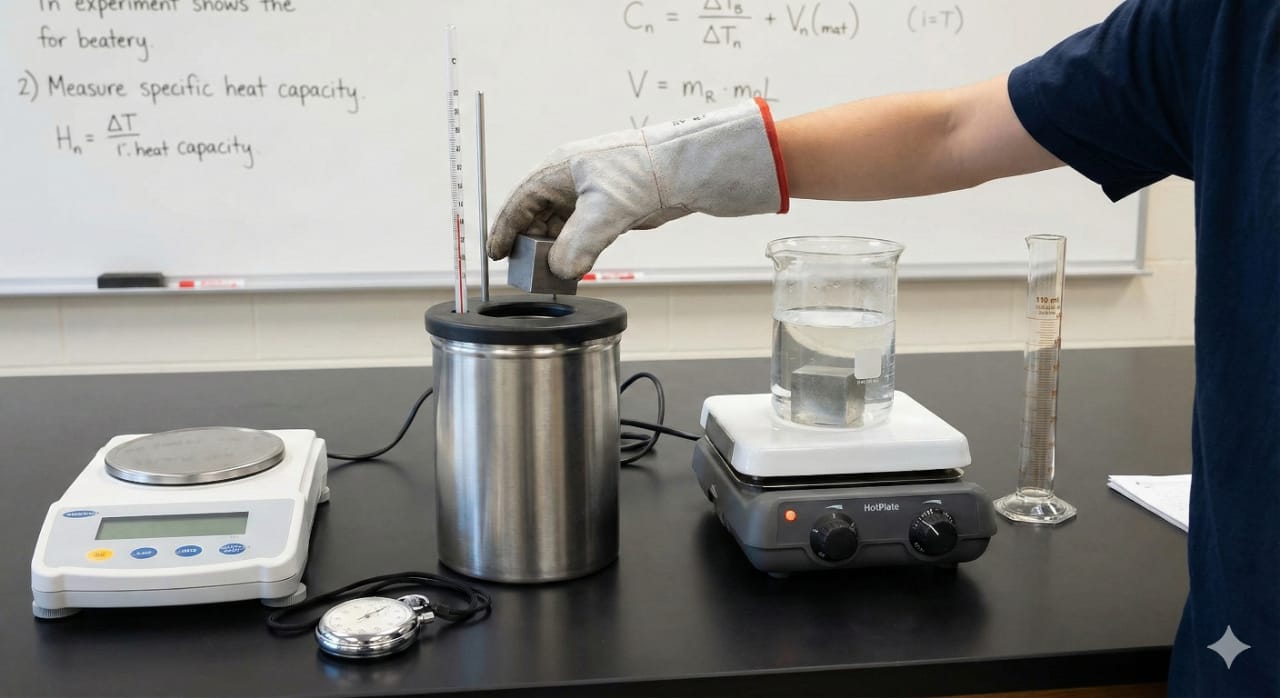
Objective
To determine the specific heat capacity of a solid body
Apparatus
Materials for the heat-capacity / calorimetry experiment.
- TThermometerDigital or mercury; range suitable for experiment
- SSolid blockMetal sample (test specimen)
- AAluminum or CopperChoose one for specific-heat comparison
- CCalorimeterInsulated container (simple foam or commercial)
- BTriple beam balanceFor measuring mass of block and water
- HElectric stove / hot plateTo heat the metal block safely
- EBeakerLarge enough to hold water used in calorimeter
- TThreadTo suspend the metal block in water
- WWaterDeionized or tap as appropriate; record initial temperature
Theory
When heat energy is supplied to a system one of the following things may happen:- International energy may increase and appear in the form of
- Translational kinetic energy of the molecules, which is indicated by an increase in temperature.
- Rotational energy of the molecules.
- Vibrational energy of the molecules, which is indicated by expansion of the body.
- Electronic excitations, which may result in the ionization of the atom.
The system may indicate a chemical reaction, thereby changing the chemical potential of the system. And the system may accelerate, thereby changing its kinetic energy or potential energy i.e., the mechanical energy. When a new area of physics is being investigated, units are defined in terms of experimental procedures. These units may latter have to be related to more general units, or it may even be desirable to replace the tentative units by those of more general applicable. Heat was originally measured by noting the rise in temperature of a measured quantity of water which absorbed heat. The calorie was defined as the quantity of water that absorbed heat. The calorie was defined as the quantity of heat required to raise the temperature of one gram of water through one degree Celsius from 14.5 C to 15.5 C
Heat, in science, is defined as the energy which is transferred from a body at a higher temperature to one at a lower temperature by measured in joules. Refined version of experiment, especially those performed by joules, established the number of units of work equivalent to one unit of heat, and called the mechanical equivalent of heat. So, the unit is defined by international agreement as 1 cal=4.1605J

The internal energy of a body may be may be changed in two ways: by doing work or by transferring heat. Work and heat are both connected with energy in the process of transfer and when the transfer is over, neither term is relevant. The heat required to raise the temperature of a body by one degree is what we called the heat capacity C of that body. It is expressed in joule per Kelvin (J/K) or joule per centigrade degree (J/C). Materials differ from one another in the quantity of heat needed to produce a certain rise of temperature. It is the heat Q required to rise the temperature of a mass M of a material through 1 degree called the heat capacity per unit mass of the substance. Then C is defined by the equation
C = ΔQ / (M ΔT)Then, the heat ΔQ or simply Q gained (or lost) by an object is given by Q=CMΔT
Where M is the mass of the object, C its specific heat capacity and ΔT its temperature change. Once the transfer of energy occurred, the system is said to have undergone a changed in internal energy. Suppose an isolated system constitutes two bodies, body A and B. If body A absorb heat Q internal energy or the body is ΔU=Q-W
This equation is known as the first law of thermodynamics. Similarly, if the amount of heat extracted from B is Q, and the amount of work done on B is W, than the change in the internal energy of B is ΔU
U=W A
Since energy is neither created not destroyed within a process. the total energy of isolated system must remain constant. That is the change in the isolated internal energy of the isolated system ΔU+ΔW should zero. Hence 0=ΔQ , Q i =Q
This means the heat lost by B is equal to heat gained by A. So, our important law for the analysis of mixture method is obtained; Heat lost = Heat gained This law is general true for number of bodies provided that all the heat transferred to or from each body is taken into account
Procedure
- Measure the mass of the metal block (Ms).
- Measure the mass of the empty calorimeter (Mc).
- Half-fill the calorimeter with cold water and weigh it again (M).
- Record the initial temperature of the cold water and calorimeter (T0).
- Heat some water to its boiling point in a beaker.
- Using a thread, suspend the solid block in the boiling water and leave it for about five minutes.
- Record the temperature of the boiling water (T).
- Quickly transfer the hot solid into the calorimeter.
Carefully, but quickly, stir the water with the calorimeter and read the highest temperature reached, (Tf)
Data and analysis
| Quantity | Value |
|---|---|
| Mass of solid block (Ms) | __________________________________________ |
| Mass of calorimeter (Mc) | __________________________________________ |
| Mass of calorimeter + cold water (M) | __________________________________________ |
| Mass of cold water (Mw) | __________________________________________ |
| Temperature of calorimeter and cold water (T0) | __________________________________________ |
| Temperature of boiling water (T) | __________________________________________ |
| Final temperature (Tf) | __________________________________________ |
Given:
- Specific heat capacity of water = 4200 J·kg⁻¹·K⁻¹
- Specific heat capacity of Aluminum calorimeter = 910 J·kg⁻¹·K⁻¹
- Specific heat capacity of Copper calorimeter = 390 J·kg⁻¹·K⁻¹
To Calculate:
Specific heat capacity of the solid block (cs)
Formula:
When a hot solid is placed in the calorimeter with cold water, heat lost by solid equals heat gained by (calorimeter + water):
Ms · cs · (T − Tf) = Mw · 4200 · (Tf − T0) + Mc · cc · (Tf − T0)
Where:
- Ms = mass of solid block
- Mw = mass of water
- Mc = mass of calorimeter
- cc = specific heat of calorimeter (use 910 if aluminum, 390 if copper)
- T = temperature of boiling water
- T0 = initial temperature of water + calorimeter
- Tf = final equilibrium temperature
Final Rearranged Formula to Find the Solid’s Specific Heat Capacity:
cs = [ Mw·4200·(Tf − T0) + Mc·cc·(Tf − T0) ] ÷ [ Ms·(T − Tf) ]
Question
Write down the overall expression to determine the required value.
Using the values of the specific heat capacity of water and calorimeter given calculate the specific heat capacity C of the solid
Estimate the type of substance the block is made of?
List all possible sources of error.