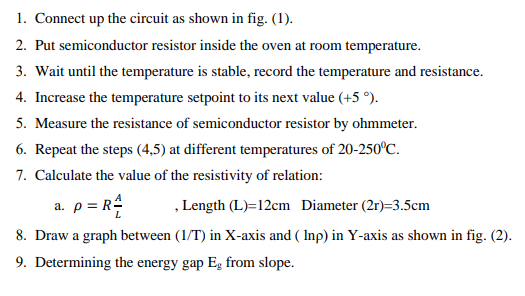

Measuring the Temperature Dependency of a Semiconductor Resistor


Objectives
Determining the resistance R of a semiconductor as a function of temperature T
Determining the ” band gap “
Theory
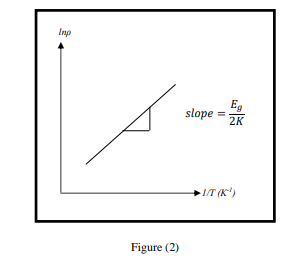
At absolute zero all electrons of insulators and semiconductors are on valence band. Higher conducting band is empty and therefore charges don’t move. Between valence band and conducting band there is an energy gap (Si: 1.12 eV, Ge: 0.67 eV). To cross this gap, electrons need energy. This is the reason why the resistance of semiconductors depends on temperature. Insulators have so broad energy gap (several eV:s) that electrons can’t get into conducting band at room temperature. Furthermore,the valence band of insulators is full, so electrons can’t move there either. Conductors have partially filled valence band and thus electrons can move regardless temperature. At the temperature scale used in this measurement (20 −250˚C ) the resistivity of a semiconductor, ρ (the inverse number of conductivity) abides relation:
𝑙𝑛𝜌 = 𝑙𝑛𝜌0 + 𝐸𝑔/2𝐾𝑇
where: Eg is the energy gap, k is the Boltzmann constant (8.625X10⁻⁵ eV. K-1) and
T is temperature (in Kelvins).
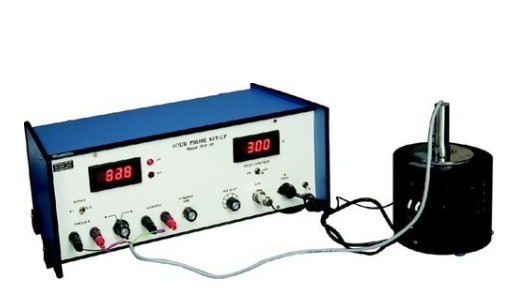
Apparatus
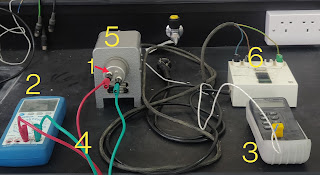

Circuit Diagram

Procedure