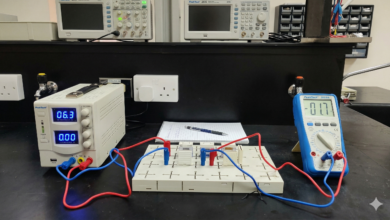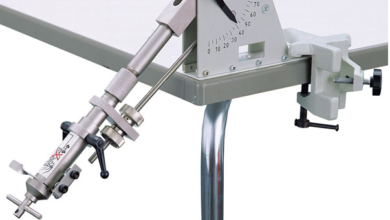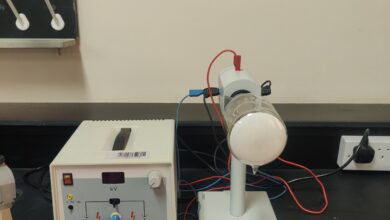


Experiment Objectives
- To study the hysteresis behavior of a ferromagnetic material.
- To obtain the B–H curve (hysteresis loop) of the given ferromagnetic specimen.
- To determine key magnetic parameters:
- Coercivity (Hc)
- Remanence (Br)
- Saturation magnetization (Bs)
- Energy loss per cycle
Apparatus / Components Required
- Ferromagnetic core (toroidal or rod-shaped).
- Primary coil (excitation winding) with known number of turns (Np).
- Secondary coil (sensing winding) with known number of turns (Ns).
- Signal generator / AC source (low frequency, e.g., 50–200 Hz).
- Shunt resistor (Rshunt) for current measurement.
- RC Integrator circuit (resistor and capacitor).
- Dual-channel CRO or Digital Storage Oscilloscope with X–Y mode.
- Connecting wires, resistors, capacitors.


Theory
When an alternating current flows through the primary coil, a magnetizing field H is produced inside the ferromagnetic core:
H = (Np · I) / lm
The magnetic flux density B inside the core is related to the induced emf in the secondary coil according to Faraday’s law:
Vs(t) = –Ns · A · dB/dt
By passing the secondary voltage through an RC integrator, the output voltage becomes proportional to B:
B(t) = (R · C) / (Ns · A) · Vint(t)
On the oscilloscope (X–Y mode), the closed curve obtained is the hysteresis loop of the material:
- The width of the loop (X-axis) → Coercivity (Hc).
- The height of the loop (Y-axis) → Remanence (Br).
- The area of the loop → Energy loss per cycle.
Practical part