
Determination of the Speed of Sound Using a Resonance Tube

Objective
To determine the speed of sound in air using a resonance tube.
To study the relationship between the air-column length L and the tuning fork frequency f.
To obtain the speed of sound from the graph using the slope of the best-fit line.
Theory
In a closed–open resonance tube, the first resonance (loudest sound) occurs when: L= λ/4
The wave equation is: v=fλ
Substituting λ=4f L=v/4f
This can be written in the straight-line form: L= v/4 *1/f
Compare with: y=mxy = m xy=mx
Thus:
y≡ L (vertical axis)
X= 1/f (horizontal axis)
m=v/4
Apparatus
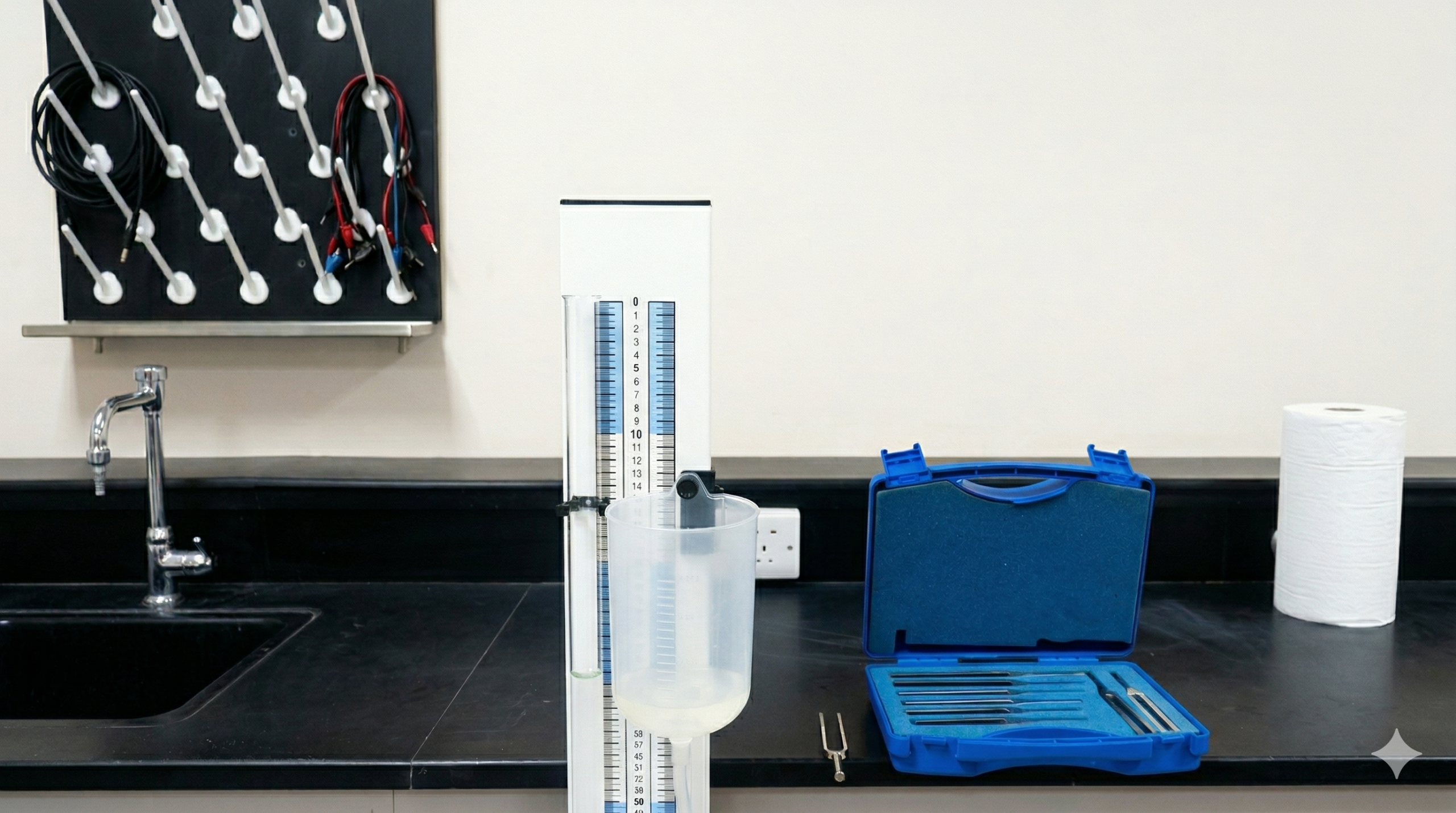
1- Resonance tube with adjustable water level.
2-Set of tuning forks with different frequencies
3-Rubber hammer.
4-Meter ruler (cm scale).
Procedure
1-Fill the resonance tube so that the air column is initially short.
2-Select a tuning fork with a known frequency f.
3-Strike the tuning fork gently and hold it near the open end of the tube.
4-Slowly raise or lower the water level until the loudest sound is heard (first resonance).
5- Measure the air-column length L from the water surface to the open end of the tube.
6- Repeat with tuning forks of different frequencies.
7- Convert all lengths from cm to m and calculate 1/f for each reading.