تجربة توصيل المكثفات على التوالي والتوازي وثابت زمن التفريغ
Capacitors in Series and Parallel, and the RC Discharge Time Constant

توصيل المكثفات على التوالي والتوازي وثابت زمن التفريغCapacitors in Series and Parallel, and the RC Discharge Time Constant
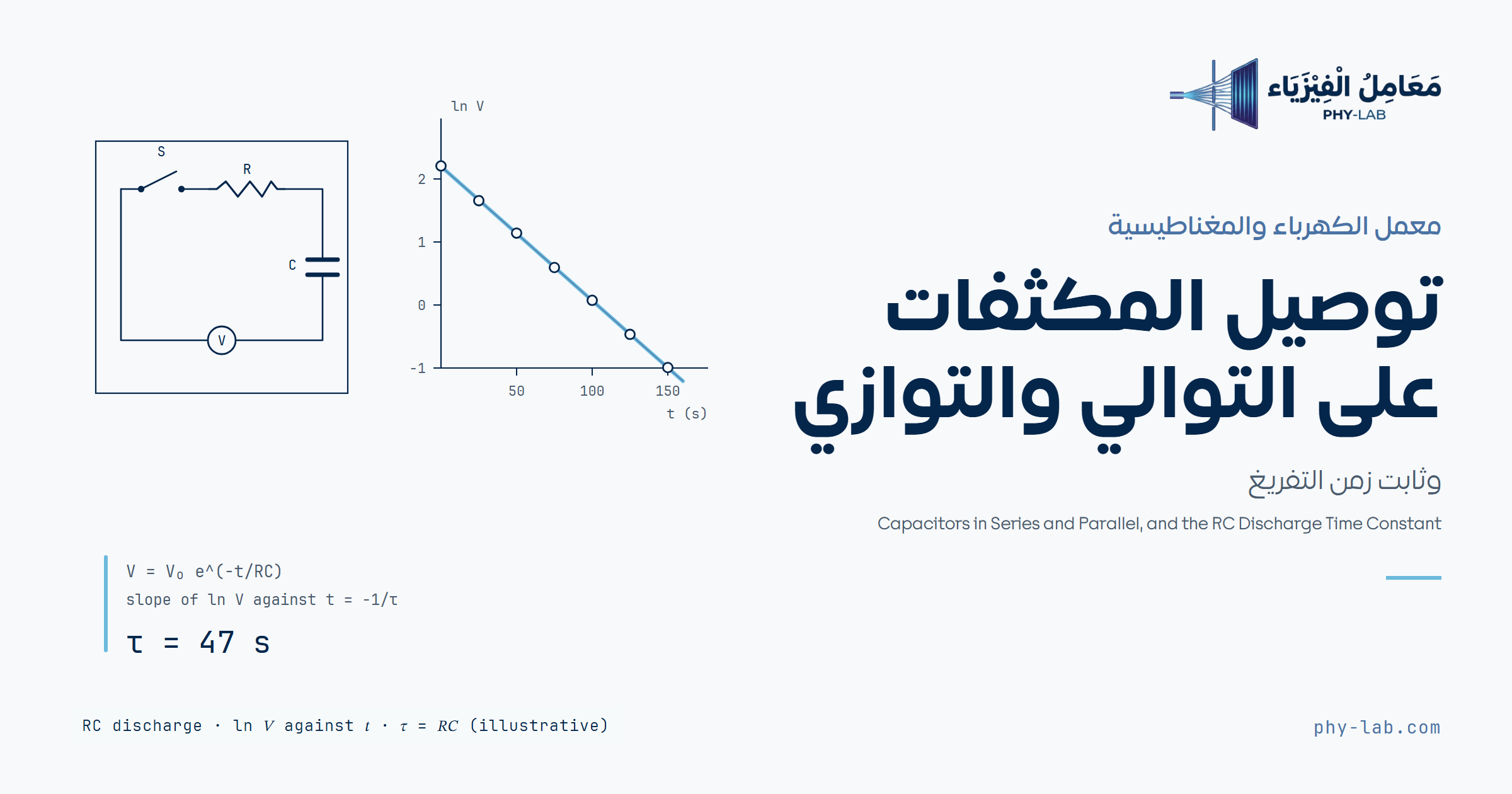
تُقاس سعات ثلاثة مكثفات منفردة، ثم السعة المكافئة عند توصيلها على التوالي وعلى التوازي، وتُقارن بالقيم النظرية. بعد ذلك تُشحن كل مجموعة ثم تُفرَّغ عبر مقاومة كبيرة ويُسجَّل الجهد مع الزمن، فيعطي ميل الخط المستقيم في منحنى ln(V/V0) مع الزمن الثابت الزمني RC، ومنه السعة المكافئة.The capacitances of three single capacitors are measured, then the equivalent capacitance when they are connected in series and in parallel, and compared with the theoretical values. Each group is then charged and discharged through a large resistance while the voltage is recorded against time, and the slope of the straight line of ln(V/V0) against time gives the time constant RC, and from it the equivalent capacitance.
الأهداف والأدواتObjectives and apparatus
- قياس السعة المكافئة لمجموعة من المكثفات عند توصيلها على التوالي وعلى التوازي.
- دراسة تفريغ المكثف عبر مقاومة كبيرة.
- تعيين الثابت الزمني RC من ميل منحنى ln(V/V0) مع الزمن.
- مقارنة القيم النظرية للسعة بالقيم المقيسة وحساب نسبة الفرق.
- To measure the equivalent capacitance of a group of capacitors connected in series and in parallel.
- To study the discharge of a capacitor through a large resistance.
- To determine the time constant RC from the slope of ln(V/V0) against time.
- To compare the theoretical capacitances with the measured ones and compute the percent difference.
- ثلاثة مكثفات بسعات مختلفة C1 وC2 وC3
- مصدر جهد مستمر لشحن المكثفات (مثلاً من 9 إلى 20 V)
- مقاومة كبيرة يحدث التفريغ عبرها (مثل 40 MΩ)
- جهاز قياس السعة لقياس سعة كل مكثف والسعة المكافئة
- فولتميتر لقياس الجهد على المكثف أثناء التفريغ
- ساعة إيقاف لتسجيل زمن كل قراءة
- مفتاح ثنائي وأسلاك للتبديل بين الشحن والتفريغ
- Three capacitors of different capacitances C1, C2 and C3
- A DC voltage supply to charge the capacitors (e.g. 9 to 20 V)
- A large resistance through which the discharge takes place (such as 40 MΩ)
- A capacitance meter to measure each capacitance and the equivalent capacitance
- A voltmeter to measure the voltage across the capacitor during the discharge
- A stopwatch to record the time of each reading
- A two-way switch and leads to change between charging and discharging
النظريةTheory
السعة الكهربائيةCapacitance
يتكون المكثف من لوحين موصلين يفصل بينهما عازل، وسعته C هي نسبة الشحنة Q المختزنة على أحد اللوحين إلى فرق الجهد V بينهما:
A capacitor consists of two conducting plates separated by an insulator, and its capacitance C is the ratio of the charge Q stored on one plate to the potential difference V between them:
ووحدة السعة الفاراد (F = C/V)، وتُقاس سعات المكثفات في المعمل عادة بالميكروفاراد (1 µF = 10−6 F).
The unit of capacitance is the farad (F = C/V), and the capacitances in the laboratory are usually measured in microfarads (1 µF = 10−6 F).
التوصيل على التوالي والتوازيSeries and parallel connection
في التوصيل على التوالي (الشكل 2، يساراً) تحمل المكثفات الشحنة نفسها ويتوزع الجهد بينها، فتكون السعة المكافئة أصغر من أصغر سعة:
In the series connection (figure 2, left) the capacitors carry the same charge and the voltage is shared between them, so the equivalent capacitance is smaller than the smallest capacitance:
وفي التوصيل على التوازي (الشكل 2، يميناً) يكون الجهد واحداً على المكثفات وتتجمع شحناتها، فتكون السعة المكافئة مجموع السعات:
In the parallel connection (figure 2, right) the voltage is the same across the capacitors and their charges add, so the equivalent capacitance is the sum of the capacitances:
تفريغ المكثف وثابت الزمنCapacitor discharge and the time constant
عند تفريغ مكثف مشحون إلى جهد V0 عبر مقاومة R، يتناقص الجهد عليه أُسّياً مع الزمن:
When a capacitor charged to a voltage V0 is discharged through a resistance R, its voltage decreases exponentially with time:
وبأخذ اللوغاريتم الطبيعي للطرفين تصبح العلاقة خطاً مستقيماً يمر بنقطة الأصل:
Taking the natural logarithm of both sides makes the relation a straight line through the origin:
فإذا رُسم ln(V/V0) على المحور الرأسي وt على الأفقي، كان الميل m = −1/RC، ومنه:
If ln(V/V0) is plotted on the vertical axis and t on the horizontal axis, the slope is m = −1/RC, and from it:
الثابت الزمني τ هو الزمن الذي يهبط فيه الجهد إلى e−1 ≈ 37% من قيمته الابتدائية. وكلما كبرت السعة طال زمن التفريغ، لذلك يكون تفريغ مجموعة التوازي أبطأ بكثير من مجموعة التوالي.
The time constant τ is the time in which the voltage falls to e−1 ≈ 37% of its initial value. The larger the capacitance, the longer the discharge, so the parallel group discharges much more slowly than the series group.
أثر الفولتميترThe effect of the voltmeter
إذا بقي الفولتميتر موصولاً على المكثف أثناء التفريغ فإن مقاومته الداخلية RV تكون على التوازي مع R، فيحدث التفريغ عبر:
If the voltmeter stays connected across the capacitor during the discharge, its internal resistance RV is in parallel with R, so the discharge takes place through:
وهذا مهم عندما تكون R من رتبة الميغا أوم، لأن مقاومة الفولتميتر الرقمي من الرتبة نفسها (نحو 10 MΩ). وتُستعمل Reff مكان R في المعادلة (6). وتُقارن كل سعة بقيمتها النظرية بنسبة الفرق:
This matters when R is of the order of megohms, because the resistance of a digital voltmeter is of the same order (about 10 MΩ). Reff is then used in place of R in equation (6). Each capacitance is compared with its theoretical value by the percent difference:
طريقة العملProcedure
الجزء الأول: قياس السعاتPart one: measuring the capacitances
- فرّغ كل مكثف بتوصيل طرفيه معاً لعدة ثوانٍ قبل القياس.
- قِس سعة كل مكثف C1 وC2 وC3 بجهاز قياس السعة.
- صِل المكثفات على التوالي وقِس السعة المكافئة، ثم على التوازي وقِسها.
- Discharge each capacitor by connecting its terminals together for a few seconds before measuring.
- Measure the capacitance of each capacitor C1, C2 and C3 with the capacitance meter.
- Connect the capacitors in series and measure the equivalent capacitance, then in parallel and measure it.
الجزء الثاني: التفريغ على التواليPart two: discharge in series
- صِل المكثفات على التوالي مع المقاومة R والمصدر والمفتاح كما في الشكل 1.
- اجعل المفتاح على وضع الشحن حتى يستقر الجهد عند V0.
- انقل المفتاح إلى وضع التفريغ وابدأ التوقيت عند t = 0 مع تسجيل V0.
- سجّل الجهد V على فترات منتظمة حتى يهبط إلى نحو عُشر قيمته: كل 20 s تقريباً، أو أقصر إذا كان التفريغ سريعاً.
- Connect the capacitors in series with the resistance R, the supply and the switch as in figure 1.
- Put the switch in the charging position until the voltage settles at V0.
- Move the switch to the discharging position and start timing at t = 0 while recording V0.
- Record the voltage V at regular intervals until it falls to about a tenth of its value: about every 20 s, or shorter if the discharge is fast.
الجزء الثالث: التفريغ على التوازيPart three: discharge in parallel
- صِل المكثفات على التوازي، وكرر خطوات الجزء الثاني بالجهد الابتدائي نفسه والمقاومة نفسها.
- ارسم ln(V/V0) مع t للتوصيلين، واحسب من كل ميل الثابت الزمني والسعة المكافئة بالمعادلة (6).
- Connect the capacitors in parallel, and repeat the steps of part two with the same initial voltage and the same resistance.
- Plot ln(V/V0) against t for the two connections, and compute from each slope the time constant and the equivalent capacitance by equation (6).
احتياط: فرّغ المكثفات قبل لمس أطرافها أو تغيير توصيلها أو قياس سعتها، وراعِ قطبية المكثفات الإلكتروليتية عند التوصيل.
Precaution: discharge the capacitors before touching their terminals, changing their connection or measuring their capacitance, and observe the polarity of electrolytic capacitors when connecting them.
أخطاء شائعةCommon errors
- إهمال مقاومة الفولتميتر: فولتميتر رقمي مقاومته 10 MΩ موصول مع 40 MΩ يجعل التفريغ أسرع بنحو خمس مرات، فتخرج السعة أصغر بكثير إذا لم تُستعمل المعادلة (7).
- بدء التوقيت متأخراً: إذا لم تُسجَّل V0 عند t = 0 تماماً لا يمر الخط بنقطة الأصل، لكن الميل لا يتغير.
- قراءات قرب الصفر: عندما يصبح الجهد صغيراً تكبر نسبة خطأ القراءة في ln V، فتتشتت آخر النقاط.
- فترات طويلة في تفريغ سريع: مجموعة التوالي تتفرغ أسرع بكثير، فتلزمها قراءات متقاربة.
- Ignoring the voltmeter resistance: a digital voltmeter of 10 MΩ connected with 40 MΩ makes the discharge about five times faster, so the capacitance comes out much smaller unless equation (7) is used.
- Starting the timing late: if V0 is not recorded exactly at t = 0, the line does not pass through the origin, but the slope does not change.
- Readings near zero: when the voltage becomes small, the relative reading error in ln V grows, so the last points scatter.
- Long intervals in a fast discharge: the series group discharges much faster, so it needs closely spaced readings.
المحاكاة التفاعليةInteractive simulation
اختر التوصيل والمقاومة والفولتميتر وجهد المصدر. فرّغ المكثفات وقِس السعة وسجّلها. ثم اشحن، وانقل المفتاح إلى التفريغ فتبدأ الساعة من الصفر، وقدّم الزمن بالأزرار وسجّل الجهد عند كل زمن. تذهب قراءات التوالي إلى جدوله وقراءات التوازي إلى جدوله.
Choose the connection, the resistance, the voltmeter and the supply voltage. Discharge the capacitors, measure the capacitance and record it. Then charge, and move the switch to discharge so that the clock starts from zero, advance the time with the buttons and record the voltage at each time. The series readings go to their table and the parallel readings to theirs.
النموذج: ثلاثة مكثفات سعاتها الحقيقية قريبة من المكتوب عليها ضمن التفاوت، ومقاومات قريبة من قيمها الاسمية، وفولتميتر رقمي مقاومته الداخلية نحو 10 MΩ أو مقياس جهد إلكتروني مقاومته أكبر بكثير، يبقى موصولاً أثناء التفريغ، ودقة قراءة الجهد 0.01 V، وجهاز سعة دقته نحو 1%. المحاكاة نموذج لا قياس.Model: three capacitors whose true capacitances are close to their marked values within the tolerance, resistances close to their nominal values, and a digital voltmeter with an internal resistance of about 10 MΩ or an electronic voltmeter of much higher resistance, which stays connected during the discharge, a voltage resolution of 0.01 V, and a capacitance meter accurate to about 1%. The simulation is a model, not a measurement.
إدخال البياناتData entry
جدول السعاتTable of capacitances
أدخل السعات المقيسة بجهاز قياس السعة بالميكروفاراد. تُحسب القيم النظرية للتوالي والتوازي من C1 وC2 وC3 وتُقارن بالقيم المقيسة.
Enter the capacitances measured with the capacitance meter, in microfarads. The theoretical series and parallel values are computed from C1, C2 and C3 and compared with the measured ones.
جدولا التفريغDischarge tables
أدخل قيمة المقاومة، ثم أزمنة القراءات والجهد المقابل لكل توصيل. أول قراءة في كل جدول هي V0. ويلزم ثلاث قراءات على الأقل في أحد الجدولين. واترك RV فارغاً إن لم يبقَ الفولتميتر موصولاً أثناء التفريغ.
Enter the resistance, then the times of the readings and the matching voltage for each connection. The first reading in each table is V0. At least three readings are needed in one of the two tables. Leave RV empty if the voltmeter did not stay connected during the discharge.
التواليSeries
| رقمNo | t (s) | V (V) |
|---|
التوازيParallel
| رقمNo | t (s) | V (V) |
|---|
البيانات الحالية توضيحية من نموذج المحاكاة؛ وليست قياساً.Current data are illustrative, from the simulation model; not a measurement.
لصق بيانات أو تحميل ملف CSVPaste data or load a CSV file
سطر لكل قراءة: الحرف s للتوالي أو p للتوازي، ثم الزمن بالثانية، ثم الجهد بالفولت. وللسعات والمقاومة أسطر مثل C1, 1.04 وR, 40.
One line for each reading: the letter s for series or p for parallel, then the time in seconds, then the voltage in volts. Capacitances and the resistance take lines such as C1, 1.04 and R, 40.
النتائجResults
خطوات الحلSolution steps
التفسيرInterpretation
إجابات أسئلة المناقشة من بياناتكAnswers to the discussion questions from your data
أسئلة المناقشةDiscussion questions
- هل جاءت السعة المكافئة على التوالي أصغر من أصغر سعة، وعلى التوازي أكبر من أكبر سعة؟ فسّر ذلك.
- هل كانت العلاقة بين ln(V/V0) والزمن خطية؟ ماذا يدل ذلك على شكل تفريغ المكثف؟
- أي التوصيلين كان تفريغه أسرع؟ اربط إجابتك بقيمة الثابت الزمني RC.
- قارن السعة المحسوبة من منحنى التفريغ بالسعة المقيسة بالجهاز. ما مصادر الفرق المحتملة؟
- كيف تؤثر مقاومة الفولتميتر الداخلية في زمن التفريغ المقيس؟ ومتى يمكن إهمالها؟
- Was the equivalent series capacitance smaller than the smallest capacitance, and the parallel one larger than the largest? Explain.
- Was the relation between ln(V/V0) and time linear? What does this say about the shape of the capacitor discharge?
- Which connection discharged faster? Relate your answer to the value of the time constant RC.
- Compare the capacitance computed from the discharge curve with the capacitance measured with the meter. What are the possible sources of the difference?
- How does the internal resistance of the voltmeter affect the measured discharge time? When can it be neglected?
بعد حساب النتائج تظهر إجابة كل سؤال بأرقام قياساتك في قسم النتائج.
After the results are computed, the answer to each question appears with the numbers of your measurements in the results section.
المراجعReferences
- Serway, R. A., & Jewett, J. W. (2018). Physics for scientists and engineers (10th ed.). Cengage Learning.
- Taylor, J. R. (1997). An introduction to error analysis: The study of uncertainties in physical measurements (2nd ed.). University Science Books.