
Objectives
To determine the first excitation potential of gas (Argon) by Frank-Hertz experiment.
Apparatus:
Tetrode tube filled with experimental Argon gas, filament, power supply three variable voltage sources, nanoammeter
Experimental Set-up
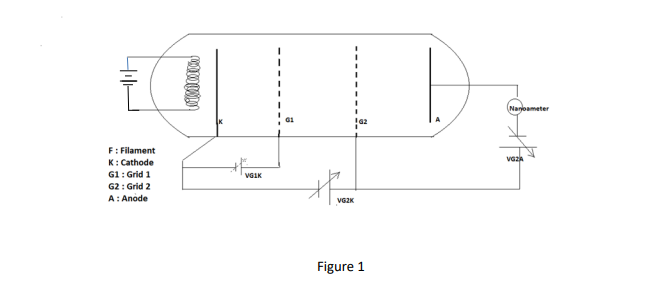
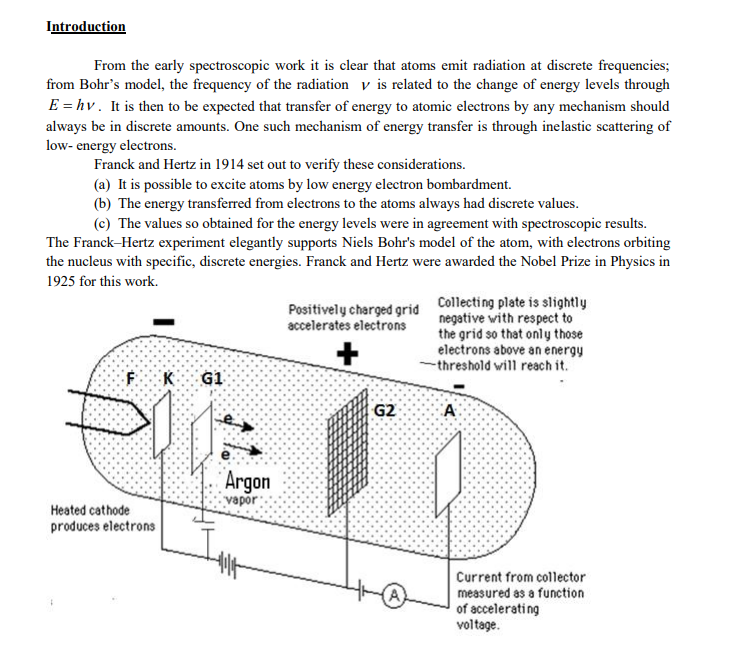
The experimental set up involves a tube containing low pressure experimental gas fitted with four electrodes: an electron-emitting cathode (K), a mesh grid (G1) for minimizing space charge effects a mesh grid (G2) for acceleration, and an anode (A). The anode was held at a slightly negative electrical potential relative to the grid G2 (although positive compared to the cathode), so that electrons had to have at least a corresponding amount of kinetic energy to reach it after passing the grid and thereby making the dips in the plate current more prominent. Instruments were fitted to measure the current passing between the electrodes, and to adjust the potential difference (voltage) between the cathode (negative electrode) and the accelerating grids Fig (1).
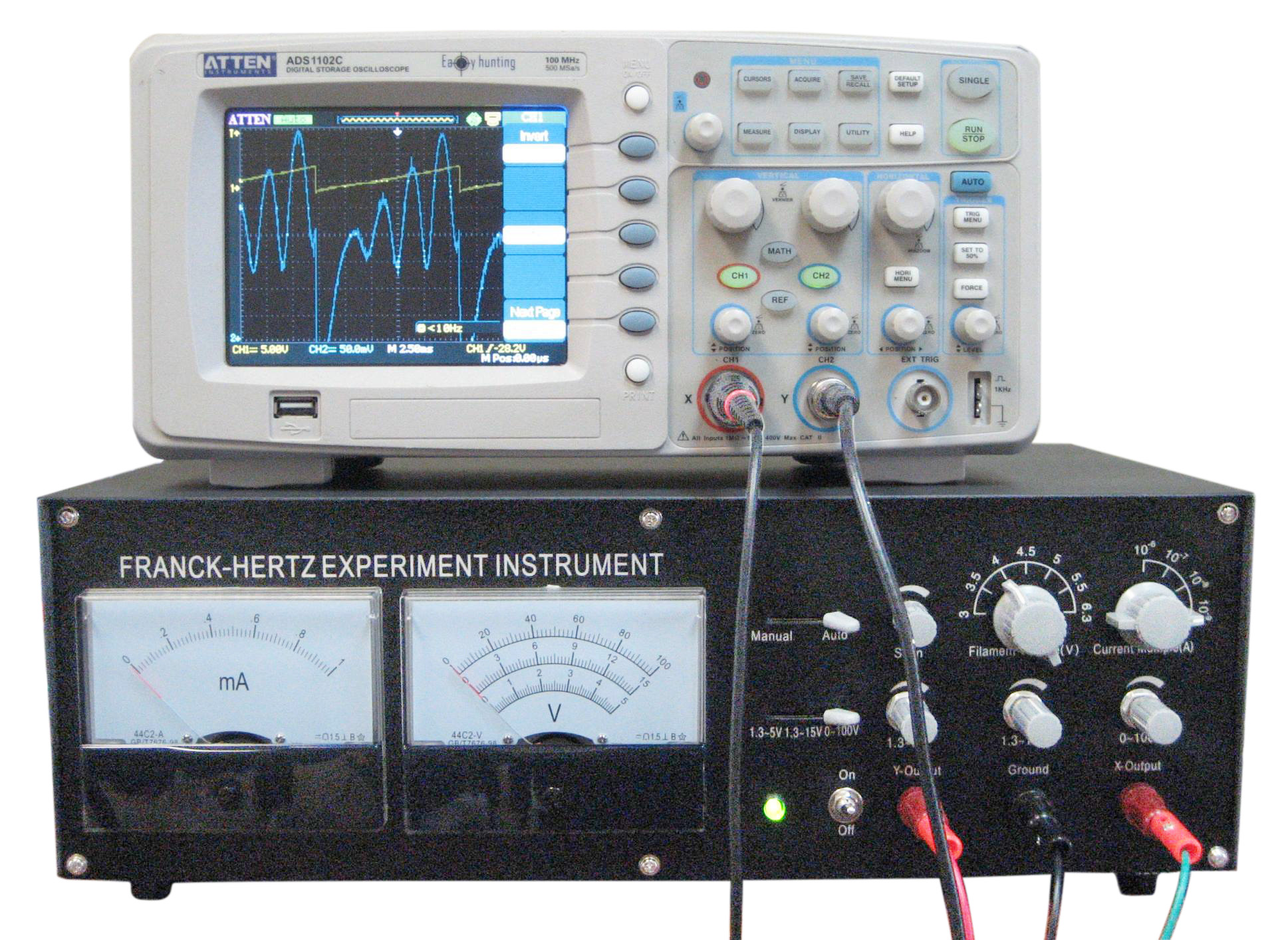
Franck-Hertz Experiment Set-up, Model :FH-2558, consists of the following
Argon filled tetrode
Filament Power Supply : 2.6 -3.3V continuously variable
Power Supply For VG1K : 1.3 – 5V continuously variable
Power Supply For VG2A : 1.3 – 15V continuously variable
Power Supply For VG2K : 0 – 80V continuously variable
Multirange Analogue Voltmeter Range : 0-5V, 0-15V & 0-100V
Multirange Analogue Voltmeter Range : 0-1 (50 divisions)
Range Multiplier : 10-6 ,10-7 , 10-8 & 10-9
The instrument can lead to a plot of the amplitude spectrum curve by means of point by point measurem
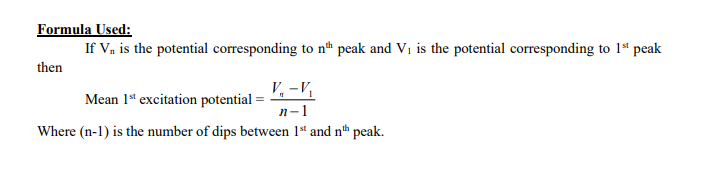
Formula Used
Introduction
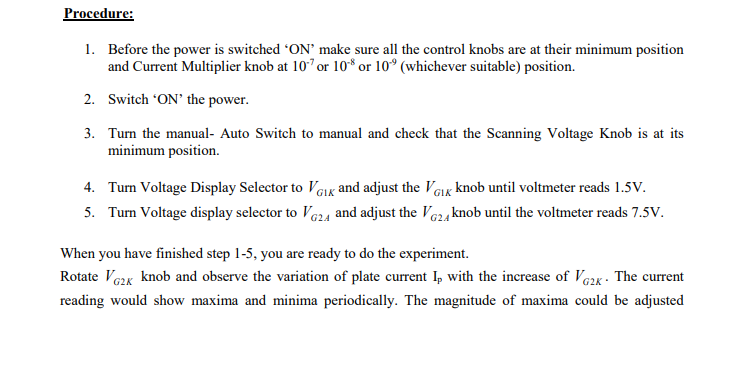
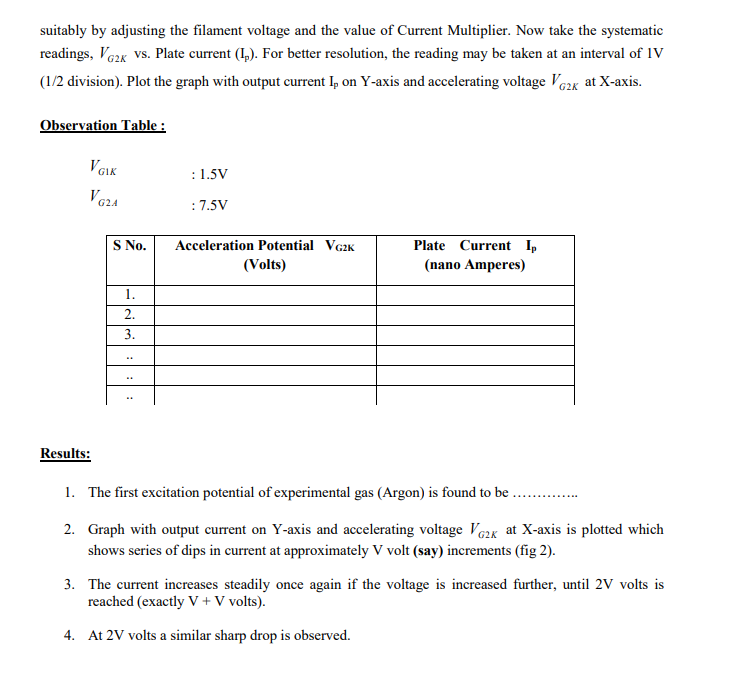
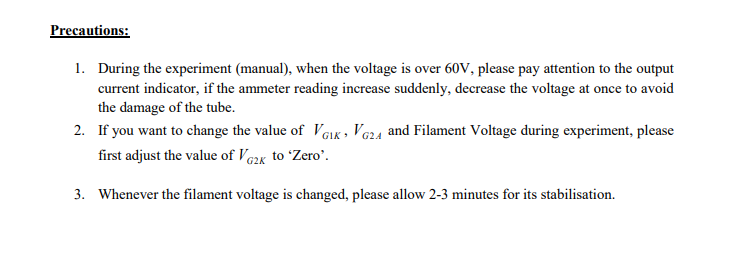
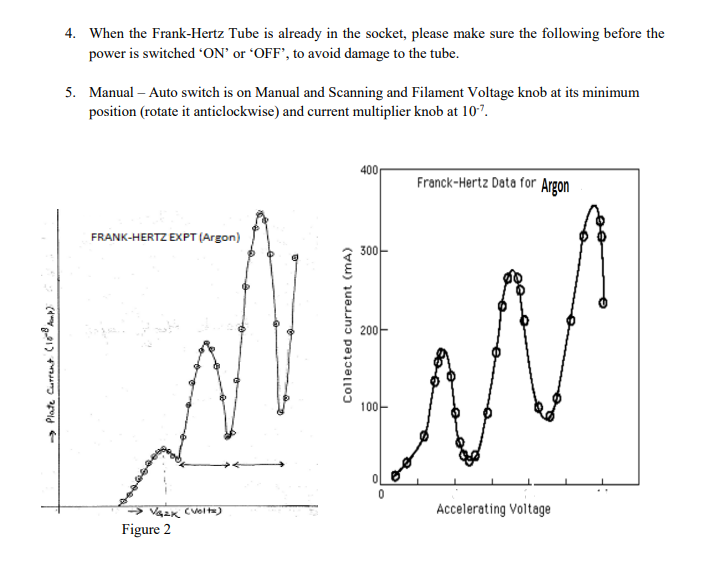
Procedure